
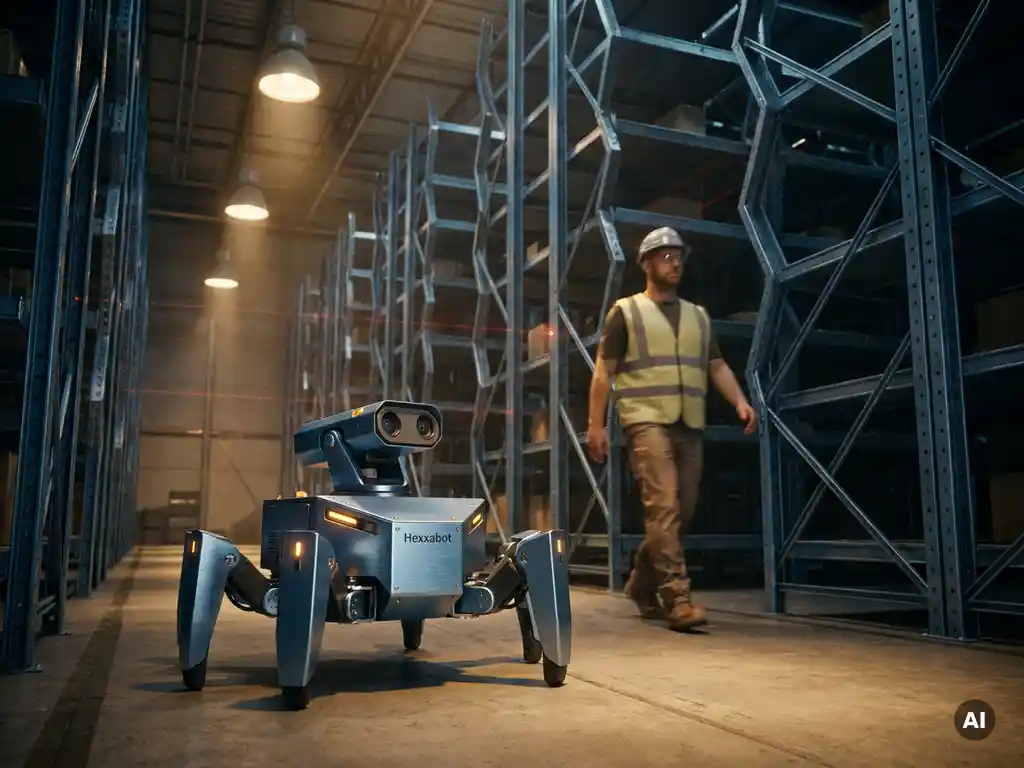
AGVs navigate safely around warehouse workers by combining multiple sensor technologies with real-time decision-making software that continuously monitors the surrounding environment. When a person enters an AGV’s detection zone, the vehicle automatically reduces speed or stops completely, depending on how close the worker is. The sections below break down exactly how each layer of that safety system works, from the sensors themselves to the standards that govern their behavior.
What sensors do AGVs use to detect people nearby?
AGVs primarily use laser scanners, also known as LiDAR sensors, to detect people in their path. These sensors emit rapid pulses of light and measure how long each pulse takes to return, building a precise real-time map of the surrounding space. Most AGVs combine LiDAR with additional technologies such as ultrasonic sensors, cameras, and infrared detectors to create overlapping detection zones that cover different distances and angles.
Each sensor type serves a specific purpose in the overall detection strategy. LiDAR excels at accurate distance measurement across a wide horizontal arc, making it the primary tool for forward-path monitoring. Ultrasonic sensors handle close-range detection and work reliably in low-light or dusty conditions where optical sensors can struggle. Cameras, increasingly paired with computer vision software, add the ability to classify what the system detects, distinguishing between a stationary pallet and a moving person, which allows the AGV to respond proportionally rather than treating every obstacle identically.
Modern AGVs also use safety-rated encoders and inertial measurement units to track their own speed and position with precision. This self-awareness is just as important as external sensing, because the vehicle needs to know how quickly it can stop given its current load and velocity before it can calculate a safe response to a detected obstacle.
How do AGVs decide when to slow down or stop?
AGVs decide when to slow down or stop based on a zoned detection model. The area around the vehicle is divided into concentric warning and protective zones. When a person enters the outer warning zone, the AGV reduces its speed. If that person moves closer and enters the inner protective zone, the vehicle performs a controlled stop. The exact dimensions of these zones are calculated based on the vehicle’s speed, load weight, and braking distance.
This zone-based logic is processed continuously by the AGV’s onboard safety controller, which evaluates sensor input many times per second. The controller applies a hierarchy of responses: slow first, stop if necessary, and only resume movement once the path is confirmed clear. The speed reduction in the warning zone is intentional: it gives the vehicle more time to stop cleanly if a person continues moving toward it, without causing unnecessary halts that would disrupt workflow.
Some advanced AGV systems adapt their zone sizes dynamically. At higher speeds, the protective zone extends further forward because the stopping distance increases. When the AGV turns or operates in a narrow aisle, the zone geometry adjusts to reflect the actual travel path rather than a fixed radius. This dynamic adjustment reduces unnecessary stops in congested areas while maintaining the required safety margins wherever the vehicle actually needs them.
What safety standards govern AGV behavior around workers?
AGV behavior around workers is governed primarily by ISO 3691-4, the international standard specifically covering industrial trucks that are driverless, and by ANSI/ITSDF B56.5 in North American contexts. These standards define the minimum requirements for detection performance, braking response times, zone dimensions, and the validation methods manufacturers must use to demonstrate compliance. In Europe, the Machinery Directive and its successor, the Machinery Regulation, also apply, requiring a formal risk assessment before any AGV system is deployed.
ISO 3691-4 is the most widely referenced benchmark. It specifies that an AGV must be able to detect a person-sized object within its defined protective zone and bring the vehicle to a safe stop before contact occurs. The standard also addresses what happens when sensors fail, requiring that the system defaults to a safe state rather than continuing to operate with degraded detection capability.
For environments where AGVs and people work in close proximity, IEC 62061 and ISO 13849 govern the functional safety of the control systems themselves. These standards classify safety functions by Performance Level or Safety Integrity Level, ensuring that the software and hardware responsible for stopping the vehicle are reliable enough for the risk level involved. Manufacturers must certify their sensor and controller combinations against these frameworks, and site operators are responsible for maintaining that certification through regular inspection and testing.
What happens when an AGV and a worker reach the same point at the same time?
When an AGV and a worker converge on the same point simultaneously, the AGV’s protective zone detection triggers a controlled stop before physical contact occurs. The vehicle does not attempt to maneuver around the person; it halts and waits. Once the person clears the zone, the AGV resumes its route automatically or awaits a signal from the fleet management system, depending on how the site is configured.
This outcome depends on the detection zones being correctly sized for the vehicle’s operating speed. If an AGV is traveling at its maximum speed and a person steps directly into its path at very close range, the stopping distance must still be shorter than the gap between the sensor and the person at the moment of detection. This is why safety standards require manufacturers to validate stopping performance under worst-case conditions, including maximum load and maximum speed, not just average operating scenarios.
In high-traffic areas, warehouse operators often implement additional controls beyond the AGV’s onboard sensors. Floor markings, physical barriers, and light curtains at intersection points create predictable pedestrian corridors that reduce the frequency of these convergence events. Traffic management software can also assign right-of-way rules to specific zones, routing AGVs away from areas where workers are active rather than relying solely on reactive stopping.
How do AGVs differ from AS/RS robots in worker safety design?
AGVs and AS/RS robots differ fundamentally in how they handle worker safety: AGVs share open floor space with people and therefore require active, real-time detection and collision avoidance. AS/RS robots, by contrast, typically operate within a physically separated storage structure where workers do not enter during normal operations, which shifts the safety design from collision avoidance to access control and perimeter guarding.
An AGV must constantly monitor a dynamic environment where people move unpredictably. Its safety system is reactive by necessity, using sensors to detect and respond to humans who may enter its path at any moment. This requires significant onboard processing, redundant sensor arrays, and carefully validated stopping performance, all of which add mechanical and software complexity to each vehicle unit.
AS/RS systems take a fundamentally different approach. Because the robotic units operate inside a defined structural envelope, the primary safety mechanism is preventing unauthorized human entry rather than detecting and avoiding people in real time. Light curtains, interlocked access doors, and perimeter fencing ensure that the system stops automatically if a person attempts to enter the active zone. Inside the structure itself, the robots operate without the need to share space with humans at all.
This architectural separation has meaningful implications for system design. AS/RS robots do not need the same sensor payload as AGVs because their operating environment is controlled rather than open. They can be optimized for speed, density, and throughput without the engineering trade-offs that come with pedestrian coexistence. For warehouse operations where maximizing storage density and retrieval performance is the priority, this separation of human and robotic zones is a significant operational and safety advantage.
How Hexxabotics addresses warehouse automation safety through system design
Hexxabotics takes a fundamentally different approach to warehouse safety by eliminating the need for AGVs to share floor space with workers entirely. The Hexxabotics AS/RS system is built around a self-contained hexagonal storage structure where autonomous Hexxabots operate within a defined, enclosed grid, removing the core challenge of AGV-human coexistence from the equation.
- Separated operating zones: Hexxabots navigate beneath and within the hexagonal tower structure, keeping robotic movement physically separated from human workstations.
- No in-rack electrification: The passive steel structure contains no embedded motors or powered components, reducing failure points and simplifying safety validation.
- Distributed resilience: The system has no single point of failure. If one robot unit stops, the rest of the fleet continues operating, maintaining throughput without manual intervention.
- Direct access to every tote: Because every storage location is directly accessible with no reshuffling required, workers at goods-to-person stations never need to enter the storage structure.
- Scalable without redesign: Storage capacity and throughput scale independently, so safety-critical infrastructure does not need to be rebuilt as the system grows.
If you are evaluating warehouse automation solutions that reduce operational risk while maximizing storage density, contact Hexxabotics to discuss how the system fits your facility requirements.