
Fully automated warehouses carry real safety risks, including collisions between autonomous robots and personnel, mechanical failures, software faults, and electrical hazards. These risks are distinct from those found in manual warehouses because the speed, autonomy, and complexity of robotic systems introduce failure modes that workers and engineers may not immediately anticipate. Understanding each category of risk is the first step toward designing and operating automated facilities that are both productive and safe.
What types of accidents are most common in automated warehouses?
The most common accidents in automated warehouses involve collisions between autonomous mobile equipment and personnel, falling loads from elevated storage systems, pinch points created by moving machinery, and electrical incidents near powered rack infrastructure. These accident types tend to cluster around the intersections where human activity and robotic operation overlap.
Collision incidents are especially prevalent during maintenance windows, when technicians enter zones that are normally robot-only. Even with safety interlocks in place, human error in zone management or software override procedures creates exposure. Falling load incidents are more common in high-bay environments where totes or pallets are stored at significant height, and where vibration, improper loading, or structural fatigue can cause items to dislodge.
Pinch-point injuries tend to occur at goods-to-person workstations, where robotic conveyors or transfer mechanisms operate close to human hands. These workstations are often the only place humans and automated systems interact in close proximity, making ergonomic and guarding design at these interfaces especially important. Electrical incidents, while less frequent, remain a concern in systems where power is distributed throughout the rack structure itself.
How do robotic AS/RS systems create unique hazards compared to manual warehouses?
Robotic AS/RS systems introduce hazards that do not exist in manual warehouses because they combine high-speed autonomous movement, elevated storage at heights up to 16 meters, complex software dependencies, and reduced human presence. The absence of workers in most operational zones can delay hazard detection, while the speed and autonomy of robots leave little margin for human intervention when something goes wrong.
In a manual warehouse, a worker who notices a structural issue, a misplaced tote, or an unstable load can respond immediately. In a fully automated environment, the system must detect and respond to those conditions through sensors, software logic, and automated safety responses. When those detection layers fail or are misconfigured, hazards can escalate before anyone is aware.
High-density vertical systems add another dimension of risk. The greater the storage height, the more energy is involved in a falling load event, and the more complex the structural loading on the rack system. Systems that embed motors, cabling, and lifting mechanisms directly into the rack structure also increase the number of failure points distributed throughout the facility, making inspection and fault isolation more difficult.
By contrast, architectures that keep the rack structure passive and place all active components in the robots themselves concentrate the risk into units that can be individually removed, inspected, and replaced. This design philosophy reduces the number of failure points embedded in the fixed infrastructure and simplifies both maintenance access and safety validation.
What causes system failures in warehouse automation environments?
System failures in warehouse automation environments are most commonly caused by software faults, sensor degradation, communication loss between robots and the control system, mechanical wear in high-cycle components, and single points of failure in centralized infrastructure. Any one of these causes can halt operations or, in more serious cases, create unsafe conditions.
Software and communication failures
The warehouse control system coordinates robot movements, manages inventory logic, and enforces safety zones. When software encounters an unhandled exception, receives corrupted sensor data, or loses communication with one or more robots, the system may stop unexpectedly or, in poorly designed implementations, allow robots to operate without current positional awareness. Robust systems include watchdog timers, fail-safe stop behaviors, and redundant communication pathways to prevent these scenarios from becoming safety incidents.
Mechanical and infrastructure failures
In systems that rely on centralized cranes, fixed vertical conveyors, or a small number of high-cycle lifting mechanisms, mechanical wear in those components directly threatens overall system availability. When a central crane fails, the entire storage volume it serves becomes inaccessible. Distributed robotic architectures reduce this risk by eliminating single points of failure: if one autonomous unit stops operating, the remaining units continue to handle throughput. This resilience is a meaningful safety and operational advantage because it prevents the kind of cascading shutdown that forces unplanned human entry into automated zones.
How does warehouse layout design affect automation safety?
Warehouse layout design directly affects automation safety by determining where human and robotic zones intersect, how emergency egress is structured, how maintenance access is provided without entering live operational areas, and whether the physical environment supports the sensor and communication systems that robots depend on. Poor layout decisions made early in a project are difficult and expensive to correct after installation.
Zone separation is the foundational layout principle for automated warehouse safety. Fully automated storage zones should be physically separated from human activity areas using barriers, light curtains, or interlocked access gates. Goods-to-person workstations, which are the primary human-robot interface, require careful ergonomic and guarding design to prevent hand and arm injuries at the point of tote transfer.
Aisle and floor design also matter. Floors in automated zones must be level and free of obstructions that could interfere with robot navigation. Drainage features, expansion joints, and floor markings must all be compatible with the robot’s navigation system. Emergency stop stations should be positioned at all access points and at regular intervals around the perimeter of automated zones, so that any person entering the area can halt robot activity immediately.
Vertical storage systems introduce layout considerations around structural load paths, fire suppression access, and the positioning of maintenance platforms. Systems that require workers to climb into the rack structure for routine maintenance create significant fall risk. Designs that allow maintenance to be performed from ground level or from designated safe platforms outside the active storage zone substantially reduce that exposure.
What safety standards apply to fully automated warehouse systems?
Fully automated warehouse systems are subject to a combination of machinery safety standards, industrial robot standards, and sector-specific regulations that together define requirements for risk assessment, guarding, control system integrity, and operator safety. The specific standards that apply depend on the geography of the installation and the types of equipment involved.
In Europe, the Machinery Directive and its successor, the Machinery Regulation, set the overarching framework for placing automated equipment on the market. AS/RS systems and the robots within them must comply with relevant harmonized standards, including EN ISO 10218 for industrial robots, EN 528 for rail-dependent storage and retrieval equipment, and EN ISO 13849 for safety-related control system performance levels.
In North America, ANSI/RIA R15.06 governs industrial robot safety, while ANSI MH16.1 covers automated storage and retrieval systems specifically. OSHA regulations provide baseline requirements for worker safety in warehousing environments, including lockout/tagout procedures that are especially relevant during maintenance of automated systems.
Beyond formal standards, risk assessment is a legal and practical requirement in most jurisdictions. A systematic risk assessment conducted before installation identifies hazards specific to the layout, the equipment, and the operational workflows, and drives the selection of appropriate protective measures. Standards should be treated as a floor, not a ceiling: many of the most effective safety measures go beyond minimum compliance requirements.
How can automated warehouse safety risks be effectively mitigated?
Automated warehouse safety risks are most effectively mitigated through a layered approach that combines sound system architecture, physical safeguarding, robust software controls, rigorous staff training, and ongoing risk monitoring. No single measure is sufficient on its own; safety in automated environments depends on multiple overlapping layers of protection.
Key mitigation strategies include:
- Zone separation and access control: Physical barriers, interlocked gates, and light curtains prevent unauthorized entry into active robot zones. Access procedures should require positive confirmation that the zone is safe before entry is permitted.
- Distributed system architecture: Eliminating single points of failure in the automation infrastructure means that individual component faults do not force emergency human entry into automated zones. Systems where robots operate independently and the rack structure contains no embedded electronics reduce both the frequency and the severity of failure events.
- Fail-safe control logic: The warehouse control system should default to a safe stopped state when communication is lost, sensor data is out of range, or an unhandled condition is detected. Safety functions must meet the performance level required by the risk assessment.
- Maintenance-safe design: Equipment that can be inspected, maintained, and replaced without requiring workers to enter active storage zones substantially reduces maintenance-related incident risk. Robots that are removed from the system for servicing rather than serviced in place are inherently safer.
- Staff training and procedure discipline: Workers who understand how the system operates, what the safety interlocks do, and how to follow lockout/tagout and zone entry procedures are the last line of defense against human error-driven incidents.
- Regular risk reviews: As operational patterns change, throughput increases, or new product types are introduced, the risk profile of the facility changes too. Periodic risk reviews ensure that safety measures remain appropriate for current conditions.
Architectural decisions made at the design stage have the greatest long-term impact on safety. Systems that minimize embedded infrastructure, distribute robotic function across many independent units, and keep human-robot interaction confined to well-designed workstations are inherently safer than those that concentrate risk in centralized, complex mechanisms.
How Hexxabotics addresses warehouse automation safety risks
Hexxabotics has designed its AS/RS system with several architectural choices that directly reduce the safety risks described in this article. Rather than treating safety as an add-on, the system’s core design eliminates or reduces several hazard categories at the source:
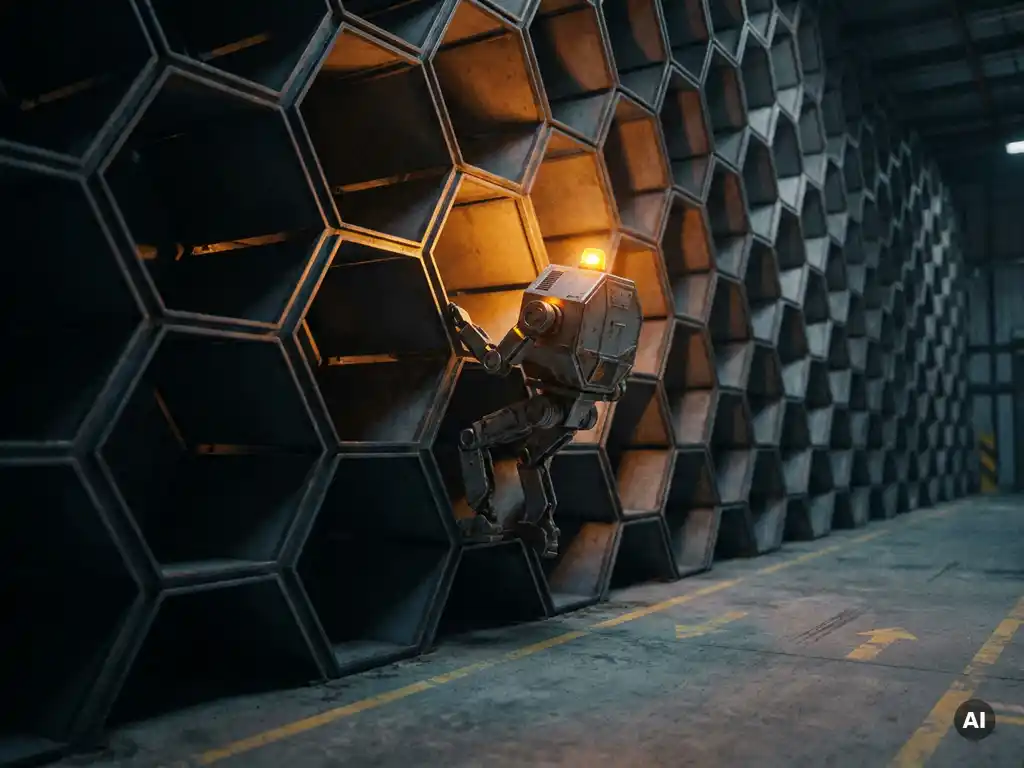
- No in-rack electrification: The hexagonal tower structure contains no embedded motors, cabling, or powered components, eliminating electrical hazards within the storage structure and reducing the number of failure points that require maintenance access.
- Distributed robot operation: Autonomous Hexxabots operate independently across the grid, so a single unit fault does not halt the system or force unplanned human entry into automated zones. Throughput remains stable even when individual units are removed for service.
- No single point of failure: The absence of centralized cranes or fixed vertical conveyors means there is no critical component whose failure triggers a system-wide safety event.
- Direct access to every storage location: Because every tote is directly accessible without reshuffling, the system avoids the complex multi-robot sequencing that creates collision risk in grid-based systems.
- Scalable without structural change: Adding capacity or throughput does not require rebuilding infrastructure, which means fewer installation-phase hazards and no need to modify live systems around operational staff.
If you are evaluating AS/RS options and want to understand how system architecture affects both safety and operational performance, explore Hexxabotics to learn more about the technology and speak with the team about your specific environment.
Related Articles
- What technology is used for real-time pharmaceutical inventory monitoring?
- How do regulatory agencies inspect pharmaceutical warehouses in 2026?
- What are the controlled substance storage requirements for warehouses?
- What is the role of natural light and ventilation in warehouse design decisions?
- What is the impact of mezzanine floors on warehouse storage and workflow?