
Warehouse automation typically reduces direct labor costs by a meaningful margin over time, with most operations seeing significant headcount reductions in picking, sorting, and replenishment roles within the first few years of deployment. The exact impact depends on the scale of automation, the complexity of the operation, and how thoroughly the system is integrated into existing workflows. The questions below unpack the financial mechanics in detail, from payback periods to the less obvious cost savings that most ROI models overlook.
How much do warehouse labor costs typically decrease after automation?
Warehouse automation commonly reduces direct labor costs in the range of 40 to 70 percent for the functions it replaces, particularly repetitive tasks like order picking, tote transport, and inventory retrieval. The reduction is not uniform across an entire workforce, but concentrated in the highest-volume, most physically demanding roles where manual labor is both costly and difficult to sustain at scale.
The most significant savings come from goods-to-person systems, where robots bring inventory to stationary operators rather than having workers walk the floor. Walking accounts for a substantial share of a picker’s shift time in a traditional warehouse, so eliminating travel time alone can double or even triple the number of picks a single operator handles per hour. When throughput per person increases that dramatically, fewer people are needed to process the same order volume.
Labor cost reduction also compounds over time. Wage inflation, benefits costs, and turnover-related expenses grow year over year in a manual operation, while the cost of operating an automated system remains relatively stable after deployment. This means the financial gap between manual and automated operations widens as the years pass, not just at the point of implementation.
What is the payback period for warehouse automation investments?
The payback period for warehouse automation investments typically falls between two and five years, depending on the scale of the operation, the labor costs being displaced, and the type of system deployed. High-volume operations with significant labor spend in repetitive roles tend to reach payback faster, while smaller or more complex environments may take longer to fully realize returns.
Several factors accelerate or extend that window. Operations in regions with high labor costs or persistent recruitment challenges often see faster payback because the baseline they are replacing is expensive. Conversely, operations that require heavy customization, extended integration timelines, or significant building modifications may push payback further out due to higher upfront capital expenditure.
Total cost of ownership matters as much as the initial investment. Systems with simpler infrastructure, fewer mechanical failure points, and lower energy consumption tend to deliver stronger long-term returns. For example, automated storage and retrieval systems that eliminate in-rack electrification reduce ongoing maintenance costs and energy draw, which improves the economics well beyond the initial payback window. The ongoing operational cost of the system, not just the purchase price, determines whether the investment continues to generate returns over a five-, ten-, or fifteen-year horizon.
Does warehouse automation eliminate jobs or just change them?
Warehouse automation does both, and the balance between elimination and transformation depends heavily on the type of work being automated and how the organization responds to the change. Repetitive, high-volume physical tasks, particularly walking, lifting, and sorting, are most likely to be reduced or eliminated. Roles requiring judgment, exception handling, system oversight, and coordination tend to persist or expand.
In practice, most automated warehouses do not simply replace every manual worker with a robot. They redeploy a portion of the workforce into higher-value roles such as goods-to-person station operators, system supervisors, maintenance technicians, and quality control personnel. The total headcount typically decreases, but the skill profile of the remaining workforce shifts upward.
The long-term picture is more nuanced. Automation enables warehouses to handle significantly higher order volumes without proportional headcount growth. This means that as a business scales, the labor cost per unit processed decreases, even if the absolute number of employees stays flat or grows modestly. The impact is less about eliminating existing jobs overnight and more about decoupling growth from linear labor hiring.
How does automation affect indirect labor costs beyond headcount?
Warehouse automation reduces indirect labor costs in ways that rarely appear in a basic ROI model but add up substantially over time. These include costs related to workforce management, training and onboarding, workplace injuries, absenteeism, and the operational overhead of supervising large manual teams.
Turnover is one of the most underestimated cost drivers in manual warehousing. High-turnover roles like order picking require continuous recruitment, onboarding, and training investment. Automating those roles removes the recurring cost of replacing and retraining workers, which in some operations represents a significant annual expense.
Workplace injury costs also decrease meaningfully when automation handles the most physically demanding tasks. Repetitive lifting, awkward postures, and constant walking create musculoskeletal injuries that generate workers’ compensation claims, lost-time incidents, and reduced productivity. Shifting those tasks to autonomous systems reduces exposure to those costs and the administrative burden that comes with managing them.
Finally, automated systems tend to reduce supervisory overhead. Managing a large manual picking team requires shift supervisors, performance tracking, and scheduling complexity. A smaller, more skilled workforce operating alongside automated systems generally requires less direct supervision, which reduces the management layer needed to keep operations running.
How does storage density affect the labor cost equation?
Higher storage density directly reduces labor costs by concentrating inventory in a smaller, more accessible footprint, which shortens travel distances, reduces the number of locations workers or systems need to manage, and enables faster retrieval cycles. When more inventory fits within a compact area, every unit of labor, whether human or robotic, becomes more productive.
In manual warehouses, low storage density forces workers to cover large floor areas to fulfill orders. Every additional meter of travel is time spent not picking. Increasing density through vertical storage or optimized slotting reduces that travel, which is why goods-to-person automation combined with high-density storage delivers a compounding labor efficiency gain that neither approach achieves alone.
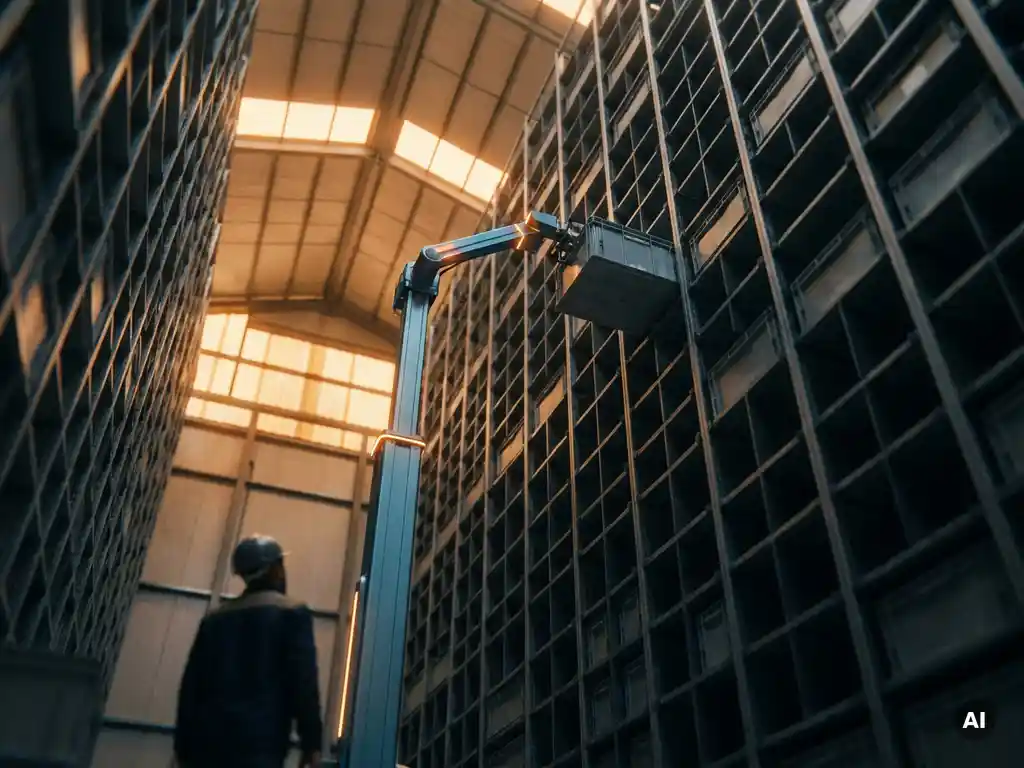
Automated systems that utilize full building height amplify this effect. A system capable of storing totes up to 16 meters vertically, with every location directly accessible without reshuffling, converts space that would otherwise be unused into productive storage. This means a warehouse can process higher order volumes within the same building footprint, without adding floor space or proportionally increasing the labor required to serve that inventory. The relationship between density and labor cost is not incidental; it is structural. More density means fewer movements per order, which means lower labor cost per unit fulfilled.
For operations evaluating automated storage and retrieval systems, the density of the chosen architecture has a direct bearing on the labor cost trajectory over time, not just at launch but across the entire operational life of the system.
When does warehouse automation stop making financial sense?
Warehouse automation stops making financial sense when the cost of the system, including capital, maintenance, and integration, exceeds the labor and operational costs it displaces over a realistic operational horizon. This threshold is most commonly reached in operations with very low order volumes, highly variable SKU profiles that resist standardization, or environments where labor costs are unusually low relative to the cost of the technology.
Automation also becomes less viable when the infrastructure required to support it is disproportionately expensive relative to the operational benefit. Systems that require significant building modifications, custom engineering for every deployment, or heavy ongoing technical support carry a higher cost basis that narrows the financial case, particularly for smaller operations.
There are also scenarios where partial automation makes more sense than full automation. Operations with a mix of high-volume standard SKUs and low-volume irregular items may benefit from automating the predictable, high-frequency portion of their inventory while keeping manual processes for the exception-heavy remainder. Forcing full automation onto a mixed operation can introduce complexity that erodes the efficiency gains the system was meant to create.
The financial case weakens further when a system cannot scale without significant reinvestment. If adding throughput capacity requires rebuilding infrastructure or duplicating core equipment, the cost of growth compounds in a way that reduces long-term returns. Systems where capacity and throughput scale independently, without structural redesign, preserve the financial case across a longer operational life because the incremental cost of growth remains predictable and controlled.
How Hexxabotics helps reduce warehouse labor costs over time
Hexxabotics addresses the core drivers of warehouse labor cost through a next-generation AS/RS designed to maximize storage density, eliminate operational bottlenecks, and scale performance without rebuilding infrastructure. Here is how the system directly impacts the labor cost equation:
- Goods-to-person retrieval: Autonomous Hexxabots deliver totes directly to operator workstations, eliminating floor travel and dramatically increasing picks per person per hour.
- 100% direct access: Every storage location is accessible without digging or reshuffling, removing the wasted cycles that inflate labor hours in conventional dense storage systems.
- Independent scalability: Storage capacity and throughput scale independently, so operations can grow order volume by adding robots without structural redesign or proportional labor increases.
- No in-rack electrification: The passive rack structure eliminates embedded motors and cabling, reducing maintenance labor and the failure-related downtime that creates unplanned labor demand.
- Distributed resilience: With no single point of failure, the system maintains stable throughput even when individual units are serviced, preventing the costly disruptions that require emergency labor responses in centralized systems.
For industrial automation engineers evaluating how to reduce warehouse labor costs over a five- to fifteen-year horizon, the architecture of the storage system matters as much as the robots themselves. Explore the Hexxabotics system to see how hexagonal geometry and distributed robotics combine to deliver a lower cost per order fulfilled, from day one through full scale.
Related Articles
- What is the difference between a dark warehouse and a smart warehouse?
- What are the biggest challenges of implementing warehouse automation?
- Why are fulfillment centers moving toward fully automated operations?
- When should a 3PL provider invest in automated fulfillment systems?
- How do digital twins help prevent warehouse operational failures?