
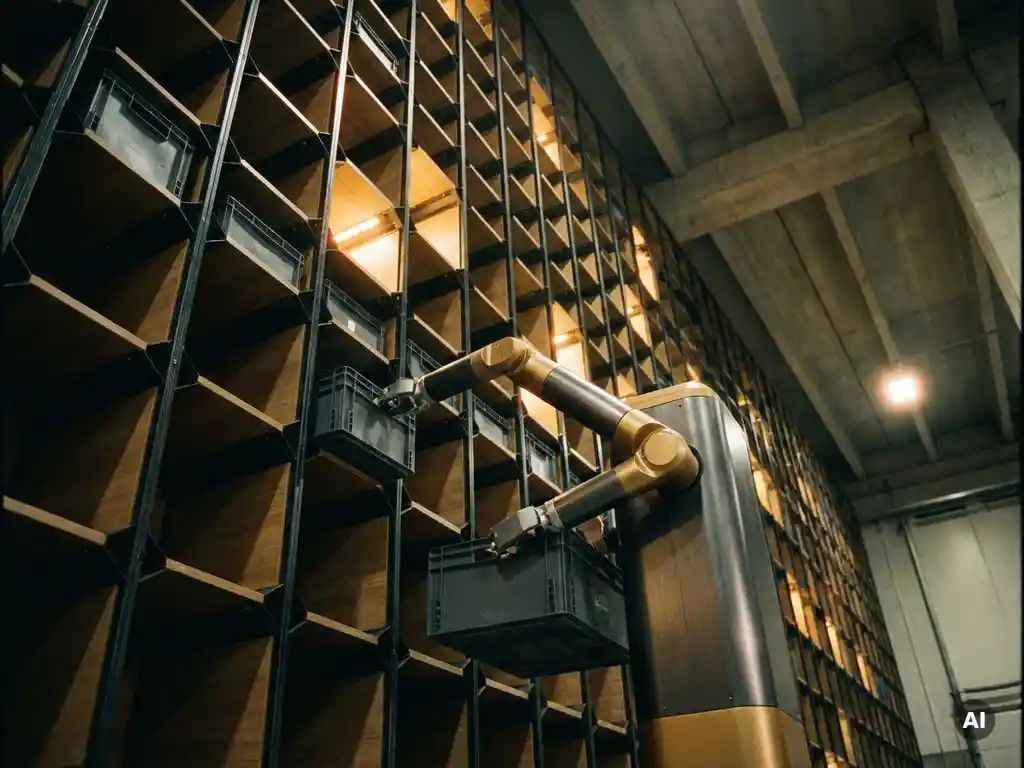
Warehouse automation reduces labor costs by replacing repetitive, manual tasks with autonomous robotic systems that operate continuously without breaks, errors, or overtime pay. The savings come from fewer workers needed for picking, sorting, and inventory management, while output stays consistent or improves. This article breaks down where those costs come from, how automation eliminates them, and what engineers need to evaluate before committing to a system.
What tasks in a warehouse are most expensive to staff manually?
The most labor-intensive and costly warehouse tasks are order picking, inventory replenishment, put-away, and cycle counting. Picking alone typically accounts for the majority of direct warehouse labor hours, since it requires workers to travel between storage locations repeatedly throughout a shift. These tasks are physically demanding, error-prone at high volumes, and difficult to scale during peak demand without significant overtime or temporary hiring.
Beyond picking, manual put-away and replenishment require workers to navigate large floor areas, locate available storage positions, and physically place or retrieve totes and cartons. In dense storage environments, workers often spend more time walking and searching than actually handling product. Cycle counting, which keeps inventory records accurate, adds another layer of labor that runs in parallel with daily operations.
The cost pressure intensifies because these tasks scale linearly with volume. As order volumes rise, labor requirements rise proportionally. There is no natural efficiency gain from adding more people to a manual operation, which makes high-volume warehouses especially vulnerable to labor cost inflation.
How does warehouse automation actually reduce labor costs?
Warehouse automation reduces labor costs by removing workers from the most repetitive, high-frequency tasks and replacing them with robotic systems that handle storage and retrieval around the clock. Instead of workers traveling to inventory locations, automated systems bring inventory directly to stationary operators at Goods-to-Person workstations, dramatically cutting the time each operator spends per order line.
The mechanism is straightforward: a worker stationed at a pick station receives a tote, picks the required item, confirms the action, and the tote is returned to storage automatically. That worker can process far more orders per hour than a picker walking the floor, which means fewer total operators are needed to achieve the same throughput.
Automation also reduces indirect labor costs that are easy to overlook. Fewer workers on the floor means lower supervision ratios, reduced training overhead, fewer workplace injuries, and less exposure to labor market volatility. Systems like modern AS/RS platforms handle inventory tracking automatically, which largely eliminates the need for dedicated cycle-count teams.
Distributed robotic architectures add another dimension of labor cost reduction. When autonomous robots operate in parallel across a storage grid without depending on a single centralized crane or conveyor, throughput scales by adding robotic units rather than adding headcount. This breaks the linear relationship between volume and labor that makes manual warehouses so expensive to operate at scale.
What’s the difference between AS/RS and traditional conveyor-based automation?
An Automated Storage and Retrieval System (AS/RS) stores and retrieves inventory using robotic units that navigate a structured storage grid, while traditional conveyor-based automation moves goods along fixed pathways between fixed points. The core difference is flexibility: AS/RS systems provide direct access to individual storage locations, while conveyor systems move product through a predetermined sequence of stations.
How AS/RS systems handle storage and retrieval
In an AS/RS, robotic units navigate horizontally and vertically within a storage structure to deposit and retrieve totes. Every storage location is accessible without moving other inventory out of the way. This direct-access model eliminates the digging and reshuffling that slow down dense manual storage, and it allows the system to serve multiple Goods-to-Person workstations simultaneously from a shared inventory pool.
How conveyor-based automation works differently
Conveyor systems automate the movement of goods between fixed points, such as receiving, sorting, and shipping. They excel at high-speed sortation and transport but require significant floor space for the conveyor infrastructure itself, and their routing is largely fixed at installation. Reconfiguring a conveyor layout to accommodate new workflows or facility changes is expensive and disruptive. Conveyor systems also tend to create bottlenecks at merge points and sortation junctions, which limits their ability to handle demand spikes without significant investment in redundant equipment.
For labor cost reduction specifically, AS/RS systems typically deliver greater savings because they address the picking task directly, which is where most warehouse labor hours are spent. Conveyor systems reduce labor in transport and sortation, but they do not eliminate the need for workers to locate and retrieve individual items from storage.
How much labor cost can warehouse automation realistically save?
The realistic labor cost savings from warehouse automation depend heavily on the operation’s starting point, but well-implemented AS/RS deployments commonly reduce direct picking labor by 50 to 80 percent compared to manual operations at equivalent volumes. Operations that run multiple shifts, handle high SKU counts, or experience significant seasonal demand swings tend to see the largest reductions.
These figures reflect the structural advantage of Goods-to-Person systems: a single operator at a pick station can process significantly more orders per hour than a floor picker, because travel time between locations is eliminated entirely. In a manual operation, industry experience suggests that walking accounts for a substantial portion of a picker’s shift. Automating that movement converts dead time into productive picks.
It is important to frame these savings accurately. Automation does not eliminate all warehouse labor. Receiving, quality control, exception handling, system maintenance, and supervisory roles remain. The reduction applies specifically to the repetitive, high-frequency tasks that dominate direct labor budgets. Operations should model their specific task mix rather than applying a blanket percentage to total headcount.
Energy and infrastructure costs also factor into the total picture. Systems that eliminate in-rack electrification, for example, reduce both energy consumption and the maintenance labor associated with powered rack components, contributing to ongoing operational savings beyond direct headcount reduction.
When does warehouse automation pay for itself?
Warehouse automation typically reaches payback within three to seven years, with the range driven by labor costs in the target market, order volume, shift patterns, and the specific system chosen. Operations with high labor costs, multiple shifts, and consistent order volume tend to reach payback faster because the system’s productivity advantage compounds across more operating hours.
The payback calculation should account for both direct and indirect savings. Direct savings include reduced headcount and overtime. Indirect savings include lower error rates and the associated rework costs, reduced workers’ compensation exposure, lower training costs in high-turnover environments, and the avoided cost of scaling manual labor during growth periods.
Capital expenditure structure matters as well. Systems that allow independent scaling of storage capacity and throughput offer a meaningful financial advantage: operators can right-size their initial investment and expand incrementally as volume grows, rather than committing to full capacity upfront. This modular approach reduces the initial capital outlay and shortens the time to positive return on the deployed portion of the system.
Maintenance costs are a critical variable that is often underestimated in payback models. Systems with fewer mechanical components, no embedded motors in the rack structure, and distributed robotic architectures that eliminate single points of failure tend to have lower ongoing maintenance costs and more predictable uptime, both of which protect the payback timeline.
What should engineers evaluate before automating warehouse labor?
Before committing to a warehouse automation system, engineers should evaluate order profile characteristics, facility constraints, throughput requirements, scalability needs, integration complexity, and total cost of ownership over the system’s expected life. Getting these inputs right determines whether the selected system will deliver the labor savings projected at the business case stage.
- Order profile: Analyze SKU count, order line frequency, tote or carton weight ranges, and the ratio of single-line to multi-line orders. Systems optimized for high-velocity, low-SKU operations perform differently from those designed for long-tail SKU environments.
- Throughput requirements: Establish peak throughput targets, not just average daily volumes. A system that handles average demand but cannot absorb peak load will require manual overflow, undermining the labor savings case.
- Facility constraints: Measure available floor area, ceiling height, floor load capacity, and column grid. Systems that utilize full building height can achieve higher storage density within a smaller footprint, which is critical in facilities where floor space is constrained.
- Scalability architecture: Determine whether storage capacity and throughput can scale independently. Systems where adding capacity requires rebuilding infrastructure create expensive inflection points as the business grows.
- Integration requirements: Assess how the automation system connects to the existing Warehouse Management System. Standard API integration reduces deployment time and ongoing IT maintenance compared to proprietary interfaces.
- Maintenance model: Evaluate whether the system has centralized components that create single points of failure, and what the maintenance labor requirement looks like over time. Distributed robotic architectures that continue operating when individual units are offline reduce both maintenance risk and the need for dedicated maintenance headcount.
- Total cost of ownership: Model capital expenditure, installation, energy consumption, maintenance contracts, and software licensing across a ten-year horizon rather than evaluating purchase price alone.
Engineers should also assess vendor track record in comparable applications, the availability of simulation or modeling tools to validate throughput projections before commitment, and the flexibility to reconfigure or relocate the system if the facility or business model changes.
How Hexxabotics helps reduce warehouse labor costs
Hexxabotics delivers a next-generation autonomous AS/RS system purpose-built to address the labor cost drivers described throughout this article. The system combines a hexagonal vertical storage grid, autonomous Hexxabots, and standardized totes to bring inventory directly to operators at Goods-to-Person workstations, eliminating floor travel and reducing the headcount required to hit throughput targets.
- Every storage location is directly accessible with no digging or reshuffling, keeping pick rates high without additional labor
- Storage capacity and throughput scale independently: add towers to increase positions, add robots to increase picks per hour, with no structural redesign
- No in-rack electrification means fewer failure points, lower energy costs, and reduced maintenance labor over the system’s life
- Distributed robotic operation eliminates single points of failure, protecting throughput and uptime during peak demand
- The system utilizes full building height up to 16 meters, maximizing storage density within a compact footprint and reducing facility cost per stored unit
- Standard API integration connects to existing WMS platforms, reducing deployment complexity and IT overhead
If you are evaluating warehouse automation to reduce labor costs and improve operational resilience, learn more about Hexxabotics and how the system’s architecture fits your throughput and scalability requirements.