
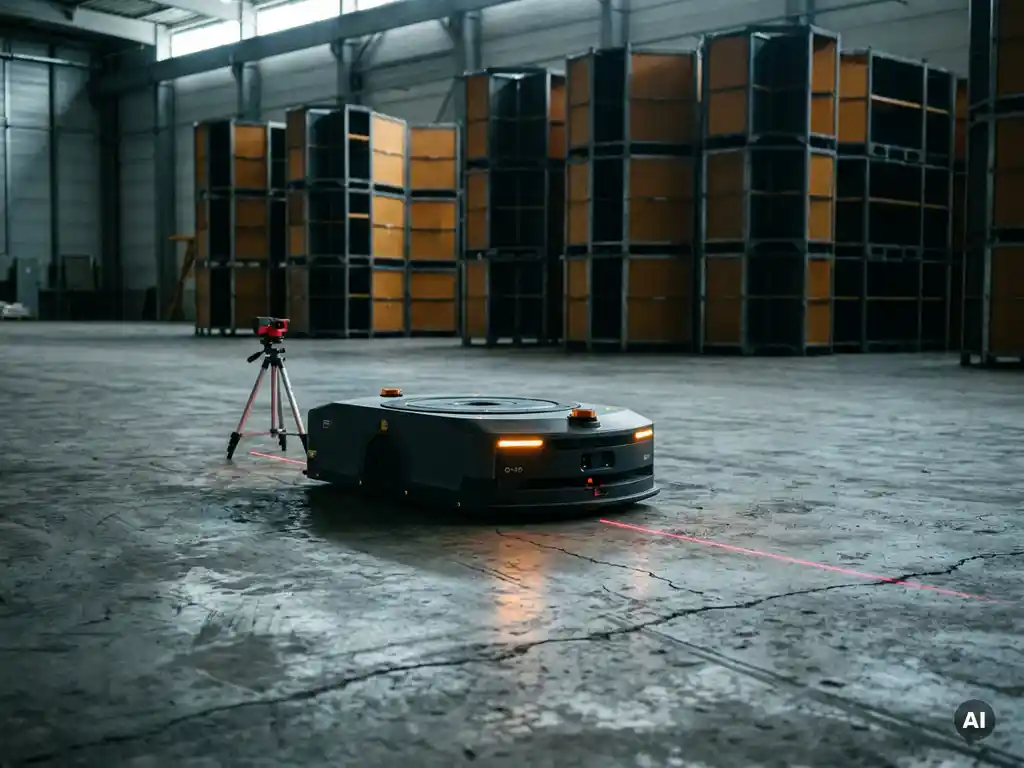
Floor flatness has a direct and significant impact on automated warehouse systems: uneven floors cause navigation errors, sensor misalignment, mechanical stress, and throughput loss in robotic AS/RS installations. The tolerance requirements for automated systems are considerably tighter than those for conventional forklifts or manual operations. The sections below address the most common technical questions engineers and project teams face when specifying, measuring, and correcting warehouse floors for automation.
How does floor flatness affect robot navigation in AS/RS systems?
Floor flatness affects robot navigation in AS/RS systems by disrupting the precise positioning, sensor calibration, and drive mechanics that autonomous robots depend on. Even small deviations from a flat surface can cause cumulative positioning errors, sensor misreadings, and mechanical wear that degrade system performance over time.
Autonomous robots in modern AS/RS environments use a combination of onboard sensors, encoders, and control system feedback to navigate defined paths at speed. When the floor surface deviates from the expected plane, the robot’s odometry, its internal calculation of position based on wheel rotation, begins to drift. Over a long travel path, a gradient of just a few millimeters can translate into a positioning error large enough to misalign a tote at a transfer point or cause a robot to miss its docking position.
Beyond positioning, uneven floors create dynamic instability. A robot carrying a loaded tote across a surface with unexpected undulations experiences shifting loads that stress the chassis, drive wheels, and load-handling mechanism. In high-throughput environments where robots operate continuously across the full floor area, this mechanical stress accelerates wear and increases the frequency of unplanned maintenance.
The effect is compounded in systems where robots navigate beneath a storage grid structure. Any floor deviation that causes a robot to tilt changes the clearance geometry between the robot and the structure above it, creating collision risk and forcing conservative speed limits that reduce throughput.
What floor flatness standards apply to automated warehouse systems?
Automated warehouse systems typically require floors specified to TR34 (UK), DIN 15185 (Germany), or ASTM E1155 (North America) standards, with F-number tolerances significantly tighter than those used for conventional warehouse floors. The specific requirement depends on the AS/RS technology, robot type, and operating speed.
The two most widely referenced measurement frameworks in industrial automation are:
- F-numbers (FF/FL): The North American standard from ASTM E1155 uses two values: Floor Flatness (FF) and Floor Levelness (FL). FF measures local surface waviness over short distances; FL measures the overall slope across the floor. Automated guided vehicle (AGV) and robotic AS/RS environments typically require FF values of 50 or higher and FL values of 35 or higher, compared to FF 25/FL 20 for standard warehouse use.
- TR34 (UK) and equivalent European standards: The Concrete Society’s TR34 specification defines “defined movement” floors for environments where vehicles follow fixed paths, and “free movement” floors for random-path vehicles. Robotic AS/RS installations almost always fall into the defined movement category, which carries the tightest flatness tolerances of any warehouse classification.
Equipment manufacturers typically publish their own floor specification requirements as part of the system design package. These project-specific requirements take precedence over generic standards and should be obtained early in the building or refurbishment design process, before the concrete specification is finalized.
What problems does poor floor flatness cause in warehouse automation?
Poor floor flatness in automated warehouse environments causes positioning errors, increased mechanical wear, sensor calibration failures, throughput reduction, and in severe cases, structural misalignment of the storage grid itself. These problems compound over time and can be expensive to resolve after installation.
The most immediate consequence is navigation inaccuracy. Robots that cannot maintain precise positioning along their travel paths begin to accumulate errors that affect tote placement, retrieval accuracy, and handoff reliability at Goods-to-Person workstations. Control systems compensate to a degree, but repeated correction cycles slow robot movement and reduce effective throughput.
Mechanical degradation is a longer-term consequence. Drive wheels, bearings, and suspension components experience uneven loading when operating on non-flat surfaces. In a system running dozens of robots continuously across a full operational shift, the cumulative effect on component life is material. Maintenance intervals shorten, and the risk of unplanned downtime increases.
Floor unevenness also affects the storage grid itself. Hexagonal and rectilinear grid structures are designed to be self-supporting and geometrically precise. If the floor beneath the grid anchor points is not level, the structure may rack or twist during installation, introducing misalignment into the vertical towers that robots must climb. This directly affects the reliability of vertical access and the consistency of deposit and retrieval cycles.
How is floor flatness measured before installing an automated system?
Floor flatness is measured using a floor profilometer, a digital level, or a laser scanning system that records surface elevation at defined intervals across the floor area. The measurement process produces a profile map that is then analyzed against the applicable standard (FF/FL numbers, TR34, or the equipment manufacturer’s specification).
A structured pre-installation floor survey typically follows these steps:
- Define the measurement grid: Establish a grid of measurement points across the planned installation footprint. The density of the grid depends on the standard being applied and the sensitivity of the robotic system.
- Record elevation data: Use a digital floor profilometer or laser scanner to capture surface height at each grid point. Modern laser scanning can produce dense point clouds that reveal subtle undulations not visible to the naked eye.
- Calculate F-numbers or deviation values: Apply the relevant calculation method (ASTM E1155 for FF/FL, or TR34 for defined/free movement classification) to derive flatness and levelness values for each zone.
- Map problem areas: Produce a heat map or deviation report identifying zones that fall outside the required tolerance. This informs remediation priorities before installation begins.
- Confirm against the equipment specification: Compare the measured values against the AS/RS manufacturer’s stated floor requirements for the specific system being installed.
Conducting this survey before finalizing the installation layout allows the project team to adjust the equipment footprint, prioritize grinding or leveling in critical zones, and avoid placing high-traffic robot paths over known problem areas.
Can poor warehouse floor flatness be corrected after installation?
Yes, poor floor flatness can be corrected after an automated system is installed, but the options are significantly more limited and more costly than addressing the problem before installation. The most common remediation methods are diamond grinding for high spots and self-leveling compounds for low spots, but access constraints make both more difficult once racking and robots are in place.
Diamond grinding is the standard technique for removing high spots and surface waviness. It is effective, controllable, and does not require the floor to be taken out of service for extended periods. However, working around installed grid structures, robot charging stations, and cable management requires careful planning and may mean grinding can only be performed in sections during planned maintenance windows.
Self-leveling cementitious compounds can address low spots and localized depressions, but they require the surface to be clean, properly primed, and free of traffic during curing. In an operating warehouse with an installed AS/RS, achieving these conditions across a significant floor area is operationally disruptive.
In cases where floor deviation is severe and widespread, the most practical solution may be to adjust the system’s control parameters to compensate for known floor conditions, effectively teaching the robots to navigate around problem zones at reduced speed. This is a compromise that accepts reduced throughput rather than resolving the underlying floor condition, and it should be treated as a temporary measure rather than a permanent solution.
How do different AS/RS designs tolerate floor flatness variation?
Different AS/RS designs vary considerably in their sensitivity to floor flatness. Rail-guided systems with fixed tracks are relatively tolerant of gradual floor slope but sensitive to local surface irregularities at rail anchor points. Free-navigating robotic systems are sensitive to both flatness and levelness because their positioning depends on consistent surface contact across the entire floor area.
Traditional crane-based AS/RS systems transfer most of their structural load through defined anchor points and rails. The floor flatness requirement is concentrated at those specific locations rather than across the entire floor surface. This makes them somewhat easier to accommodate in existing buildings with imperfect floors, provided the rail anchor zones can be prepared correctly.
Robotic shuttle and grid-based systems, including those where autonomous units navigate freely beneath a storage structure, place demands on the entire floor surface within the system footprint. Because robots travel across the full area rather than following fixed rails, every part of the floor within the operational zone must meet the flatness specification. This is a more demanding requirement but reflects the operational advantage these systems provide: distributed movement, parallel operation, and the absence of a single mechanical bottleneck.
Systems designed with no in-rack electrification and distributed robot operation, where robots charge autonomously and navigate independently, place additional importance on floor quality because there is no centralized mechanical infrastructure to absorb or compensate for floor deviation. The floor becomes a shared resource for every robot in the system, and its condition directly affects the performance of the entire fleet.
How Hexxabotics addresses floor requirements in robotic AS/RS design
Hexxabotics has designed its autonomous AS/RS system with the realities of industrial floor environments in mind. The system’s architecture reflects several principles relevant to floor flatness management:
- Distributed robot operation: Hexxabots navigate independently beneath the hexagonal grid, meaning floor quality is assessed across the full operational zone during site preparation rather than at isolated rail points.
- Self-supporting hexagonal structure: The grid structure is engineered to be self-supporting, reducing the number of floor anchor points and concentrating structural load at defined locations that can be prepared to the required specification.
- No in-rack electrification: With no fixed electrical infrastructure embedded in the rack, the system is simpler to install, adjust, and relocate, including in scenarios where floor remediation requires partial system movement.
- Scalable and modular architecture: The modular design allows the installation footprint to be configured around areas of the floor that meet specification, with expansion planned into zones that have been prepared to the required standard.
For project teams evaluating a Hexxabotics AS/RS installation, the floor specification is established as part of the system design process, and site assessment is a defined step before deployment. To discuss your facility’s floor conditions and understand the preparation requirements for a Hexxabotics system, contact the team directly to begin a project-specific evaluation.
Related Articles
- How do you select a pharmaceutical warehousing partner for compliance-critical products?
- What are the biggest compliance risks in pharmaceutical cold storage?
- How does product mix complexity affect warehouse design decisions?
- What is the difference between forward pick areas and reserve storage in a warehouse?
- How does predictive maintenance prevent downtime in automated warehouses?