
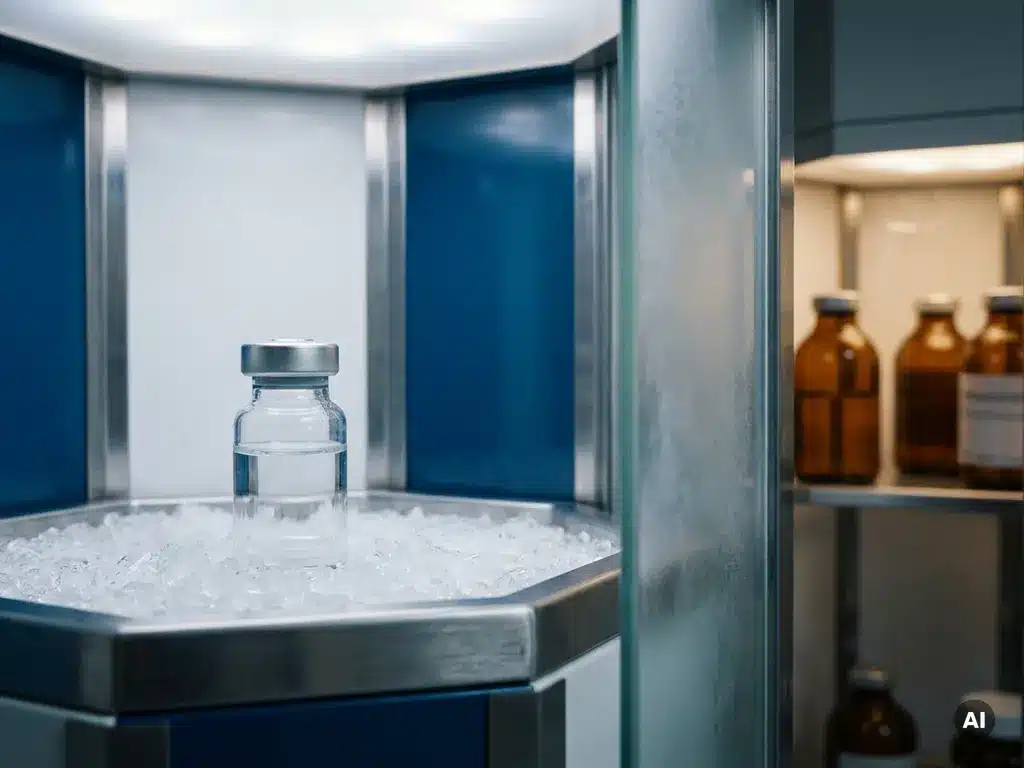
Cold chain pharmaceutical storage maintains products within a controlled low-temperature range, typically between 2°C and 8°C for refrigerated items or below -20°C for frozen biologics, while ambient pharmaceutical storage keeps products at room temperature, generally between 15°C and 25°C. The distinction is not simply about temperature preference: it reflects the chemical and biological stability requirements of the product itself. This article works through the most important questions pharmaceutical warehouse operators face when managing both storage types.
What temperature ranges define cold chain vs. ambient pharmaceutical storage?
Cold chain pharmaceutical storage covers any controlled-temperature environment below standard room temperature. Refrigerated cold chain typically maintains a range of 2°C to 8°C, while frozen storage operates at -20°C or colder, and ultra-cold storage for certain advanced biologics can reach -70°C or below. Ambient pharmaceutical storage, by contrast, targets a controlled room temperature band of 15°C to 25°C, sometimes extended to 30°C for products labeled “store below 30°C.”
The definitions are not informal conventions. Regulatory bodies and pharmacopeial standards, including those published by the European Pharmacopoeia and the United States Pharmacopeia, set specific temperature classifications that manufacturers reference on product labeling. Warehouse operators must match their storage conditions to those labeled requirements precisely.
A common source of confusion is the term “controlled room temperature.” This does not mean an unmonitored warehouse floor. It refers to a maintained environment within a defined band, protected from humidity extremes, direct light, and temperature spikes. Both cold chain and ambient pharmaceutical storage therefore require active environmental control; the difference lies in where that control band is set.
Which pharmaceutical products require cold chain storage?
Pharmaceutical products that require cold chain storage are those whose active ingredients, biological structures, or formulations degrade or lose efficacy when exposed to temperatures above their labeled storage range. This category includes vaccines, insulin and other biological injectables, certain antibiotics in liquid form, blood-derived products, monoclonal antibodies, and many cell and gene therapies.
The underlying reason is molecular stability. Proteins, enzymes, and living biological components can denature, aggregate, or become biologically inactive at elevated temperatures. For a vaccine, this can mean the difference between full immunological protection and none at all. For a biologic injectable, degradation may produce fragments that are not only ineffective but potentially harmful.
Ambient-suitable products, by contrast, are typically small-molecule pharmaceuticals in solid dosage forms: tablets, capsules, and many oral liquids that remain chemically stable within a standard room-temperature range. Pharmaceutical cartons containing these products make up the majority of SKUs handled by pharmaceutical wholesalers and distributors, which is why ambient-compatible inventory tends to dominate assortment counts even in operations that also manage cold chain lines.
What happens when pharmaceutical products are stored at the wrong temperature?
Storing pharmaceutical products outside their labeled temperature range can cause chemical degradation, loss of potency, physical instability, or microbial growth, depending on the product type and the severity of the excursion. In the most serious cases, a product that has experienced a temperature excursion cannot be released for use and must be quarantined or destroyed, representing a direct financial and supply loss.
For cold chain products, a break in the temperature-controlled environment, even a temporary one, is called a cold chain excursion. Excursions do not automatically render a product unusable, but they trigger a formal assessment process. The manufacturer’s stability data, the duration and magnitude of the excursion, and the product’s known degradation kinetics all inform whether the batch can be released or must be withdrawn. Regulatory guidance in most markets requires that excursion events be documented, investigated, and reported as part of Good Distribution Practice (GDP) compliance.
For ambient products, the risks are different but real. Exposure to high humidity can cause tablets to swell or dissolve prematurely. Excessive heat can accelerate oxidation or hydrolysis reactions. Freezing conditions can crack emulsions, damage suspensions, or alter the physical integrity of certain formulations. Regulatory authorities treat inadequate ambient storage conditions as a quality failure, not simply an operational inconvenience.
How do infrastructure and equipment requirements differ between the two storage types?
Cold chain pharmaceutical storage requires dedicated refrigeration or freezer infrastructure, continuous temperature monitoring systems, validated environmental controls, backup power provisions, and documented alarm response procedures. Ambient pharmaceutical storage requires a controlled building environment with heating, ventilation, and humidity management, but does not require active refrigeration at the storage level.
Cold chain infrastructure demands
Cold rooms and refrigerated chambers must be designed, qualified, and validated before use. This includes installation qualification, operational qualification, and performance qualification (IQ/OQ/PQ) to demonstrate that the equipment consistently maintains the required temperature range under realistic loading and operational conditions. Monitoring sensors must be calibrated, positioned to represent the full temperature distribution within the space, and connected to alarm systems with defined response times. Backup power is typically mandatory because a refrigeration failure during off-hours can result in a significant excursion before staff intervene.
Ambient infrastructure demands
Ambient pharmaceutical storage facilities require robust building insulation, HVAC systems capable of maintaining the temperature band year-round across seasonal extremes, and humidity controls appropriate to the product portfolio. Warehouse layout matters significantly: products stored near loading bays, roof panels, or south-facing walls can experience localized temperature variation that exceeds acceptable limits even when the central monitoring point reads within range. Mapping studies that characterize temperature distribution across the full storage area are required under GDP frameworks and must be repeated if the facility layout changes materially.
The capital and operational cost gap between cold chain and ambient infrastructure is substantial. Cold chain facilities carry higher construction costs, ongoing energy consumption, maintenance obligations, and qualification burdens. This cost differential is one reason pharmaceutical distributors work to accurately classify their assortment: storing an ambient-suitable product in refrigerated space wastes expensive capacity, while storing a cold chain product in ambient conditions creates a compliance and patient-safety risk.
What regulatory and compliance standards apply to each storage type?
Both cold chain and ambient pharmaceutical storage fall under Good Distribution Practice (GDP) regulations in most markets, which set requirements for temperature control, monitoring, documentation, staff training, and deviation management. Cold chain storage carries additional and more stringent requirements because the consequences of failure are typically more severe and less reversible than for most ambient products.
In the European Union, the GDP Guidelines (2013/C 343/01) provide the primary framework for pharmaceutical distribution, applying to both temperature-controlled and ambient operations. The guidelines require that storage conditions be defined, maintained, monitored, and documented throughout the supply chain. Cold chain operations must demonstrate continuous temperature control from manufacturer to end recipient, with no unmonitored gaps.
The Falsified Medicines Directive (FMD), implemented through the EU’s Delegated Regulation 2016/161, applies primarily at the point of dispensing and requires serialization verification and decommissioning of unique identifiers on prescription medicines. This applies regardless of storage temperature category, but it adds a layer of process and system integration that pharmaceutical warehouse operators must plan for across both cold chain and ambient fulfillment flows.
In the United States, the Drug Supply Chain Security Act (DSCSA) governs traceability requirements across the pharmaceutical supply chain. The FDA’s guidance on storage and distribution conditions sets expectations that parallel GDP principles, with specific guidance on temperature-sensitive products. Internationally, the World Health Organization publishes GDP guidelines that many markets reference when developing their own regulatory frameworks.
For warehouse operators, compliance is not achieved by the storage equipment alone. It depends on the complete implementation: validated equipment, qualified processes, trained personnel, documented procedures, and software systems capable of recording and reporting the data regulators expect to see during inspections.
When should a pharmaceutical warehouse invest in cold chain over ambient capacity?
A pharmaceutical warehouse should invest in cold chain capacity when its current or planned assortment includes products that require refrigerated or frozen storage conditions, when regulatory obligations require temperature-controlled distribution, or when business growth into biologics, vaccines, or specialty medicines makes ambient-only infrastructure insufficient for the portfolio.
The investment decision is not purely about product type. It also involves volume, SKU count, and the economics of cold chain operations at scale. A small number of cold chain SKUs with low turnover may be more economically handled through third-party cold chain logistics than through in-house refrigerated infrastructure. As cold chain volume grows, the economics of owned infrastructure improve, and the operational and compliance advantages of in-house control become more compelling.
Several trends are shifting this calculation. The growth of biologics, biosimilars, and cell and gene therapies is expanding the proportion of the pharmaceutical market that requires temperature-controlled distribution. Pharmaceutical wholesalers and distributors who historically handled predominantly ambient assortments are increasingly managing mixed portfolios, which creates pressure to build or expand cold chain capability alongside existing ambient operations.
Ambient capacity investment, by contrast, remains the baseline for any pharmaceutical distribution operation. The majority of pharmaceutical SKUs in a typical wholesale assortment are ambient-compatible, and the infrastructure costs are significantly lower. Investing in higher-density ambient storage, through automation that exploits vertical warehouse space rather than expanding the building footprint, can deliver meaningful capacity gains without the capital intensity of cold chain expansion.
How Hexxabotics supports pharmaceutical warehouse storage operations
Hexxabotics provides a high-density Automated Storage and Retrieval System designed for pharmaceutical distribution environments where accurate inventory control, direct product access, and operational scalability are essential. For ambient pharmaceutical storage, where the majority of SKUs in a typical wholesale assortment are held, the system addresses several of the most common operational constraints:
- Direct tote access without digging: Every storage location is individually accessible, supporting batch traceability, expiry-date management, and controlled retrieval without reshuffling inventory.
- Vertical cube utilization: The hexagonal grid structure uses full building height up to 16 meters, increasing storage density within an existing footprint rather than requiring building expansion.
- Independent capacity and throughput scaling: Storage capacity grows by extending the structure; throughput grows by adding robots; the two dimensions scale independently as assortment and order volumes evolve at different rates.
- Compliance-supporting architecture: The system supports the traceability, batch control, and audit requirements of GDP-regulated operations when integrated with appropriate warehouse management software.
- Integration with hybrid fulfillment: Hexxabotics is designed to work alongside high-speed dispensing systems and goods-to-person processes, so different SKU profiles are each routed to the technology best suited to their demand pattern.
If your pharmaceutical distribution operation is managing growing SKU counts, running out of ambient storage capacity, or preparing for a GDP compliance review, contact Hexxabotics to discuss how a direct-access AS/RS can fit your specific facility and assortment profile.
Related Articles
- How does batch traceability work in pharmaceutical warehousing?
- How do you design a warehouse layout that supports multiple shifts?
- Can warehouse automation lower your energy consumption?
- Should you choose an AMR system or a fixed-rail AS/RS in 2026?
- How do robots and human workers collaborate in hybrid warehouses?