
AI improves warehouse inventory optimization by enabling real-time demand forecasting, intelligent slotting, continuous visibility, and autonomous robot coordination, all working together to reduce errors, cut pick times, and eliminate stockouts. Traditional warehouse management systems react to inventory events after they happen; AI anticipates them before they occur. The sections below unpack the specific problems AI solves and how each capability works in practice.
What specific inventory problems does AI actually solve in warehouses?
AI in warehouse inventory management directly addresses four persistent operational failures: inaccurate demand forecasting that leads to overstock or stockouts, inefficient product placement that inflates pick times, blind spots in real-time stock visibility, and coordination bottlenecks that slow down automated retrieval systems. These are not marginal inefficiencies; they compound into significant labor costs, missed orders, and wasted storage capacity.
Manual inventory processes rely on historical averages and human judgment, both of which struggle under conditions of variable demand, seasonal spikes, and growing SKU complexity. AI replaces these reactive approaches with models that process far more variables simultaneously and update continuously as conditions change.
The practical result is a warehouse that adjusts its own behavior. When demand signals shift, the system repositions inventory before the surge hits. When a pick path becomes inefficient, slotting logic recalculates without waiting for a quarterly review. When a robot unit goes offline, coordination algorithms redistribute workload automatically. AI does not eliminate warehouse complexity; it makes that complexity manageable at scale.
How does AI-powered demand forecasting work in warehouse environments?
AI-powered demand forecasting in warehouses works by training machine learning models on a combination of historical order data, seasonal patterns, supplier lead times, and external signals such as promotional calendars or market trends. The model continuously updates its predictions as new data flows in, producing rolling forecasts that are far more granular and accurate than static safety stock calculations.
Traditional forecasting methods apply fixed reorder points based on average past demand. This works reasonably well when demand is stable, but most warehouses operate in environments where order volumes fluctuate significantly. A fashion fulfillment operation, for example, may see a SKU sell zero units for weeks before a promotional event triggers hundreds of orders in a single day. Static models cannot anticipate this; AI models trained on promotional history can.
Replenishment triggers and inventory positioning
AI forecasting systems translate predictions directly into replenishment triggers. Rather than waiting for stock to fall below a fixed threshold, the system calculates the optimal reorder point dynamically based on predicted demand velocity and current lead times. This reduces both overstock, which ties up storage capacity and capital, and stockouts, which damage fulfillment rates and customer trust.
Multi-location inventory balancing
In multi-site or multi-zone warehouse environments, AI forecasting also determines where inventory should be positioned across the facility. Placing high-velocity SKUs closer to dispatch areas, or distributing stock across zones to reduce retrieval distances, directly reduces pick cycle times. This positioning intelligence connects demand forecasting to physical storage strategy in a way that manual planning cannot replicate consistently.
What is AI-driven slotting optimization and how does it reduce pick times?
AI-driven slotting optimization is the process of using machine learning algorithms to determine the most efficient physical location for each SKU within a warehouse, based on demand velocity, order co-occurrence, weight, and retrieval frequency. By placing frequently picked items in the most accessible storage positions and grouping items commonly ordered together, slotting optimization directly reduces the travel time and handling effort required for each pick.
In a conventional warehouse, slotting decisions are made periodically by operations managers using spreadsheet analysis. The problem is that demand patterns shift continuously, and manual reviews cannot keep pace. AI slotting systems monitor order data in real time and recalculate optimal slot assignments on a rolling basis, flagging or automatically triggering repositioning when the current layout no longer reflects actual demand.
The reduction in pick times comes from two mechanisms. First, high-velocity items are always stored in positions that minimize retrieval distance or cycle time. Second, items frequently ordered together are stored in proximity, reducing the number of separate retrieval movements required to fulfill a multi-line order. In high-throughput environments, these gains accumulate into meaningful reductions in labor cost and order cycle time per day.
How does AI improve real-time inventory visibility across a warehouse?
AI improves real-time inventory visibility by continuously reconciling data from multiple sources, barcode scans, RFID readers, robotic retrieval logs, and inbound receiving events, to maintain an accurate, live picture of stock levels, locations, and movement. Unlike periodic cycle counts, AI-driven visibility systems flag discrepancies as they occur and can predict where errors are likely to emerge before a physical audit confirms them.
The core challenge with warehouse inventory visibility is that stock records drift from physical reality over time. Items get misplaced, scans get missed, and returns create location ambiguity. Traditional warehouse management systems accumulate these errors between count cycles. AI systems address this by treating every robot movement, every tote retrieval, and every inbound scan as a data point that updates the inventory record in real time.
Beyond accuracy, AI visibility systems add predictive capability. By analyzing movement patterns, they can identify slow-moving stock that is consuming premium storage space, flag items approaching expiry in perishable environments, and surface inventory that has not been touched in a defined period. This transforms visibility from a passive record-keeping function into an active operational tool that informs storage decisions continuously.
How does AI coordinate autonomous robots in an AS/RS environment?
AI coordinates autonomous robots in an automated storage and retrieval system by managing task assignment, traffic routing, charging cycles, and retrieval sequencing across the entire robot fleet in real time. The coordination layer ensures that robots operate in parallel without collisions or idle time, and that retrieval orders are sequenced to minimize total cycle time across concurrent picks.
In a distributed robotic AS/RS, the coordination challenge is significant. Multiple robots operate simultaneously within the same physical space, each executing tasks that affect the availability of storage locations and retrieval paths. Without intelligent coordination, robots queue behind each other, retrieval sequences conflict, and throughput drops. AI resolves this by treating the entire fleet as a single optimized system rather than a collection of independent units.
A key advantage of AI coordination in modern AS/RS architectures is resilience. When a robot unit requires charging or maintenance, the coordination system redistributes its pending tasks to other units without human intervention. This eliminates the single point of failure that plagues systems dependent on centralized cranes or fixed conveyor infrastructure. Throughput remains stable even when individual units cycle in and out of operation, a property that becomes especially valuable during peak demand periods.
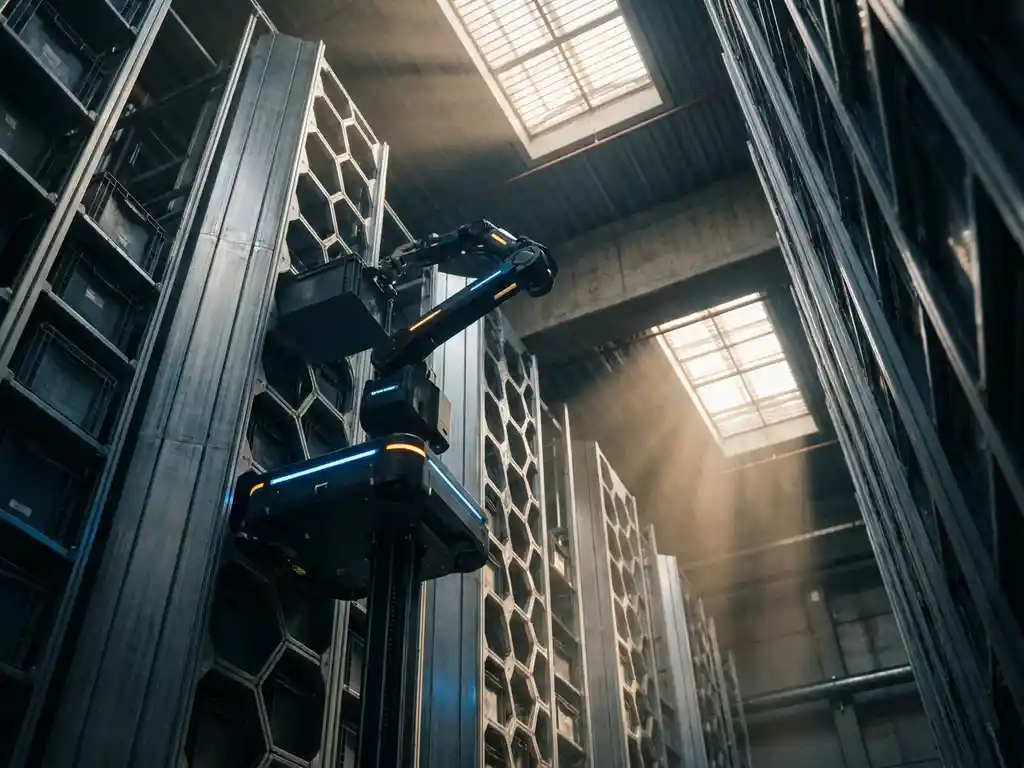
The Hexxabotics control system applies this coordination logic across its fleet of autonomous Hexxabots, managing horizontal navigation beneath the storage grid and vertical climbing within towers to execute deposit and retrieval in one continuous motion. Because every storage location is directly accessible without reshuffling, the AI can sequence tasks purely on efficiency rather than working around blocked positions.
What are the integration requirements for AI inventory optimization systems?
AI inventory optimization systems require integration with the warehouse management system (WMS), the warehouse control system (WCS) or robot fleet controller, and ideally upstream data sources such as the ERP and order management system. The most common integration method is API-based connectivity using standardized data exchange formats, which allows the AI layer to consume live order, inventory, and movement data without requiring a full system replacement.
The data quality requirements are equally important as the technical connections. AI models produce accurate outputs only when the input data is consistent and complete. Warehouses with fragmented scanning coverage, inconsistent SKU master data, or unreliable receiving records will see degraded AI performance regardless of the sophistication of the model. Addressing data hygiene before or during AI deployment is a prerequisite, not an afterthought.
From an infrastructure perspective, AI inventory systems do not typically require significant hardware investment beyond what a modern automated warehouse already operates. The AI logic runs at the software layer, coordinating with existing robotic systems through standard control interfaces. Scalability is managed by expanding the robot fleet or storage structure rather than rebuilding the integration architecture, a critical consideration for operations that expect to grow throughput or capacity over time.
How Hexxabotics helps with AI warehouse inventory optimization
Hexxabotics delivers a robotic AS/RS architecture designed to work in direct alignment with AI inventory optimization logic. The system provides the physical infrastructure that makes AI coordination effective at scale:
- 100% direct access: Every storage location is immediately accessible without digging or reshuffling, so AI retrieval sequencing can optimize purely for speed rather than working around blocked positions.
- Independent scalability: Storage capacity and throughput scale separately, add towers to expand locations, add Hexxabots to increase picks per hour, without redesigning the AI integration layer.
- Distributed resilience: No centralized cranes or single points of failure mean AI coordination maintains stable throughput even when individual units are offline for charging or maintenance.
- Standard API integration: The Hexxabotics Control System connects to external WMS and ERP platforms through standard interfaces, reducing the integration effort required to activate AI inventory logic.
- No in-rack electrification: The passive rack structure simplifies the physical environment that AI systems must model and coordinate within, reducing failure points and maintenance overhead.
If you are evaluating how warehouse automation infrastructure can support your AI inventory strategy, contact Hexxabotics to discuss how the system fits your operational requirements.
Related Articles
- How does automated slotting optimization reduce travel time in warehouses?
- How do AGVs navigate safely around warehouse workers?
- Why are fulfillment centers moving toward fully automated operations?
- Why is multi-agent robot coordination important in fulfillment centers?
- What is a dark warehouse and how does it operate?