
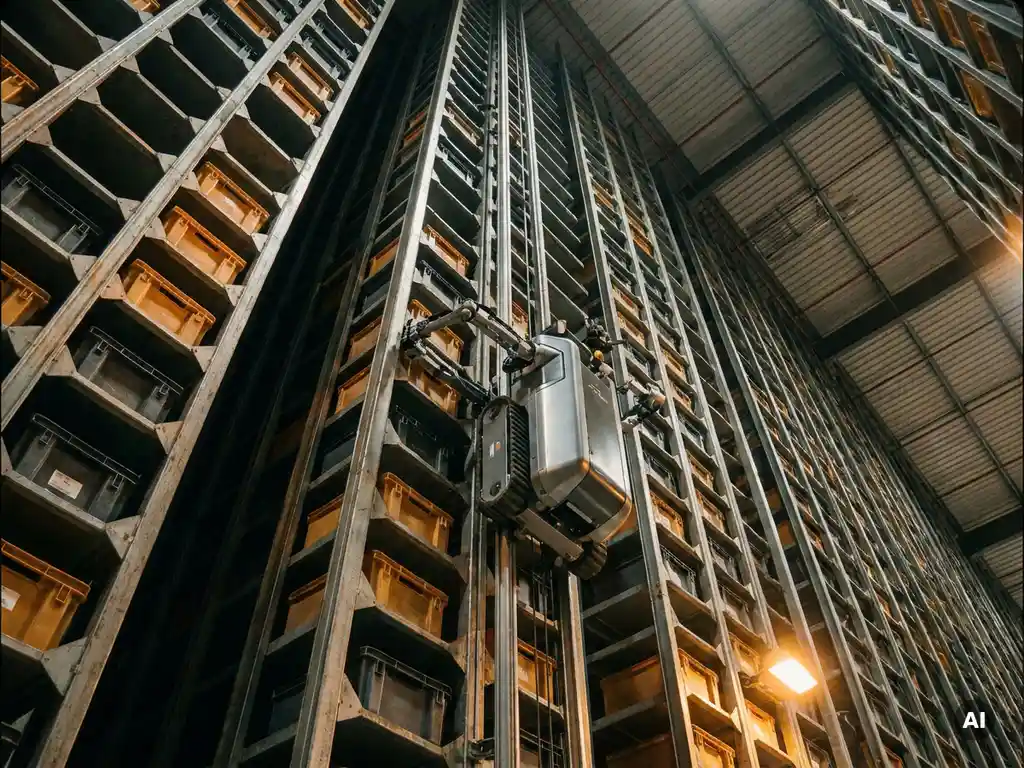
Free-roaming robots improve warehouse storage density by eliminating the fixed infrastructure constraints that limit how much vertical and horizontal space a facility can actually use. Unlike traditional systems where the machinery dictates the layout, free-roaming autonomous robots navigate independently, allowing the storage structure itself to be optimized purely for density rather than for mechanical access paths. The sections below unpack the key questions engineers and operations teams ask when evaluating this technology.
What makes free-roaming robots different from fixed-path AS/RS systems?
Free-roaming robots are autonomous units that navigate a storage grid without being bound to a single fixed rail, crane, or conveyor path. In a traditional fixed-path AS/RS, the retrieval machine defines what can be stored and where, because every location must fall within its physical reach. Free-roaming robots decouple movement from structure, meaning the grid can be designed around storage geometry rather than around machinery travel paths.
In conventional systems such as mini-load cranes or shuttle AS/RS, each aisle or lane typically requires dedicated hardware. When that hardware reaches capacity or fails, the entire zone it serves is affected. Free-roaming robots operate as independent agents within a shared architecture. Multiple units work simultaneously across the same grid, and if one unit goes offline, the others continue without interruption. This distributed model removes the single points of failure that make fixed-path systems vulnerable during peak demand.
The practical engineering difference is significant. Fixed-path systems require embedded motors, rails, and electrified rack infrastructure. Free-roaming robotic systems, by contrast, can use a passive structural grid with no in-rack electrification. The robots carry their own power and intelligence, which reduces structural complexity, lowers installation costs, and makes the system far easier to reconfigure or relocate when operational needs change.
How do free-roaming robots use vertical space to increase storage density?
Free-roaming robots increase warehouse storage density by climbing vertically inside storage towers, converting the full building height into directly accessible inventory locations. Rather than relying on a centralized crane that grows heavier and more mechanically complex as it rises, individual robots travel up and down the structure independently, reaching any location at any height without adding fixed infrastructure per level.
The geometry of the storage structure plays a critical role here. A hexagonal tower architecture, for example, achieves significantly higher space utilization than a cubic grid because the geometry minimizes dead space between locations. Where a standard cubic arrangement uses roughly 74% of available volume, a hexagonal structure can push that figure toward 94%, according to Hexxabotics’s engineering analysis. That difference translates directly into more storage positions within the same building footprint.
Vertical density also benefits from the absence of embedded lifting systems in the rack itself. Because the robots perform all vertical movement, the towers remain passive steel structures with no motors, cabling, or electrified components at height. This keeps the structural weight lower than traditional high-bay systems and simplifies fire safety integration, both of which become meaningful cost and compliance factors as buildings approach 10 to 16 meters in usable height.
Why does direct-access retrieval matter for warehouse throughput?
Direct-access retrieval means every storage location can be reached without moving other totes out of the way first. This eliminates the reshuffling cycles that slow down cube storage and dense grid systems, where retrieving a buried item requires relocating multiple other units before the target tote can be extracted. In high-SKU environments, reshuffling accumulates quickly and becomes a major throughput bottleneck.
The throughput impact is both immediate and compounding. In a direct-access system, a robot travels to a location, completes a deposit-and-retrieve cycle in a single vertical interaction, and returns without empty trips or repositioning delays. Each robot cycle is productive. In systems that require digging, a significant share of robot cycles are spent on housekeeping rather than fulfillment, which means more hardware is needed to achieve the same output.
For operations running e-commerce picking, pharmaceutical fulfillment, or any workflow with high order frequency and diverse SKU profiles, direct access is not a convenience feature. It is the mechanism that makes consistent pick rates achievable across the full inventory depth, not just the most accessible front layer. Throughput figures in the range of 200 to 8,000 picks per hour become realistic precisely because every location is equally accessible regardless of where it sits in the grid.
How can warehouses scale capacity and throughput independently?
Warehouses can scale storage capacity and throughput independently when the system architecture separates the two functions. In a free-roaming robot AS/RS, storage capacity is a function of the physical grid structure, while throughput is a function of how many autonomous robots operate within that grid. Extending the structure adds locations; adding robots increases pick rate. Neither change requires the other.
This independence is a meaningful departure from traditional AS/RS design. In crane-based or shuttle systems, storage and throughput are tightly coupled. Adding capacity often means adding aisles, which means adding cranes or shuttles, which means rebuilding infrastructure. The cost and disruption of that process make many facilities reluctant to scale incrementally, so they either over-invest upfront or operate under-resourced as demand grows.
Scaling storage capacity
Storage capacity grows by extending the hexagonal tower structure horizontally or vertically. Because the architecture uses a consistent modular geometry, new towers connect to the existing grid without engineering redesign. Critically, this expansion can happen during regular operations. There is no requirement to shut down the system while new sections are added, which protects throughput continuity during growth phases.
Scaling throughput performance
Throughput scales by deploying additional autonomous robots into the existing grid. Each robot added operates in parallel with the others, and performance grows roughly linearly with unit count because there is no centralized crane or conveyor creating a bottleneck. The control system manages coordination and routing across all active units simultaneously, maintaining efficiency as the fleet expands.
What types of warehouse operations benefit most from free-roaming robot systems?
Warehouse operations that combine high SKU counts, variable throughput demand, and constrained floor space benefit most from free-roaming robotic storage systems. These conditions make the limitations of fixed-path AS/RS most visible and make the advantages of distributed, direct-access automation most impactful.
E-commerce fulfillment is a strong fit because order profiles are highly diverse, pick frequencies fluctuate sharply between peak and off-peak periods, and storage footprint is often limited by real estate cost. A system that scales throughput by adding robots rather than rebuilding infrastructure handles seasonal peaks without permanent over-investment in hardware.
Retail replenishment and 3PL logistics operations benefit for similar reasons. SKU ranges are wide, product mix changes regularly, and the ability to reconfigure or even relocate the storage system without major engineering effort preserves operational flexibility as client contracts and product categories evolve.
Spare parts storage and pharmaceutical fulfillment represent another high-value application category. Both require reliable access to a large number of low-velocity SKUs, where a system that buries infrequently picked items behind more active inventory would generate constant reshuffling overhead. Direct access to every location regardless of pick frequency makes these inventory profiles manageable without throughput penalties.
Fashion and apparel, food and grocery, and FMCG operations share the characteristic of needing dense storage for a broad product range while managing promotional spikes and seasonal demand shifts. In each case, the ability to expand capacity and throughput independently without stopping operations is a practical advantage that fixed-path systems struggle to match.
How Hexxabotics helps with warehouse storage density
Hexxabotics delivers a next-generation AS/RS built specifically to solve the density, flexibility, and scalability challenges described throughout this article. The system combines three core elements: hexagonal high-density towers, autonomous Hexxabots, and standardized totes, all managed by an intelligent control system that integrates with existing warehouse management platforms via standard APIs.
- Maximum cubic volume utilization up to 16 meters in height, with every location directly accessible and no reshuffling required
- No in-rack electrification, reducing infrastructure complexity, energy consumption, and maintenance overhead
- Independent scaling of storage capacity and throughput, expandable during live operations without structural redesign
- Distributed robot operation that eliminates single points of failure and maintains stable throughput even during peak demand
- Broad application fit across e-commerce, retail, 3PL, pharma, food and grocery, fashion, FMCG, and spare parts environments
If you are evaluating warehouse automation robots that can grow with your operation without locking you into fixed infrastructure, or want to understand how the hexagonal architecture performs against your specific storage density requirements, learn more about Hexxabotics and get in touch with the team to discuss your use case.
Related Articles
- What are the benefits of autonomous mobile robots in warehousing?
- Can warehouse automation lower your energy consumption?
- How does a hexagonal grid system change warehouse logistics?
- How do 3PL providers choose between leasing and buying automation equipment?
- What is the difference between an AMR and an AGV in warehousing?