
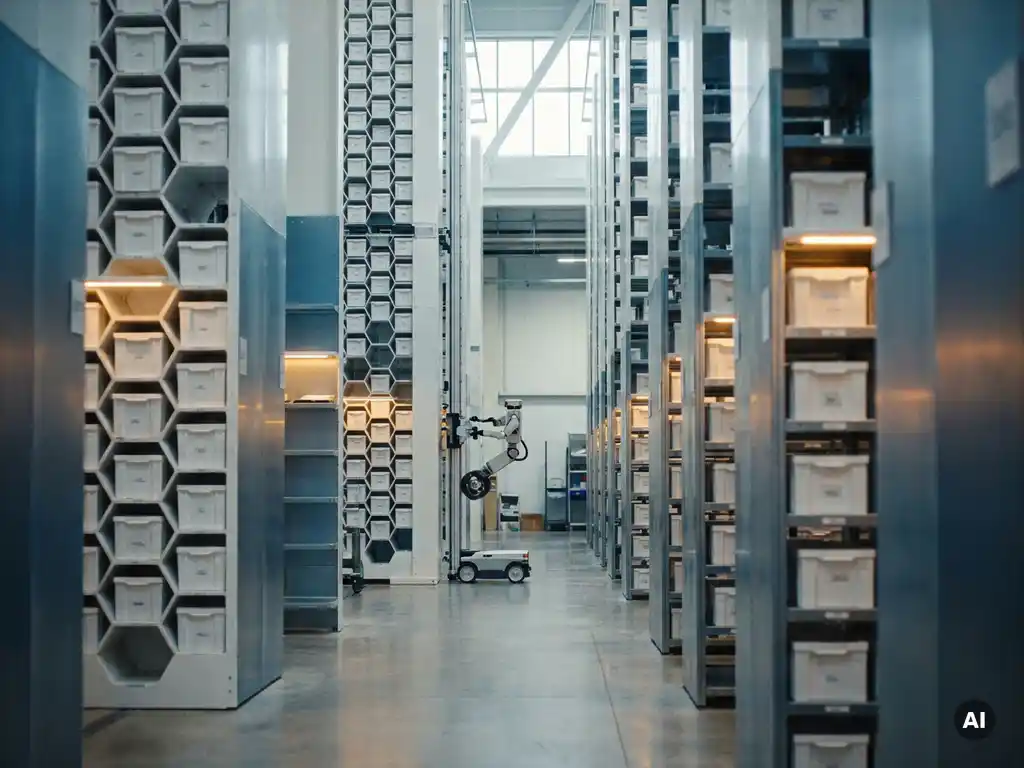
Choosing the right racking system for pharmaceutical warehousing means matching storage infrastructure to your product mix, regulatory obligations, and operational requirements. The correct answer depends on factors including SKU velocity, temperature sensitivity, GMP compliance requirements, and whether your operation benefits more from manual flexibility or automated throughput. This article works through the key questions engineers and operations managers face when evaluating pharmaceutical warehouse storage options.
What storage conditions must pharmaceutical racking systems support?
Pharmaceutical racking systems must support controlled temperature zones, humidity management, segregation of product categories, and clean, accessible storage that enables traceability. The specific conditions vary by product type, but every pharmaceutical storage environment must maintain conditions that preserve product integrity and satisfy regulatory requirements throughout the storage period.
Temperature is the most commonly cited requirement. Ambient pharmaceutical products typically require storage between 15°C and 25°C, while cold chain products demand refrigerated or frozen environments. The racking structure itself must be compatible with these conditions, meaning materials, coatings, and mechanical components must perform reliably across the relevant temperature range without degrading, corroding, or creating contamination risk.
Beyond temperature, pharmaceutical warehouse storage must support:
- Controlled humidity to prevent moisture damage to packaging and product
- Segregation of different product categories, including controlled substances, hazardous materials, and quarantine stock
- Clean surfaces that can be inspected and cleaned without dismantling the structure
- Lighting adequate for picking, inspection, and labeling tasks
- Pest exclusion compatibility, meaning the structure should not create inaccessible harboring points
- Support for batch and lot identification, so every stored unit can be associated with its traceability record
Cold storage racking introduces additional structural considerations. Steel components expand and contract with temperature cycling, so cold storage racking must be engineered for dimensional stability. Coatings must resist condensation and the repeated thermal shock that occurs when cold zones are accessed. Where cold storage racking is used in automated systems, mechanical interfaces between robots and the storage structure must also function reliably at low temperatures.
What are the main types of racking systems used in pharmaceutical warehouses?
The main racking systems used in pharmaceutical warehouses are selective pallet racking, drive-in or push-back racking, mobile shelving, carton flow racking, and automated storage and retrieval systems (AS/RS). Each serves a different balance of storage density, accessibility, and throughput, and most pharmaceutical operations combine more than one type to match their product mix.
Selective pallet racking
Selective pallet racking is the most widely deployed type in pharmaceutical warehousing. Every pallet location is directly accessible from an aisle, which supports FEFO (first expiry, first out) rotation and makes batch traceability straightforward. The trade-off is that aisles consume a significant proportion of floor space, limiting storage density. For pharmaceutical operations with large SKU counts and strict lot control requirements, the direct accessibility of selective racking is operationally important even when it sacrifices cubic efficiency.
Dense and automated storage
Drive-in racking, push-back racking, and pallet flow systems increase density by reducing aisle count, but they introduce depth-based storage that complicates individual lot access. This makes them less suitable for pharmaceutical operations where every batch must be independently retrievable. Automated storage and retrieval systems address this by combining high density with direct, software-controlled access to individual totes or pallets. Mobile shelving achieves density gains without full automation but requires careful integration with picking workflows. Carton flow racking supports gravity-fed FEFO rotation for smaller pharmaceutical cartons and is commonly used alongside faster-moving product lines.
How does GMP compliance affect racking system selection?
GMP compliance directly affects racking system selection by requiring that storage infrastructure supports product segregation, traceability, cleanability, and documented inventory control. A racking system that cannot support these requirements creates compliance risk regardless of its cost or storage efficiency, making regulatory fit a primary selection criterion rather than a secondary consideration.
Good Manufacturing Practice and Good Distribution Practice (GDP) guidelines set out expectations for pharmaceutical storage environments. These include the requirement that products are stored in conditions that prevent mix-ups, contamination, and unauthorized access. Racking systems must therefore be designed so that different product categories, quarantine stock, and controlled substances can be physically or procedurally segregated.
GMP-compliant racking also needs to support inventory management practices that satisfy regulatory expectations. This means the system must be compatible with batch tracking, expiry date management, and FEFO rotation. In manual environments, this is typically achieved through labeling and warehouse management system discipline. In automated environments, the storage and retrieval system must be capable of retrieving inventory according to batch or expiry criteria rather than simply the nearest available unit.
Cleanability is a further GMP-driven requirement. Racking structures in pharmaceutical warehouses should have smooth surfaces, minimal horizontal ledges where dust accumulates, and designs that allow inspection without dismantling. Open-frame steel structures generally perform better in this regard than enclosed systems with internal cavities. Where automated systems are used, the ability to access and clean the storage environment without taking the entire system offline is an operational consideration worth evaluating during procurement.
When does automated storage and retrieval make sense for pharma warehousing?
Automated storage and retrieval makes sense for pharmaceutical warehousing when SKU counts are high, labor costs or availability are a constraint, storage space is limited, and the operation requires consistent, traceable inventory control at scale. AS/RS pharmaceutical applications are particularly well suited to distributors and wholesalers managing thousands of SKUs with variable demand patterns across a mixed assortment.
The business case for AS/RS in pharmaceutical warehousing typically rests on several converging pressures. Warehouse capacity runs out as SKU portfolios grow. Aisles in conventional racking consume floor space that could hold inventory. Labor is increasingly difficult to recruit and retain for repetitive picking tasks. And accuracy requirements in pharmaceutical distribution leave little tolerance for pick errors or traceability gaps.
Not every SKU in a pharmaceutical operation belongs in an AS/RS. High-frequency products ordered continuously in large quantities may be better served by dedicated high-speed dispensing technology. The strongest AS/RS pharmaceutical use case is for medium-velocity, slower-moving, and long-tail inventory, where the combination of dense storage and direct automated retrieval produces the greatest operational benefit. Products with variable demand, complex lot structures, or irregular order patterns are particularly well suited to a direct-access robotic storage system because every tote is retrievable without disturbing surrounding inventory.
Independent scalability is another factor that makes AS/RS attractive for pharmaceutical distribution. Assortment growth and transaction volume growth do not always occur together. A distributor may add many new SKUs without a proportional increase in daily order lines, or transaction volumes may rise while the product count remains stable. A system designed so that storage capacity and throughput capacity can be scaled independently allows the operation to respond to each form of growth without oversizing the other dimension.
What’s the difference between fixed and modular racking structures in pharma?
Fixed racking structures are installed as a permanent layout that is difficult to reconfigure without significant disruption, while modular racking structures are designed to be extended, reconfigured, or relocated as operational requirements change. For pharmaceutical warehousing, modularity reduces long-term infrastructure risk as assortments, regulations, and facility constraints evolve.
Fixed racking systems typically offer lower initial cost and are appropriate where the product mix, storage volumes, and facility layout are stable and well understood. However, pharmaceutical operations rarely remain static. SKU portfolios grow, product categories change, cold chain requirements expand, and regulatory expectations evolve. A fixed infrastructure that cannot accommodate these changes without a full redesign can become a constraint on operational agility.
Modular racking and automated storage structures address this by treating the installation as a scalable platform rather than a one-time build. Extensions can be added to increase capacity without replacing the existing structure. In automated systems, throughput can be increased by adding robots rather than rebuilding mechanical infrastructure. This separation of capacity growth from throughput growth is particularly relevant in pharmaceutical distribution, where the two dimensions of growth frequently diverge.
From a compliance perspective, modular structures also offer practical advantages. When a pharmaceutical operation needs to reconfigure storage zones to meet new segregation requirements, or to add a temperature-controlled section, a modular architecture makes that change more manageable than a fully fixed installation. The ability to adapt the physical layout without a complete shutdown reduces the operational risk associated with regulatory changes or portfolio shifts.
Which racking features reduce pharmaceutical warehouse maintenance costs?
Racking features that reduce pharmaceutical warehouse maintenance costs include smooth, corrosion-resistant surface finishes, open-frame designs that simplify inspection and cleaning, standardized components that reduce spare parts complexity, and in automated systems, infrastructure that does not require electrification within the rack structure itself.
Surface finish is a significant maintenance factor. Powder-coated or galvanized steel resists corrosion in environments where cleaning chemicals are regularly used, reducing the frequency of repainting or component replacement. Horizontal surfaces that accumulate dust require more frequent cleaning and inspection. Racking profiles with minimal horizontal ledges reduce cleaning labor and the risk of contamination accumulating undetected.
Standardized components reduce maintenance cost by simplifying the spare parts inventory. When a single beam or upright profile is used consistently across a large installation, replacement parts are interchangeable and stocking requirements are predictable. Custom or proprietary components, by contrast, can create long lead times and higher per-unit costs when replacements are needed.
In automated storage environments, the maintenance profile of the rack structure itself is shaped by whether electrification is required within it. Systems that route power cabling, data connections, or charging infrastructure through the rack structure introduce additional maintenance touchpoints within the storage zone. Architectures where robots carry their own power and charge autonomously during operation eliminate this layer of rack-embedded infrastructure, simplifying both routine maintenance and fault diagnosis.
Accessibility for inspection is the final dimension. GMP environments require documented inspection of storage areas, and racking that creates inaccessible zones complicates this process. Open structures with clear sight lines, sufficient aisle width for inspection equipment, and designs that allow cleaning without dismantling reduce the labor required to maintain compliance documentation and keep maintenance costs predictable over time.
How Hexxabotics supports pharmaceutical warehouse storage and compliance
Hexxabotics provides a high-density, direct-access AS/RS designed for pharmaceutical operations where traceability, regulatory compliance, and storage efficiency must work together rather than compete.
- Direct tote access: Every storage location is individually retrievable without moving surrounding inventory, supporting batch control, FEFO logic, and lot-level traceability requirements.
- No electrification in the rack structure: Robots operate autonomously and charge during operation, reducing maintenance complexity within the storage zone and simplifying compliance inspections.
- Independent capacity and throughput scaling: Storage capacity grows by extending the structure; throughput grows by adding robots. These two dimensions scale independently, matching the growth patterns common in pharmaceutical distribution.
- Cubic space utilization: The hexagonal vertical structure uses full building height up to 16 meters, fitting more pharmaceutical inventory into an existing facility footprint.
- WMS and WES integration: Standard APIs connect the system to existing warehouse management and execution systems, supporting orchestrated order flow across mixed automation environments.
For pharmaceutical wholesalers, distributors, and healthcare logistics providers evaluating their pharmaceutical storage options, Hexxabotics offers a system built around the operational realities of regulated pharmaceutical distribution. Contact the Hexxabotics team to discuss how the architecture fits your specific assortment, compliance requirements, and facility constraints.
Related Articles
- What are the data integrity requirements for pharmaceutical warehouse systems?
- How do you select a pharmaceutical warehousing partner for compliance-critical products?
- How do you validate a temperature-mapping study in a pharmaceutical warehouse?
- What is a GMP-compliant warehouse and how is it certified?
- How do you implement track-and-trace in an existing warehouse system?