
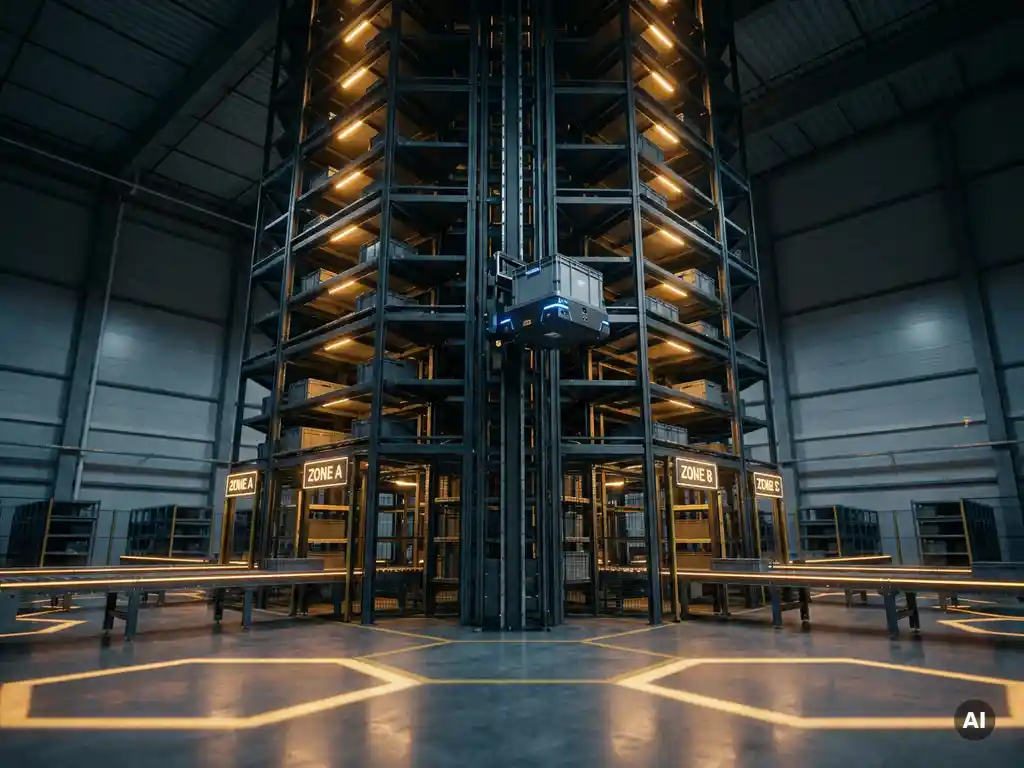
Warehouse automation supports omnichannel fulfillment strategies by centralizing inventory in a single, high-density storage system that can serve multiple sales channels simultaneously, from direct-to-consumer e-commerce orders to retail replenishment and B2B shipments. The core advantage is speed and accuracy: automated systems retrieve the right product for the right channel without manual intervention, reducing pick times and error rates across every fulfillment stream. The sections below break down the specific challenges, mechanisms, and scaling considerations that determine how well automation performs in a true omnichannel environment.
What fulfillment challenges make omnichannel operations difficult to scale?
Omnichannel fulfillment is difficult to scale because it requires a single warehouse to serve fundamentally different order profiles at the same time. A retail replenishment order ships full cases to a store. A direct-to-consumer order ships one or two items to a home address. A marketplace order may require custom packaging and same-day dispatch. Managing these simultaneously with manual or semi-automated infrastructure creates congestion, errors, and bottlenecks.
The underlying problem is that traditional warehouse layouts are designed around one primary fulfillment mode. When a second or third channel is added, the physical workflow has to accommodate demand patterns it was never built to handle. Storage locations optimized for case-pick replenishment are poorly suited for single-item e-commerce picking. Inventory visibility suffers when stock is split across zones. Labor requirements spike unpredictably during peak periods for any one channel.
Scaling compounds these issues. Adding more channels means more SKUs, more order types, and more pressure on the same storage footprint. Without a system that can handle parallel workstreams independently, throughput for each channel competes against the others. The result is a fulfillment operation that slows down precisely when demand from multiple channels peaks at the same time, which in omnichannel retail is not an exception but a regular occurrence.
How does warehouse automation handle multiple fulfillment channels simultaneously?
Warehouse automation handles multiple fulfillment channels simultaneously by decoupling order processing from physical storage access. Automated storage and retrieval systems manage inventory in a single, unified pool and route retrieval tasks based on order priority and channel requirements, without requiring separate physical zones or dedicated labor for each channel. This means a single system can process an e-commerce order, a store replenishment batch, and a 3PL shipment in parallel.
The key mechanism is intelligent task sequencing. The warehouse control system assigns retrieval tasks to available robots based on order urgency, destination, and batch logic. Because every storage location is directly accessible, the system does not need to clear one order type before starting another. Robots operate in parallel across the storage grid, each completing its own retrieval cycle independently.
This distributed approach eliminates the single-point-of-failure problem that affects conveyor-heavy or crane-dependent systems. If one robot is occupied with a high-priority e-commerce order, others continue processing retail replenishment batches. Throughput across channels remains stable rather than collapsing into a queue when demand spikes on one channel. For omnichannel operations where order urgency varies significantly by channel, this parallel processing capability is a direct operational advantage.
What role does storage density play in omnichannel fulfillment performance?
Storage density plays a critical role in omnichannel fulfillment performance because a broader SKU range is the direct consequence of serving multiple channels. Each channel may require different product variants, pack sizes, or configurations. Without sufficient storage density, an omnichannel warehouse either runs out of space for the full SKU range or spreads inventory across multiple facilities, increasing transfer costs and split-shipment rates.
High storage density allows a single facility to hold the complete inventory needed to serve all channels from one location. This consolidation reduces the complexity of inventory management, shortens pick paths, and eliminates the need to coordinate stock across sites before fulfilling an order. When inventory is unified, the system always knows where every unit is, which is the foundation of accurate, fast omnichannel order fulfillment.
Vertical storage utilization is one of the most effective ways to increase density without expanding a building’s footprint. Systems that use the full cubic volume of a facility, rather than just floor-level racking, can hold significantly more SKUs within the same square footage. This matters especially for omnichannel operations that are scaling SKU counts alongside channel counts, since both grow simultaneously and both consume storage space.
How does warehouse automation integrate with omnichannel order management systems?
Warehouse automation integrates with omnichannel order management systems through standard APIs that connect the warehouse control system to external platforms such as order management systems, warehouse management systems, and e-commerce backends. This integration allows the automation system to receive order data in real time, prioritize tasks by channel or service level, and return inventory and fulfillment status updates without manual data entry.
The practical effect of this integration is that the automation layer becomes channel-agnostic. It does not need to know whether an order came from a webstore, a retail partner, or a marketplace. It receives a task, retrieves the correct tote, delivers it to the appropriate goods-to-person workstation, and updates inventory. The order management system handles the channel logic; the automation system handles the physical execution.
For omnichannel operations, this separation of concerns is important. It means that adding a new sales channel does not require reconfiguring the automation hardware. The new channel connects at the software layer, and the physical system responds to the resulting order tasks the same way it responds to any other. This reduces the integration overhead that typically makes omnichannel expansion slow and expensive.
Which types of warehouses benefit most from automation for omnichannel fulfillment?
Warehouses that benefit most from automation for omnichannel fulfillment are those managing high SKU counts, variable order profiles, and demand that fluctuates significantly by channel or season. This includes e-commerce fulfillment centers handling single-item picks alongside retail replenishment, 3PL providers serving multiple clients with different fulfillment requirements, and distribution centers for sectors like fashion, FMCG, and consumer electronics where product variety is high and order urgency varies.
Facilities with constrained floor space gain a particular advantage from high-density automated storage. Urban fulfillment centers, for example, often operate in buildings where expanding the footprint is not possible. Automation that uses vertical space efficiently allows these facilities to hold more inventory and serve more channels than manual racking systems would permit in the same building envelope.
Operations with unpredictable peak demand also benefit strongly. Omnichannel retail creates multiple overlapping demand peaks: promotional events, seasonal spikes, and channel-specific surges can all occur within the same period. Automated systems with distributed robotic throughput maintain stable performance during these peaks without requiring proportional increases in labor, which is often unavailable at short notice and expensive when it is.
How do you scale warehouse automation as omnichannel volume grows?
Scaling warehouse automation for growing omnichannel volume requires a system architecture that separates storage capacity from throughput performance. These are two distinct variables in omnichannel growth: a business may need more storage as it adds SKUs or channels, more throughput as order volumes increase, or both. Systems that tie these two dimensions together force costly infrastructure changes whenever either one needs to grow.
The most practical scaling approach adds capacity and throughput independently as demand requires. Storage capacity grows by extending the physical structure, adding towers or locations within the existing footprint. Throughput grows by adding autonomous robotic units that operate in parallel within the same grid. Neither change requires redesigning the core infrastructure or stopping operations to implement.
This independent scalability is especially valuable for omnichannel businesses because their growth is rarely linear or predictable. A new retail partnership may require a sudden increase in storage for that partner’s SKUs. A successful marketing campaign may spike e-commerce order volumes for a short period. A system that can respond to each of these pressures independently, and do so without major capital expenditure or operational downtime, gives omnichannel operators the flexibility to grow at the pace their business demands rather than the pace their infrastructure allows.
How Hexxabotics helps with omnichannel fulfillment
Hexxabotics is a next-generation automated storage and retrieval system built specifically to address the density, throughput, and scalability demands that omnichannel fulfillment creates. The system is designed to serve operations that need to handle multiple order types simultaneously without compromising speed or accuracy for any channel.
- High-density hexagonal storage: The hexagonal tower structure converts the full cubic volume of a facility into usable storage, reaching up to 16 meters in height, allowing a single site to hold the broad SKU range omnichannel operations require.
- 100% direct access: Every storage location is directly accessible with no digging or reshuffling, so retrieval times remain consistent regardless of where a product is stored or which channel needs it.
- Independent capacity and throughput scaling: Storage capacity grows by adding towers; throughput grows by adding Hexxabots. Neither requires structural redesign, so scaling keeps pace with omnichannel growth without major capital disruption.
- No in-rack electrification: The passive rack structure eliminates embedded motors and cabling, reducing failure points and simplifying maintenance across a distributed, multi-channel operation.
- Standard API integration: The Hexxabotics Control System connects to existing warehouse management and order management platforms, making channel-agnostic fulfillment straightforward to implement.
If your operation is scaling across channels and your current storage and retrieval infrastructure is limiting your ability to keep up, contact Hexxabotics to explore how the system fits your fulfillment environment.
Related Articles
- What are the long-term operational costs of warehouse automation?
- Can warehouse automation lower your energy consumption?
- How does predictive maintenance prevent downtime in automated warehouses?
- What is the difference between an AMR and an AGV in warehousing?
- Should you choose an AMR system or a fixed-rail AS/RS in 2026?