
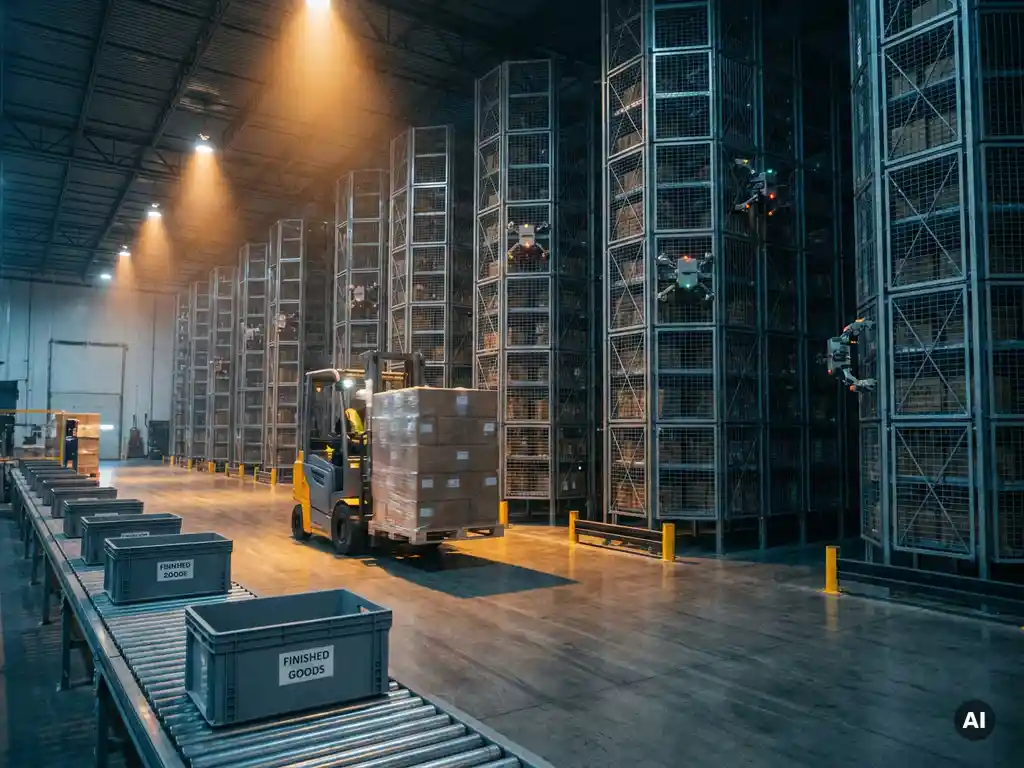
A push flow model sends inventory into the warehouse based on forecasted demand, staging goods before orders arrive. A pull flow model does the opposite: inventory moves only when a real customer order triggers it. The distinction shapes everything from how much stock you hold to how your picking and replenishment processes are designed. The sections below work through the mechanics, trade-offs, and practical implications of each model, including how modern automation is reshaping the decision.
How does each flow model move inventory through a warehouse?
In a push flow model, inventory moves forward through the warehouse based on a forecast. Goods arrive, are sorted, and are pre-positioned in pick locations or staging areas before any order exists. In a pull flow model, inventory moves only in response to a confirmed order or consumption signal. Nothing is staged until demand is real and visible.
The practical difference shows up immediately in how space and labor are allocated. A push warehouse holds buffer stock throughout the operation, so pick locations are pre-loaded and pickers can work continuously without waiting for replenishment. A pull warehouse holds less inventory in active positions, but relies on fast, accurate replenishment from reserve storage the moment an order is placed.
Both models can coexist within a single facility. Many operations use push logic for high-velocity products that are ordered predictably every day, and pull logic for slower-moving or more variable SKUs where holding pre-positioned stock would tie up space without a reliable return.
What are the main advantages and disadvantages of push flow?
Push flow excels when demand is predictable and product velocity is high. Pre-positioning inventory means pickers always have stock at hand, which supports high throughput during peak periods and simplifies labor scheduling. The model works well when lead times from suppliers are long and holding buffer stock is the only reliable way to guarantee service levels.
The disadvantages of push flow in warehouse design are equally significant:
- Overstock risk rises when forecasts are wrong, tying up working capital and consuming floor space
- SKU proliferation makes accurate forecasting harder, so the model degrades as assortment complexity grows
- Seasonal or promotional spikes can leave the warehouse holding excess inventory after demand drops
- Pre-positioned stock in pick lanes consumes active pick space that could otherwise hold more SKUs
- Replenishment cycles can create waves of labor demand that are difficult to smooth
Push flow is fundamentally a bet on forecast accuracy. When forecasts are reliable, the model delivers efficiency. When they are not, the costs accumulate quickly in the form of misallocated space, slow-moving stock, and reactive replenishment effort.
What are the main advantages and disadvantages of pull flow?
Pull flow reduces inventory risk by moving goods only when real demand exists. Because stock is not pre-positioned speculatively, the warehouse holds less working inventory in active locations, which can free up significant floor space and reduce carrying costs. The model also responds more accurately to demand variation, because each movement is triggered by an actual order rather than a forecast.
The disadvantages of pull flow are rooted in its dependency on fast, reliable retrieval:
- Response time becomes critical: if retrieval from reserve storage is slow, order cycle times suffer
- Replenishment systems must be highly responsive, which places greater demands on both technology and process design
- During demand spikes, the absence of pre-positioned buffer stock can create bottlenecks at the retrieval stage
- Pull logic works less well for products with very long internal travel distances or slow retrieval systems
The pull model rewards operations that have invested in fast, direct-access storage and retrieval. When retrieval is slow or unreliable, the model’s theoretical inventory advantages are offset by service-level problems.
Which warehouse operations are best suited to each model?
Push flow suits operations with stable, high-volume demand and a manageable SKU count. Pull flow suits operations with wide assortments, unpredictable demand, or a high proportion of slow-moving inventory. Most real-world warehouses benefit from applying both models to different parts of their inventory rather than committing to one approach across the board.
Operations that fit push flow well
Fast-moving consumer goods distribution, large-scale grocery fulfillment, and manufacturing supply operations often favor push logic for their core lines. These environments deal in products ordered repeatedly in predictable quantities, where pre-positioning stock directly reduces the time between order receipt and dispatch. Retail replenishment operations supplying stores on fixed schedules are a classic push environment: the delivery schedule is known, so inventory can be staged in advance without significant overstock risk.
Operations that fit pull flow well
E-commerce fulfillment, pharmaceutical distribution, spare parts operations, and third-party logistics providers managing diverse customer portfolios tend to favor pull logic, particularly for their long-tail and variable SKUs. These environments manage thousands or tens of thousands of SKUs with highly variable order frequencies. Pre-positioning stock for every SKU is neither practical nor economical, so inventory is held in dense reserve storage and retrieved only when a confirmed order requires it.
How does automation change the push vs. pull decision?
Automation reduces the retrieval latency that historically made pull flow operationally difficult. When a warehouse relies on manual picking from reserve storage, pull flow is constrained by how quickly a picker can travel to a location and return. Automated storage and retrieval systems eliminate that travel time, making pull flow viable at throughput levels that would have required push logic in a manual operation.
The implications for warehouse flow strategy are significant. A dense, direct-access AS/RS can retrieve a tote and present it at a Goods-to-Person workstation in seconds, removing the speed disadvantage that previously favored push pre-positioning. This shifts the calculus: pull flow becomes operationally competitive for a much wider range of SKUs, including mid-velocity products that would previously have been pre-staged as a practical necessity.
Automation also changes how capacity and throughput interact with flow model design. In a manual warehouse, increasing throughput during peaks usually means adding labor and pre-positioning more stock, which pushes the operation toward push logic. In an automated warehouse designed with independent scaling, storage capacity and retrieval throughput can be adjusted separately, which gives operations more flexibility to sustain pull logic even during demand spikes.
The result is that the push vs. pull boundary in warehouse design is no longer fixed by operational constraints in the same way it once was. Automation does not eliminate the decision, but it expands the range of SKUs and demand profiles for which pull flow is the more efficient and lower-risk choice.
How Hexxabotics supports warehouse material flow strategy
Hexxabotics is built around the operational logic that makes pull flow viable at scale. The system addresses the retrieval speed and storage density challenges that traditionally pushed operations toward pre-positioning inventory they could not afford to stage efficiently.
- Direct access to every tote: No digging, no reshuffling. Every storage location is independently accessible, so retrieval is fast regardless of where in the structure a tote sits
- Cubic storage density up to 16 meters: The hexagonal vertical grid uses the full building height, holding more SKUs in a smaller footprint without sacrificing accessibility
- Independent scaling of capacity and throughput: Storage grows by extending the structure; throughput grows by adding robots. The two dimensions do not constrain each other
- No in-rack electrification: Robots operate autonomously and charge while in operation, reducing infrastructure complexity and simplifying maintenance
- Standard API integration: The system connects to existing warehouse management systems, fitting into the broader warehouse automation architecture without requiring a full infrastructure redesign
Whether your operation needs to increase storage density, support a pull-based fulfillment model, or separate capacity growth from throughput investment, Hexxabotics provides the architecture to do it. Learn more about Hexxabotics and how the system can be configured to match your warehouse flow strategy.
Related Articles
- What are the consequences of failing a pharmaceutical warehouse audit?
- How does batch traceability work in pharmaceutical warehousing?
- What is the difference between CAPEX and OPEX in warehouse automation?
- What are the long-term operational costs of warehouse automation?
- What is an AS/RS system in a warehouse?