
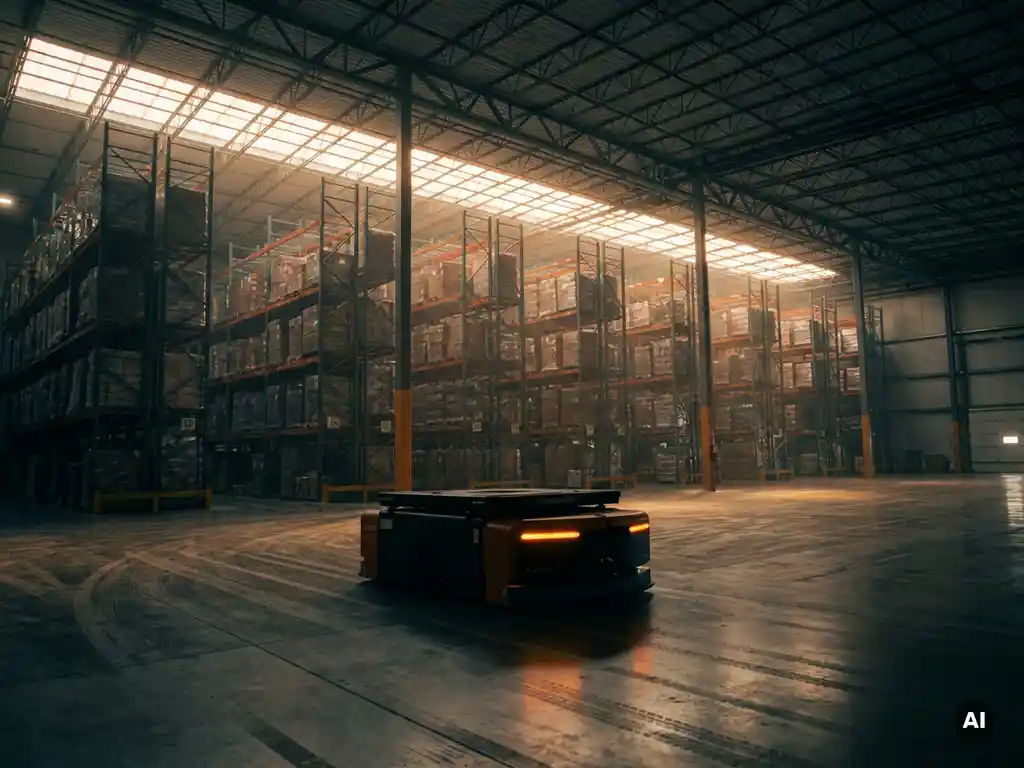
The core difference between an AMR and a traditional shuttle system is how they move, where they operate, and how they scale. A shuttle system uses fixed rails and centralized lifting infrastructure embedded in the rack structure, while an autonomous mobile robot (AMR) navigates freely without fixed tracks. The practical consequence is significant: shuttle systems deliver high throughput within a rigid architecture, whereas AMR-based storage systems offer more flexible routing but often trade off storage density. The sections below break down each dimension of that comparison, from how each system physically works to which warehouse environments they serve best.
How does a traditional shuttle system actually work?
A traditional shuttle AS/RS uses rail-mounted carrier vehicles that travel along fixed horizontal lanes within a racking structure to store and retrieve totes or pallets. A centralized lifting mechanism moves shuttles between levels, and conveyors transport goods to and from workstations. The entire system depends on a coordinated flow of fixed hardware operating within a predefined structure.
In a standard shuttle configuration, each storage level has one or more shuttle vehicles assigned to it. When an order is triggered, the warehouse management system directs a shuttle to the correct lane position, the tote is retrieved, and a vertical lift transports it to the correct floor level before a conveyor carries it to a picking station. The process is fast and reliable under normal conditions, but the architecture is deeply interdependent.
The challenge with this interdependency is that the central lift and conveyor infrastructure become natural bottleneck points. When throughput demand spikes, the system cannot simply add more capacity without modifying the physical infrastructure. Adding levels or extending the footprint typically requires structural redesign, which increases both capital expenditure and deployment downtime. The system is optimized for predictable, steady-state throughput rather than elastic demand.
How does an AMR navigate and store inventory differently?
An autonomous mobile robot in a warehouse context navigates without fixed rails, using onboard sensors, maps, and software-driven path planning to move through a facility. In AMR-based storage systems, robots travel across a floor grid or beneath a storage structure to position themselves, then perform vertical retrieval independently rather than relying on centralized lifting equipment.
The navigation logic is distributed rather than centralized. Each robot makes real-time decisions about its path, responds to other robots in the same space, and adapts to changes in the environment. This eliminates the single-point-of-failure risk that fixed-rail shuttle systems carry, because no single piece of infrastructure is responsible for the movement of all units.
In three-dimensional AMR-based AS/RS architectures, robots handle both horizontal repositioning and vertical climbing within storage towers. Rather than waiting for a central crane or lift to serve them, each robot carries its own climbing capability directly into the tower where the tote is located. Deposit and retrieval happen in one continuous vertical cycle, with no empty trips and no dependency on shared lifting infrastructure. This distributed approach means adding robots directly increases throughput without requiring any changes to the rack structure itself.
Which system offers better storage density?
Traditional shuttle systems generally achieve good storage density, but their reliance on embedded conveyor lanes, lift shafts, and horizontal access corridors consumes structural volume that could otherwise hold inventory. AMR-based storage systems designed around three-dimensional grid architectures can achieve higher cubic volume utilization because the storage structure itself carries no embedded mechanical systems.
The geometry of the storage structure matters significantly here. A conventional rectangular racking system with embedded rails and conveyor infrastructure dedicates a portion of its physical volume to that infrastructure. In contrast, a hexagonal vertical storage architecture eliminates in-rack electrification, embedded motors, and fixed lifting systems entirely. The rack is a passive steel structure. All mechanical function is carried by the robots themselves, which means the full cubic volume of the structure becomes usable storage space.
Height utilization is another factor. Shuttle systems become mechanically more complex and costly as building height increases, because taller structures require more powerful central lifts and longer conveyor paths. An AMR-based system with distributed vertical access scales height without adding centralized mechanical complexity, making it more practical to utilize full building height up to 16 meters. More height means more storage locations within the same footprint, which directly improves density per square meter of floor space.
Can AMRs and shuttle systems scale independently for capacity and throughput?
Traditional shuttle systems cannot scale capacity and throughput independently. In a shuttle AS/RS, storage capacity and throughput performance are structurally linked. Adding more storage locations typically means extending the rack, which may require additional shuttle vehicles, more lift infrastructure, and conveyor modifications. Increasing throughput without adding storage is equally constrained by the fixed number of lifts and lanes.
AMR-based storage systems separate these two dimensions by design. Storage capacity grows by extending the physical structure, adding more towers or locations. Throughput grows by adding more robots. Because the robots are autonomous units that operate in parallel without depending on shared centralized equipment, each additional robot contributes directly and proportionally to picking output. This is sometimes described as linear throughput scaling, and it is one of the most operationally significant differences between the two approaches.
For warehouse operators managing seasonal peaks, promotional surges, or long-term volume growth, this independence is a practical advantage. A business can add robots ahead of a peak period and return to a lower robot count afterward, or it can expand the storage structure during regular operations without stopping throughput. Neither adjustment requires a structural redesign or a system shutdown.
What are the infrastructure and maintenance differences?
The infrastructure footprint of a traditional shuttle system is substantially larger and more complex than that of an AMR-based storage system. Shuttle systems require powered rack structures, embedded conveyor systems, centralized lift shafts, and extensive cabling throughout the installation. Each of these components is a potential failure point, and maintenance typically requires shutting down portions of the system to access embedded hardware.
AMR-based systems that eliminate in-rack electrification reduce this complexity significantly. When the rack structure contains no embedded motors, no powered conveyors, and no fixed lifting systems, the maintenance surface shrinks considerably. The robots themselves are the primary mechanical components, and because they are discrete, independently operating units, a single robot going offline for maintenance or charging does not stop the rest of the system from operating.
Relocation and reconfiguration are also meaningfully different between the two approaches. A shuttle system with embedded infrastructure is effectively fixed once installed. Relocating it involves dismantling powered rack structures, which is expensive and disruptive. A passive rack structure with autonomous robots is inherently more relocatable. The rack can be disassembled and reassembled, and the robots move with it, reducing the long-term commitment to a specific facility layout.
Which system is better suited for which warehouse use cases?
Traditional shuttle AS/RS systems are best suited for high-volume, predictable operations where throughput requirements are stable and the product mix is relatively uniform. Distribution centers handling large quantities of a limited number of SKUs, or operations with consistent daily order profiles, benefit from the speed and reliability that a well-designed shuttle system delivers within its design parameters.
AMR-based storage systems are better suited for environments where demand is variable, SKU counts are high, or the business needs the flexibility to scale without rebuilding infrastructure. E-commerce fulfillment, 3PL logistics, spare parts warehousing, and omnichannel retail operations all involve unpredictable order patterns, wide product variety, and the need to respond quickly to volume changes. These are conditions where the rigid architecture of a shuttle system becomes a constraint rather than an advantage.
There are also cases where the choice comes down to building constraints. If a facility has significant ceiling height available but a limited floor footprint, a three-dimensional AMR-based system that converts vertical space into dense, directly accessible storage locations will outperform a shuttle system that requires horizontal lane access at every level. Conversely, if ceiling height is limited but floor space is abundant, the density advantage of vertical AMR storage is less pronounced, and a shuttle system may be competitive on throughput per square meter.
- High-volume, stable SKU mix: Traditional shuttle systems perform well and are cost-effective at scale
- Variable demand and high SKU complexity: AMR-based storage systems offer the flexibility and scalability needed
- Limited floor footprint with available ceiling height: Three-dimensional AMR storage maximizes cubic density
- Operations requiring elastic throughput: AMR systems scale throughput by adding robots, not rebuilding infrastructure
- Environments prioritizing system resilience: Distributed AMR operation eliminates single points of failure
How Hexxabotics helps with AMR vs. shuttle system decisions
Hexxabotics offers a three-dimensional robotic AS/RS that directly addresses the limitations this comparison surfaces. For warehouse engineers evaluating whether a traditional shuttle system or an AMR-based approach fits their operation, the Hexxabotics system provides a concrete alternative that combines the storage density of fixed infrastructure with the scalability and resilience of distributed robotics.
- Autonomous Hexxabots navigate beneath the grid and climb vertically within towers, eliminating centralized lifts and conveyor bottlenecks
- Storage capacity and throughput scale independently, adding towers for capacity and robots for throughput without structural redesign
- No in-rack electrification means a simpler, lower-maintenance installation with no embedded failure points in the rack structure
- Every storage location is directly accessible, with no digging or reshuffling required to reach any tote
- The system integrates with existing warehouse management systems through standard APIs, reducing deployment complexity
If you are evaluating warehouse automation options and want to understand how a hexagonal AS/RS compares to your current or planned shuttle infrastructure, learn more about Hexxabotics and speak with the team about your specific throughput and density requirements.
Related Articles
- What technology is used for real-time pharmaceutical inventory monitoring?
- How does temperature-controlled storage change warehouse layout requirements?
- What are audit trail requirements for pharmaceutical warehouses in 2026?
- How does a hexagonal grid system change warehouse logistics?
- Should you choose an AMR system or a fixed-rail AS/RS in 2026?