
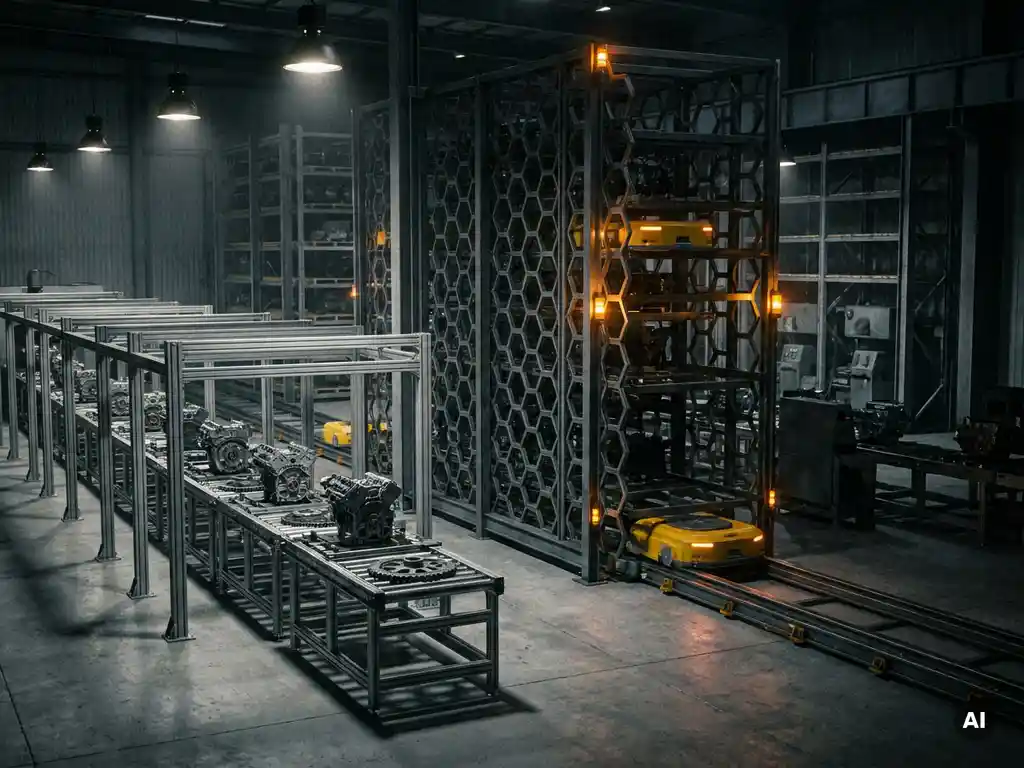
Fixed automation and flexible automation differ in how they handle change. Fixed automation (also called hard automation) is engineered to perform one specific task at high speed and volume, while flexible automation can be reprogrammed or reconfigured to handle multiple tasks, product types, or changing production demands. The right choice depends on production volume, product variety, and how often your operational requirements shift. This article unpacks the key questions engineers ask when evaluating these two approaches.
Which industries still rely on fixed automation today?
Fixed automation remains dominant in industries where production volumes are extremely high, product designs change infrequently, and the economics of dedicated machinery justify the upfront investment. Automotive manufacturing, beverage bottling, consumer electronics assembly, and chemical processing are the clearest examples. In these environments, the cost per unit drops dramatically when the same motion or process runs continuously without interruption.
In automotive body welding, for instance, dedicated robotic cells are programmed to weld a specific vehicle platform. The tooling, fixtures, and motion sequences are all designed around one product. A bottling line filling a single container format operates the same way: the machinery is tuned for one bottle size, one cap type, one fill volume. Changing any of those parameters requires significant retooling.
Fixed automation also persists in semiconductor fabrication, where photolithography equipment performs highly specialized processes at tolerances that leave no room for reconfiguration. Similarly, large-scale food processing plants often use hard automation for tasks like dough forming or continuous pasteurization, where the process itself is standardized by regulation and recipe.
The common thread across all these industries is volume stability. When demand is predictable, product lines are long, and changeovers are rare, fixed automation delivers throughput and unit economics that flexible systems struggle to match.
How does flexible automation adapt to changing production demands?
Flexible automation adapts to changing production demands through reprogrammable controllers, modular hardware, and software-driven coordination that can be updated without physically rebuilding the system. When a product specification changes or a new SKU is introduced, operators update the program logic or swap out end-of-arm tooling rather than redesigning the entire line.
At the hardware level, flexible systems typically use general-purpose robotic arms, adjustable conveyors, and standardized interfaces that accept different fixtures or grippers. At the software level, programmable logic controllers (PLCs) and warehouse or manufacturing execution systems manage task sequencing, allowing engineers to modify workflows, add new routines, or reroute materials without stopping production for extended periods.
This adaptability becomes especially valuable in three scenarios: seasonal demand swings that require different product mixes, product lifecycle transitions where new models replace old ones, and multi-client environments like third-party logistics where the same infrastructure must serve different customers. In each case, the ability to change what the system does without changing the physical infrastructure is the core advantage of flexible automation over its fixed counterpart.
Modern flexible systems also benefit from sensor feedback and machine vision, which allow robots to handle variability in real time. A robot equipped with a vision system can identify different part orientations or package sizes and adjust its grip and placement accordingly, something a fixed machine simply cannot do.
What are the main types of flexible automation?
The main types of flexible automation are programmable automation, soft automation (or computer-integrated manufacturing), and fully flexible automation systems. Each represents a different level of adaptability, from batch-level reprogramming to real-time task switching within a single production run.
Programmable automation
Programmable automation is designed to produce batches of different products by reprogramming the control system between runs. The physical equipment stays the same, but the instructions change. Industrial robot arms on assembly lines are a classic example: the same arm can be programmed to weld one vehicle model during one shift and a different model after a software update. The changeover requires downtime, but it is far shorter and less expensive than retooling a fixed system.
Flexible manufacturing systems (FMS)
Flexible manufacturing systems take programmable automation further by enabling product changeovers within a single production run, often with minimal or no manual intervention. An FMS typically combines CNC machining centers, automated material handling, and a central control system that routes workpieces dynamically. This allows manufacturers to produce a mix of part types simultaneously, responding to order priorities without stopping the line.
Autonomous mobile and robotic storage systems
In warehouse and fulfillment environments, flexible automation often takes the form of autonomous mobile robots (AMRs) and robotic AS/RS platforms. These systems handle storage, retrieval, and goods transport across variable SKU mixes without fixed conveyor paths. Because routing and task assignment are managed in software, throughput and storage capacity can be scaled independently, a key advantage over fixed conveyor-based systems.
What’s the cost difference between fixed and flexible automation?
Fixed automation generally has a lower cost per unit at high volumes but a much higher cost of change. Flexible automation carries a higher initial cost per task but distributes that investment across multiple products and longer operational lifespans, making the total cost of ownership more favorable when product variety or demand patterns are unpredictable.
The upfront capital expenditure for a fixed automated line is often lower than a comparable flexible system because the machinery is purpose-built with fewer generalized components. A dedicated transfer line for machining engine blocks costs less per station than a flexible CNC cell that can handle multiple part families. However, when that engine block design changes, the fixed line may require complete retooling, which can cost as much as a new installation.
Flexible automation shifts cost toward software, integration, and modular hardware. Reconfiguration costs are lower because the physical infrastructure does not need to be replaced. Over a five- to ten-year horizon, facilities that experience regular product changes, volume fluctuations, or SKU expansion typically find that flexible systems deliver better return on investment despite the higher entry price.
Maintenance costs also differ. Fixed systems have fewer software variables but more specialized mechanical components that may be difficult or expensive to source as the system ages. Flexible systems with distributed robotic architectures can often continue operating when individual units require service, reducing downtime risk and its associated cost.
When should a facility choose flexible automation over fixed?
A facility should choose flexible automation over fixed when it faces high product variety, frequent design changes, unpredictable demand volumes, or a need to scale operations without rebuilding infrastructure. If any of these conditions apply, the operational cost of being locked into a fixed system will outweigh its efficiency advantages within a short time horizon.
Specific situations that favor flexible automation include:
- E-commerce and omnichannel fulfillment, where SKU counts are high, order profiles change constantly, and peak seasons require rapid throughput scaling
- Contract manufacturing and 3PL logistics, where the same facility must serve multiple clients with different product specifications
- Pharmaceutical and medical device production, where regulatory changes and product line extensions require frequent process updates
- Spare parts and aftermarket warehousing, where thousands of low-velocity SKUs must remain directly accessible without reshuffling
- Fashion and apparel fulfillment, where seasonal collections create sharp demand cycles and SKU turnover is built into the business model
Conversely, fixed automation remains the better choice when a single product runs at maximum volume for years, changeover costs are negligible because changes simply do not happen, and the facility’s competitive advantage is rooted in cost-per-unit efficiency rather than adaptability.
How does flexible automation integrate with existing warehouse systems?
Flexible automation integrates with existing warehouse systems primarily through standard software interfaces, most commonly APIs that connect the automation platform’s control system to the facility’s warehouse management system (WMS) or enterprise resource planning (ERP) software. This software-first integration model means physical infrastructure does not need to be replaced for the automation layer to function alongside legacy systems.
The integration process typically involves three layers. First, the data layer: the automation system must receive order information, inventory data, and location assignments from the WMS. Second, the execution layer: the automation platform’s control system translates those instructions into robot tasks, routing decisions, and pick sequences. Third, the feedback layer: the automation system reports completed actions, inventory movements, and system status back to the WMS in real time.
Well-designed flexible automation platforms use open API architectures specifically to reduce integration effort. This matters because most warehouses already operate with an established WMS, and replacing that system to accommodate new automation is rarely practical. Systems that communicate through standard protocols allow integrators to connect automation hardware without disrupting existing inventory logic or order management workflows.
Scalability within the existing footprint is another integration consideration. Flexible systems that can expand capacity or throughput without structural redesign are far easier to integrate incrementally. A facility can start with a defined automation zone, validate performance, and extend the system as confidence and demand grow, without requiring a full-facility shutdown or infrastructure overhaul.
How Hexxabotics addresses the fixed versus flexible automation challenge
Hexxabotics is a next-generation AS/RS platform built specifically for operations that need both high storage density and the operational flexibility to scale without rebuilding. For industrial engineers evaluating the difference between fixed and flexible automation in a warehouse context, the Hexxabotics system addresses the core trade-offs directly:
- Independent scalability: Storage capacity and throughput performance scale separately. Add towers to increase locations; add Hexxabots to increase picks per hour. No structural redesign is required.
- No in-rack electrification: The passive steel structure contains no embedded motors, conveyors, or fixed lifting systems, which eliminates the rigid infrastructure that makes fixed automation expensive to change.
- 100% direct access: Every tote location is directly accessible without digging or reshuffling, making the system practical for high-SKU environments where product mix changes frequently.
- Standard API integration: The Hexxabotics Control System connects to existing WMS and ERP platforms through standard interfaces, reducing integration effort and protecting existing software investments.
- Distributed resilience: Parallel robot operation eliminates single points of failure. If one unit requires service, the rest of the system continues operating at stable throughput.
If you are evaluating whether a flexible AS/RS can replace or complement your current fixed storage infrastructure, explore Hexxabotics to see how the hexagonal architecture delivers density and adaptability within the same system.
Related Articles
- How does a hexagonal grid system change warehouse logistics?
- How does predictive maintenance prevent downtime in automated warehouses?
- How do 3PL providers choose between leasing and buying automation equipment?
- What is the difference between an AMR and an AGV in warehousing?
- Should you choose an AMR system or a fixed-rail AS/RS in 2026?