
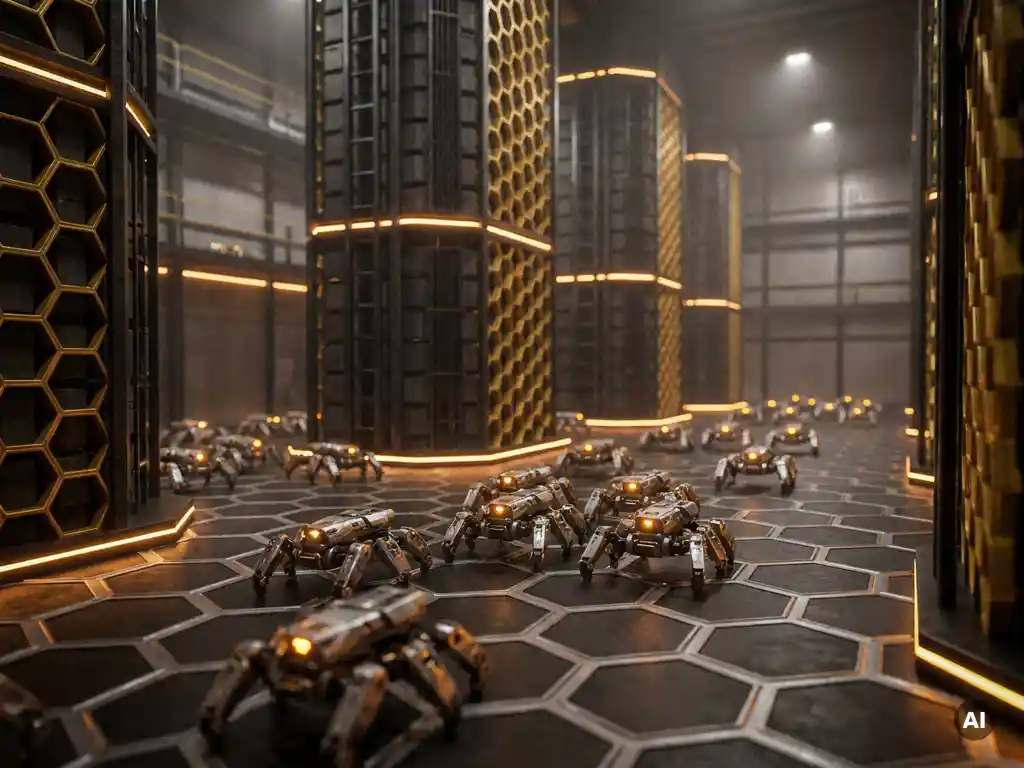
Swarm robotics is a field of robotics where large numbers of simple, autonomous robots coordinate to complete complex tasks collectively, without any single central controller directing every action. Each robot follows local rules and responds to its environment, and the desired system-level behavior emerges from those interactions. In logistics, swarm robotics powers warehouse automation systems where fleets of independent robots handle storage, retrieval, and transport in parallel, delivering throughput and resilience that single-machine systems cannot match. The sections below break down how these systems work, where they excel, and what the future holds for multi-robot logistics.
How does swarm robotics actually work?
Swarm robotics works by distributing tasks across many autonomous robot units that each make decisions based on local information and simple behavioral rules. No central machine controls every move. Instead, coordination emerges from the robots sensing their environment, communicating with nearby units, and executing their individual roles. The result is a system that behaves intelligently at scale without depending on any single point of control.
In a warehouse setting, this typically means a fleet of autonomous robots operating simultaneously across a shared space. Each unit knows its own position, its current task, and the state of its immediate surroundings. A central software layer, such as a warehouse control system, distributes task assignments and monitors the overall operation, but individual robots handle navigation, collision avoidance, and task execution independently. This separation between high-level coordination and low-level execution is what makes swarm systems so resilient.
The biological inspiration behind swarm robotics is well established. Ant colonies, beehives, and bird flocks all solve complex spatial and logistical problems through distributed agents following simple rules. In honeybee colonies, for example, no single bee directs the group, yet the hive achieves remarkable structural efficiency and adaptive behavior. Modern warehouse robotics draws directly from this model, applying the same logic of parallel, distributed agents to storage and retrieval operations.
What are the key benefits of swarm robotics in logistics?
The key benefits of swarm robotics in logistics are resilience, linear throughput scaling, and operational flexibility. Because no single robot or machine carries the entire workload, the failure of one unit does not stop the system. Throughput grows by adding more robots rather than rebuilding infrastructure. And because robots operate in parallel, the system handles peak demand without creating bottlenecks.
These advantages translate directly into measurable operational outcomes:
- No single point of failure: If one robot goes offline for charging or maintenance, the remaining units continue operating. The system degrades gracefully rather than stopping entirely.
- Linear throughput scaling: Adding robots increases picks per hour in a predictable, proportional way. There is no need to replace core infrastructure to handle higher volumes.
- Parallel task execution: Multiple robots work simultaneously across different parts of the storage structure, eliminating the queuing and waiting time that centralized cranes or lifts create.
- Independent capacity and throughput control: Storage capacity and picking performance can be scaled separately. Operators can expand storage by extending the physical structure and increase speed by deploying additional robots, without those two decisions interfering with each other.
- Reduced energy complexity: Distributed robotic systems can be designed so that no power infrastructure is embedded in the rack structure itself. Robots carry their own power and charge during operation cycles, simplifying installation and lowering long-term maintenance costs.
For logistics engineers evaluating automation investments, the combination of resilience and independent scalability addresses two of the most common failure modes in traditional systems: the bottleneck created by centralized handling equipment and the rigidity that makes scaling expensive.
How is swarm robotics different from traditional AS/RS?
Swarm robotics differs from traditional Automated Storage and Retrieval Systems by replacing centralized handling equipment with distributed autonomous units. Conventional AS/RS designs, such as mini-load cranes or shuttle systems, rely on one or a few high-capacity machines to move inventory. Swarm-based systems replace that centralized core with many smaller robots that each handle a portion of the workload independently.
Traditional AS/RS architectures each carry specific trade-offs. Mini-load cranes provide reliable vertical access but become a bottleneck as throughput demands grow, because adding capacity means adding more cranes and the fixed infrastructure to support them. Shuttle systems offer high throughput but embed significant mechanical complexity into the rack structure itself. Cube-storage grid systems achieve dense storage but can require extensive reshuffling to reach items that are not at the top of a stack.
Swarm-based warehouse robotics addresses these constraints by eliminating the dependency on centralized lifting cores, fixed vertical conveyors, and embedded rack electrification. Robots navigate horizontally beneath the storage structure and climb vertically within individual towers to access any location directly. Because every storage position is independently reachable, there is no digging through layers of inventory and no duplication of heavy mechanical infrastructure to add throughput capacity.
The practical implication for system integrators and operations engineers is significant. In a traditional AS/RS, storage capacity and throughput performance are structurally linked. Changing one typically requires modifying the other. In a swarm-based multi-robot system, those two dimensions are decoupled, giving operators far more control over how and when they invest in expansion.
What types of logistics tasks can swarm robots handle?
Swarm robots in logistics can handle storage and retrieval of totes, goods-to-person order fulfillment, inventory management, and high-density buffer operations. They are well suited to any task that benefits from parallel execution across many SKUs, high pick rates, and direct access to every stored item without manual intervention.
In practice, swarm robotic systems are deployed across a wide range of logistics environments:
- E-commerce fulfillment: High order volumes with many small, individual picks are ideal for swarm systems because multiple robots can process different orders simultaneously, reducing cycle times significantly.
- Retail replenishment: Swarm systems can buffer and sequence products for store replenishment, handling the mix of SKUs and varying demand patterns that retail supply chains generate.
- Spare parts and industrial distribution: Direct access to every stored location, without reshuffling, makes swarm-based AS/RS particularly effective for slow-moving but high-variety inventory common in spare parts operations.
- Food and grocery fulfillment: The ability to handle fresh and ambient SKUs within a dense, directly accessible structure supports the strict rotation requirements and high turnover rates that grocery operations demand.
- Pharmaceutical logistics: Batch traceability and regulatory compliance requirements benefit from the precise inventory control that a software-managed, direct-access swarm system provides.
- 3PL and contract logistics: The modular, reconfigurable nature of swarm-based systems allows third-party logistics providers to adapt storage configurations across different client requirements without rebuilding core infrastructure.
What challenges does swarm robotics face in warehouse environments?
Swarm robotics in warehouse environments faces challenges around software complexity, traffic management, system integration, and the upfront investment required to deploy a coordinated multi-robot fleet. While individual robots are mechanically simpler than traditional AS/RS equipment, managing the collective behavior of many autonomous units introduces its own engineering demands.
Traffic management is one of the most technically demanding aspects of operating a swarm robotic system at scale. When dozens or hundreds of autonomous robots share the same floor space or structural grid, the control system must continuously resolve potential conflicts, assign optimal paths, and rebalance workloads in real time. The algorithms that govern this coordination need to be robust enough to handle peak demand without creating congestion, and resilient enough to reroute around units that are temporarily offline.
Integration with existing warehouse management systems is another practical challenge. Most logistics operations already run WMS platforms, ERP systems, and order management tools. A swarm robotic system must connect cleanly to those existing layers through standard APIs, and the data flows between systems need to be reliable enough to maintain inventory accuracy across thousands of storage positions.
The initial capital investment and the organizational change required to transition from manual or conventional automated operations to a swarm-based system can also present barriers, particularly for smaller operations. Evaluating total cost of ownership, including installation, integration, training, and ongoing maintenance, is essential before committing to any multi-robot system deployment.
Finally, physical environment constraints matter. Building height, floor flatness, fire suppression requirements, and ceiling load limits all influence what swarm robotic architectures are feasible in a given facility. Systems that utilize vertical density up to 16 meters, for example, require buildings with sufficient clear height and appropriate structural characteristics to support the storage towers.
Where is swarm robotics in logistics headed?
Swarm robotics in logistics is moving toward greater intelligence, denser integration with AI-driven demand forecasting, and broader deployment across industries that have historically relied on manual or semi-automated warehousing. As hardware costs decrease and control software matures, swarm-based autonomous robot systems are becoming viable for a wider range of operation sizes and complexity levels.
Several trends are shaping the near-term trajectory of swarm robotics in warehouse automation. Robot hardware is becoming lighter, more energy-efficient, and easier to maintain, reducing the total cost of deploying large fleets. Control systems are incorporating machine learning to improve task sequencing, predict maintenance needs, and optimize robot routing based on real-time order patterns rather than static rules.
The push toward omnichannel fulfillment is also accelerating adoption. Retailers and logistics providers need systems that can handle both bulk replenishment and individual e-commerce picks from the same inventory pool, often within the same facility. Swarm-based systems, with their direct access to every stored item and independently scalable throughput, are structurally well suited to that dual-mode requirement.
Sustainability is becoming a more prominent factor in automation investment decisions in 2026. Systems that eliminate embedded rack electrification, reduce energy peaks through distributed operation, and use passive structural components wherever possible align well with the energy efficiency targets that large logistics operators are increasingly required to meet.
The modular, reconfigurable nature of swarm robotic architectures also positions them well for the growing 3PL market, where flexibility and redeployability across different client environments represent real competitive advantages over fixed, client-specific installations.
How Hexxabotics delivers on swarm robotics principles
Hexxabotics applies swarm robotics principles directly to high-density warehouse automation through its hexagonal AS/RS platform. The system is built around the same distributed, resilient logic that defines swarm robotics at its core, and it addresses the practical challenges that multi-robot logistics deployments face in real warehouse environments.
- Distributed autonomous operation: Hexxabots navigate independently beneath the storage grid for horizontal transport and climb vertically within towers for storage and retrieval, with no centralized crane or lift shaft creating bottlenecks.
- 100% direct access: Every storage position is reachable without digging or reshuffling, enabling consistent performance across all SKUs regardless of their location in the structure.
- Independent scalability: Storage capacity and throughput performance scale separately. Adding towers increases capacity; adding robots increases picks per hour. No structural redesign is required for either.
- No in-rack electrification: The passive steel structure contains no embedded motors, cabling, or powered components, reducing failure points and simplifying maintenance.
- Resilient by design: Distributed operation means no single point of failure. If one Hexxabot goes offline, the rest of the fleet continues operating without interruption.
- Scalable from 2,000 to 200,000 storage positions and throughput ranging from 200 to 8,000 picks per hour, with vertical density up to 16 meters.
For system integrators and warehouse operators evaluating autonomous robot solutions for logistics, Hexxabotics offers a platform designed to grow with operational demands rather than against them. Explore the Hexxabotics system to see how the architecture performs across your specific storage and throughput requirements.
Related Articles
- How do you ensure lot segregation in a high-density pharmaceutical warehouse?
- What are the data integrity requirements for pharmaceutical warehouse systems?
- What are the most common reasons pharmaceutical warehouses fail inspections?
- How do you choose the right racking system for pharmaceutical warehousing?
- What is the impact of floor flatness on automated warehouse systems?