
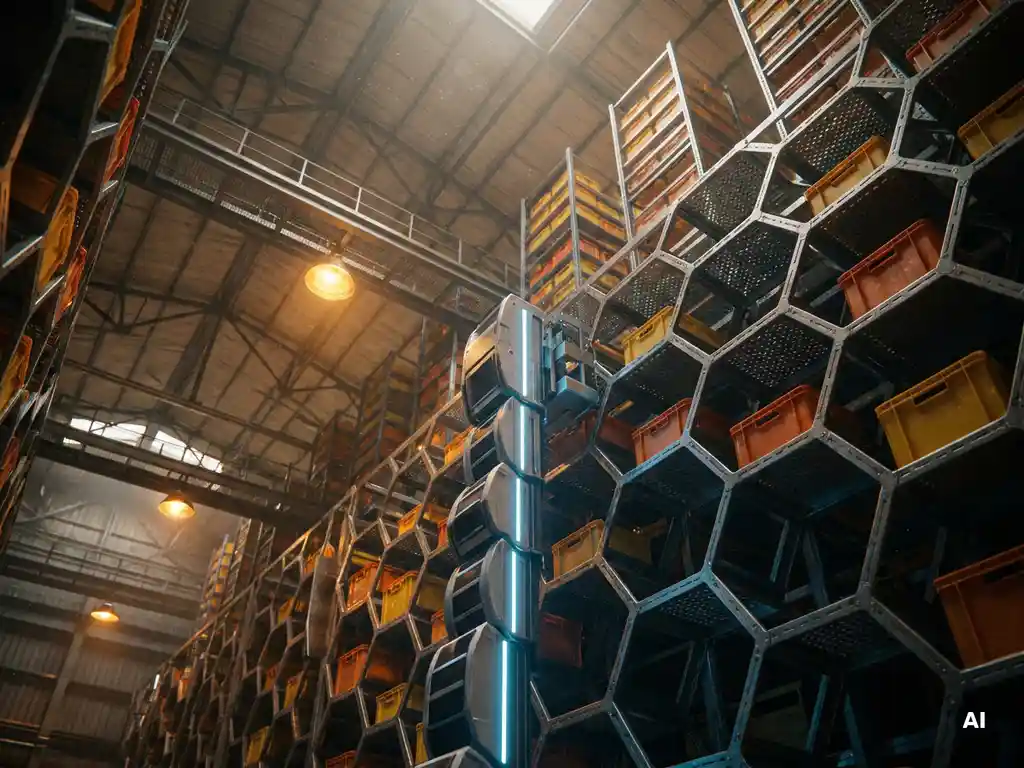
An automated storage and retrieval system (AS/RS) is a computer-controlled warehouse technology that automatically stores and retrieves inventory using mechanical equipment, robots, or both. Rather than relying on human operators to walk aisles and locate products manually, an AS/RS system uses software-driven hardware to move goods to and from fixed storage locations with speed and precision. This article answers the most common questions about how AS/RS systems work, what types exist, and when they make sense for a warehouse operation.
How does an AS/RS system actually retrieve and store goods?
An AS/RS system stores and retrieves goods by using automated equipment to move inventory between storage locations and picking or dispatch points. A warehouse management system or dedicated control software directs the equipment to a precise location, the item is retrieved or deposited, and it is transported to a workstation or outbound area, all without manual handling.
The exact mechanics vary by system type, but most AS/RS solutions follow a common operational logic. Storage locations are mapped in the control system, each tote, pallet, or container is assigned a location, and the system tracks every movement in real time. When an order triggers a retrieval request, the control software calculates the most efficient path and dispatches the appropriate equipment.
Modern AS/RS designs increasingly use a Goods-to-Person (GTP) model, where the inventory travels to the operator rather than the operator traveling to the inventory. This eliminates walking time, reduces picking errors, and allows operators to stay at ergonomically designed workstations throughout their shift. The result is significantly higher throughput per operator hour compared to conventional manual picking.
In three-dimensional robotic systems, autonomous robots navigate horizontally beneath the storage grid and climb vertically inside towers to reach the required location, completing deposit and retrieval in a single continuous motion. Because every storage position is directly accessible, there is no need to move other inventory out of the way before reaching the target item.
What are the main types of AS/RS systems?
The main types of AS/RS systems are unit-load cranes, mini-load cranes, shuttle systems, cube storage, autonomous mobile robot (AMR) storage, and vertical or horizontal carousels. Each type balances storage density, throughput speed, and infrastructure requirements differently, and the right choice depends on the specific operational profile of the warehouse.
Crane-based AS/RS systems
Unit-load and mini-load crane systems use a stacker crane that travels along a fixed aisle to access rack locations. Unit-load systems handle full pallets in high-bay warehouses, while mini-load systems manage smaller totes or trays. Both offer reliable vertical storage but become mechanically complex and expensive as they grow taller, and throughput is constrained by the number of cranes per aisle.
Shuttle and grid-based AS/RS systems
Shuttle systems deploy multiple robotic carriers within rack levels, increasing throughput by running parallel operations. Grid-based systems, sometimes called cube storage, stack totes in dense columns and use robots on a flat grid above to dig down and retrieve items. Grid systems achieve high density but can require inventory reshuffling to reach lower-positioned totes, which creates latency under high-demand conditions.
Robotic vertical tower AS/RS systems
Vertical tower systems, including next-generation designs that use hexagonal geometry, convert full building height into usable storage without embedding motors or conveyors in the rack structure. Autonomous robots climb inside towers and retrieve totes directly, with no centralized crane or lift shaft required. This architecture separates storage capacity from throughput, allowing each to scale independently.
Carousels and vertical lift modules
Horizontal and vertical carousels rotate stored items to a fixed access point. Vertical lift modules (VLMs) use a central extractor to retrieve trays from either side of a tall enclosed cabinet. Both are well-suited to smaller footprints and slower-moving inventory but have limited throughput compared to multi-robot systems.
What is the difference between AS/RS and a traditional warehouse racking system?
The key difference is automation. A traditional racking system is passive infrastructure that requires human operators or forklifts to locate and retrieve inventory. An AS/RS system uses software-controlled equipment to perform storage and retrieval automatically, removing manual travel time and enabling much higher throughput, accuracy, and storage density within the same or smaller footprint.
Traditional racking also requires wide aisles to allow forklift or operator access, which means a significant portion of the warehouse floor is dedicated to movement rather than storage. AS/RS systems eliminate or dramatically reduce aisle requirements, converting that space into productive storage locations. The difference in usable cubic volume can be substantial, particularly when vertical height is fully utilized.
From an operational standpoint, traditional racking systems are flexible and low-cost to install but scale poorly as order volumes grow. Adding throughput means hiring more operators, which increases labor costs and introduces variability in accuracy and speed. An AS/RS system, once deployed, scales throughput by adding automated units rather than headcount, and accuracy is governed by software rather than human attention.
What industries and applications use AS/RS technology?
AS/RS technology is used across a wide range of industries wherever high-volume, accurate, and space-efficient storage and retrieval are required. Common sectors include e-commerce and retail fulfillment, food and grocery, pharmaceuticals, fashion and apparel, fast-moving consumer goods (FMCG), spare parts distribution, and third-party logistics (3PL).
In e-commerce and retail, AS/RS systems handle the high SKU counts and rapid order cycles that define modern fulfillment. In pharmaceuticals, the technology supports strict batch traceability and regulatory compliance requirements while maintaining direct access to every item. In food and grocery, dense cold-storage configurations make AS/RS particularly valuable because every cubic meter of refrigerated space carries a high operating cost.
Spare parts and industrial distribution operations benefit from AS/RS because their inventory often spans thousands of small, low-velocity SKUs that are impractical to manage manually at scale. 3PL providers use AS/RS to standardize operations across multiple clients within a single facility, reducing per-unit handling costs and improving service level consistency.
What are the key benefits of implementing an AS/RS system?
The key benefits of an AS/RS system are higher storage density, faster and more accurate order fulfillment, reduced labor dependency, better use of vertical space, and the ability to scale operations without proportional increases in infrastructure or headcount. Together, these benefits improve both operational efficiency and long-term total cost of ownership.
- Storage density: AS/RS systems eliminate wide access aisles and use full building height, storing significantly more inventory within the same floor area than conventional racking.
- Picking accuracy: Software-directed retrieval removes the human error associated with manual picking, reducing mispicks and the cost of returns or corrections.
- Throughput speed: Automated systems operate continuously without fatigue, shift changes, or variability, delivering consistent picking rates around the clock.
- Labor efficiency: Goods-to-Person workflows concentrate operator activity at fixed workstations, reducing travel time and allowing fewer operators to handle higher order volumes.
- Independent scalability: In distributed robotic architectures, storage capacity and throughput can be expanded independently, adding locations or robots without redesigning the core infrastructure.
- System resilience: Distributed robot fleets eliminate single points of failure. If one unit goes offline, the remaining units continue operating, maintaining throughput during peak demand or maintenance windows.
From a financial perspective, the labor savings and density gains typically drive the strongest return on investment, particularly in high-wage markets or facilities operating multiple shifts. The reduction in picking errors also carries a measurable impact on customer satisfaction and reverse logistics costs.
When does an AS/RS system make sense for a warehouse operation?
An AS/RS system makes sense when a warehouse operation faces high order volumes, constrained floor space, rising labor costs, or accuracy demands that manual processes cannot reliably meet. It becomes especially compelling when a facility needs to scale throughput or capacity without expanding its physical footprint or undergoing major structural renovation.
Operations with a large number of SKUs and frequent, small-quantity picks are strong candidates, as the speed and accuracy advantages of automation compound quickly at high transaction volumes. Facilities with significant vertical clearance that is currently underutilized also stand to gain substantially, since AS/RS systems can convert height into productive storage that traditional racking cannot efficiently reach.
Conversely, an AS/RS system may not be the right fit for very low-volume operations, highly irregular product dimensions that do not standardize well into totes, or facilities where order profiles change so infrequently that manual processes remain cost-effective. The decision ultimately depends on the ratio of automation investment to the operational savings it generates over the system’s operational life.
A useful indicator is whether labor costs, picking errors, or space constraints are actively limiting growth. When any of these becomes a ceiling on performance, automated storage and retrieval technology offers a structured path to removing it.
How Hexxabotics helps with automated storage and retrieval
Hexxabotics is a next-generation AS/RS system built around hexagonal geometry and autonomous robotics, designed to solve the limitations that make traditional automated storage difficult to scale. The system is purpose-built for integrators and warehouse operators who need predictable, long-term performance without constant infrastructure redesign.
- Converts full cubic warehouse volume into usable storage, utilizing up to 16 meters of vertical height with no embedded motors or electrified rack structure
- Delivers 100% direct access to every tote, with no digging, reshuffling, or retrieval delays
- Scales storage capacity and throughput independently, adding locations or Hexxabots without stopping operations or modifying the core architecture
- Eliminates single points of failure through distributed robot operation, maintaining stable throughput even during peak demand
- Integrates with existing warehouse management systems via standard APIs, reducing deployment complexity for system integrators
If you are evaluating AS/RS options for a new or existing facility, learn more about Hexxabotics and how its architecture compares to conventional automated storage systems.