
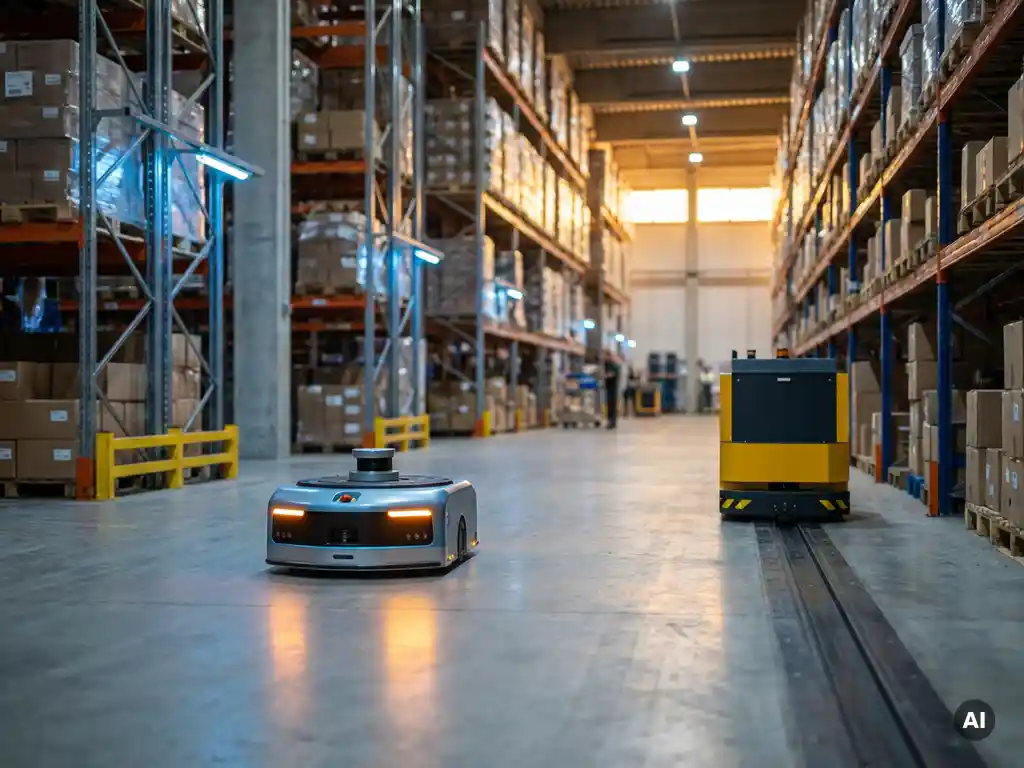
An AMR (autonomous mobile robot) and an AGV (automated guided vehicle) are both mobile robots used in warehouses, but they differ fundamentally in how they navigate. AGVs follow fixed, pre-programmed paths using physical guides such as magnetic tape, wires, or reflective markers. AMRs use onboard sensors, cameras, and mapping software to navigate dynamically, building real-time maps of their environment and choosing their own routes. The distinction matters most when evaluating flexibility, infrastructure cost, and how well each technology fits your operational environment. The questions below break down the key differences across deployment, cost, use cases, and how both compare to more advanced storage systems.
How does an AMR navigate compared to an AGV?
An AGV navigates by following a fixed physical guide embedded in or applied to the floor, such as magnetic tape, wire, laser reflectors, or optical markers. It cannot deviate from its programmed path. An AMR, by contrast, uses LiDAR sensors, cameras, and onboard computing to build a live map of its surroundings and select the most efficient route in real time, adapting when obstacles appear.
This navigational difference has significant practical consequences. An AGV requires the warehouse floor to be prepared before deployment. Tape must be laid, reflectors installed, and paths programmed. Any change to the layout, whether a new shelving unit or a relocated workstation, requires physical modification of the guide infrastructure and reprogramming of the vehicle’s routes.
An AMR, by contrast, can be introduced into an existing warehouse with minimal floor preparation. It scans its environment, builds a map, and begins navigating. When the layout changes, the robot updates its map and recalculates routes automatically. This makes AMRs considerably more adaptable in dynamic warehouse environments where layouts shift frequently or where human workers share the same floor space.
What are the main use cases for AGVs in a warehouse?
AGVs are best suited for high-volume, repetitive transport tasks along stable, predictable routes. Common warehouse applications include pallet transport between receiving docks and storage areas, movement of goods between fixed production or fulfillment stations, and towing trailer loads across long, consistent paths. Their strength lies in reliability and throughput on well-defined routes.
Because AGVs operate on fixed infrastructure, they perform most effectively in environments that do not change often. Large distribution centers with consistent inbound and outbound flows, manufacturing facilities where materials move between fixed process stations, and cold storage operations where human presence is minimized are all environments where AGVs have historically delivered strong performance.
AGVs are also commonly used for load transfer between conveyor systems, automated truck loading and unloading in controlled dock environments, and moving heavy unit loads that would be impractical for smaller, lighter mobile robots. The predictability of their routes makes them easy to integrate with existing warehouse management systems, and their operational behavior is straightforward to monitor and maintain over time.
What tasks are AMRs better suited for than AGVs?
AMRs outperform AGVs in tasks that require flexibility, adaptability, and the ability to operate safely alongside human workers. They are better suited for order picking support, goods-to-person transport in mixed-use environments, and any application where routes change frequently or where the warehouse layout evolves over time. Their dynamic navigation makes them far more practical in fast-changing operations.
In e-commerce fulfillment, for example, AMRs are widely used to carry shelving units or totes to stationary pickers, reducing the distance workers travel across the warehouse floor. Because the AMR can navigate around people, other robots, and unexpected obstacles, it can operate safely in the same space as warehouse staff without requiring physical barriers or dedicated lanes.
AMRs are also better suited to environments where demand fluctuates significantly. Adding more AMR units to a fleet scales throughput without any infrastructure changes, whereas expanding an AGV deployment typically requires extending guide paths and reprogramming routes. For operations that experience seasonal peaks, rapid growth, or frequent layout changes, the AMR’s flexibility is a meaningful operational advantage.
Which is more expensive to deploy, an AMR or an AGV?
The upfront hardware cost of an AMR is generally higher than a comparable AGV unit, reflecting the more sophisticated sensors and computing required for autonomous navigation. However, the total deployment cost often favors AMRs because they require far less site preparation. AGV deployments require significant infrastructure work, including floor modifications, guide installation, and extensive programming before the first vehicle moves.
When evaluating total cost of ownership, several factors shift the comparison. AGV infrastructure is costly to modify. Each time a warehouse layout changes, the guide system must be updated, which involves both materials and labor. Over a multi-year deployment, these change costs accumulate. AMRs, by contrast, adapt through software updates and map recalibration, which are far less expensive to implement.
Maintenance costs also differ. AGVs have fewer onboard sensors but depend on the integrity of their physical guide infrastructure, which degrades over time and requires upkeep. AMRs carry more onboard technology but are less dependent on floor-level infrastructure. For operations planning long deployment cycles or expecting layout changes, the AMR’s lower ongoing modification costs often offset its higher initial unit price within a few years of operation.
Can AMRs and AGVs work together in the same warehouse?
Yes, AMRs and AGVs can operate in the same warehouse, and many large fulfillment operations run both simultaneously. They are typically assigned to different task types based on their respective strengths: AGVs handle fixed, high-volume transport routes, while AMRs manage more flexible, variable tasks. Successful coexistence requires careful traffic management and clear zone definitions to prevent conflicts.
In practice, the two technologies often occupy different areas of the same facility. AGVs may operate in dedicated lanes between receiving docks and bulk storage, while AMRs work in the picking area alongside human staff. Where their paths intersect, warehouse management software and traffic control systems coordinate movement to prevent collisions and bottlenecks.
Modern warehouse management systems and robot fleet management platforms increasingly support multi-robot, multi-vendor environments, making it technically feasible to orchestrate both AGV and AMR fleets through a single control layer. The key challenge is not technical compatibility but operational planning: defining which robot type owns which task, how handoffs between zones are managed, and how exceptions are handled when either system encounters an unexpected situation.
How do AMRs and AGVs compare to AS/RS systems?
AMRs and AGVs are transport robots that move goods horizontally across a warehouse floor. AS/RS (Automated Storage and Retrieval Systems) are storage systems that automate the placement and retrieval of goods within a dense, structured storage structure. The two categories are not direct competitors. AMRs and AGVs move goods between locations; AS/RS systems store and retrieve goods from high-density vertical storage. Many warehouses use both.
The functional distinction matters when evaluating storage density. An AMR- or AGV-based operation still requires conventional racking or shelving, which consumes significant floor space. An AS/RS system, by contrast, stores goods in compact vertical towers, dramatically reducing the footprint required for the same number of storage positions. This makes AS/RS the preferred choice when maximizing storage density within a limited building footprint is the primary objective.
Throughput and scalability differences
AMR fleets scale throughput by adding more robots to the floor, which is straightforward and does not require infrastructure changes. Traditional AS/RS systems, particularly those built around centralized cranes or single-point lifting mechanisms, can create throughput bottlenecks as demand grows because the core equipment becomes the limiting factor.
More advanced AS/RS architectures address this by distributing robotic operation across the storage structure itself, so that throughput scales by adding autonomous units rather than replacing central machinery. This approach eliminates single points of failure and allows capacity and throughput to grow independently, something neither AMRs nor AGVs can offer when it comes to dense vertical storage.
When to use each technology
AMRs and AGVs are the right choice when the primary need is flexible horizontal transport across a warehouse floor, particularly in operations where human workers and robots share space or where routes change frequently. AS/RS is the right choice when the primary need is high-density storage with fast, reliable retrieval, particularly in operations handling large SKU counts, high order volumes, or limited floor space.
In practice, the most capable fulfillment operations combine both: an AS/RS system handles storage and retrieval within a compact, dense structure, while AMRs or conveyors move totes from the AS/RS output to packing stations or dispatch areas. The technologies complement each other rather than compete directly.
How Hexxabotics helps with warehouse automation
Hexxabotics offers a next-generation AS/RS that addresses limitations common to both conventional AS/RS systems and floor-based mobile robot approaches. If your operation needs high-density storage, fast retrieval, and a system that scales without rebuilding infrastructure, the Hexxabotics platform is built specifically for that challenge. Key advantages include:
- 100% direct access to every storage location, with no digging, reshuffling, or delays
- Independent scalability of storage capacity and throughput, so you can add locations or add robots without structural redesign
- No in-rack electrification, reducing complexity, failure points, and energy consumption
- Vertical density up to 16 meters, converting full cubic building volume into usable storage
- Distributed robotic operation with no single point of failure, maintaining stable throughput even during peak demand
- Standard API integration with existing warehouse management systems, reducing deployment effort
Whether you are evaluating AMRs, AGVs, or a full AS/RS solution, understanding how each technology fits your specific operational requirements is the starting point. To learn more about how Hexxabotics approaches warehouse automation, or to find out more about the team and vision behind the system, visit the Hexxabotics about page and get in touch to discuss your requirements.
Related Articles
- Can warehouse automation lower your energy consumption?
- How does a hexagonal grid system change warehouse logistics?
- How does predictive maintenance prevent downtime in automated warehouses?
- How do 3PL providers choose between leasing and buying automation equipment?
- Should you choose an AMR system or a fixed-rail AS/RS in 2026?