
Warehouse automation ROI is the measurable financial return a business generates from investing in automated storage, retrieval, and fulfillment systems, calculated by comparing total investment costs against quantifiable operational savings and revenue gains over time. For most warehouse automation projects, ROI is expressed as a payback period, typically ranging from two to five years depending on system complexity, labor costs, and operational scale. The sections below break down how ROI is calculated, what drives it, and when the investment genuinely makes financial sense.
How is warehouse automation ROI calculated?
Warehouse automation ROI is calculated by dividing the net financial benefit of the automation system by its total cost, then expressing the result as a percentage or payback period. The net benefit equals total savings and revenue gains minus total costs over a defined timeframe. A positive ROI means the system generates more value than it costs; a shorter payback period means it does so faster.
In practice, the calculation involves two main components: costs and benefits. On the cost side, you account for capital expenditure (hardware, software, installation), integration costs, training, and ongoing maintenance. On the benefit side, you quantify labor cost reductions, throughput improvements, space savings, error rate reductions, and any increase in order capacity that translates into revenue.
The basic ROI formula
The standard formula is: ROI (%) = ((Total Benefits minus Total Costs) divided by Total Costs) multiplied by 100. For warehouse automation, this is typically calculated over a three- to five-year horizon to capture the full value of the system after the initial ramp-up period.
Payback period as a practical metric
Many operations teams prefer the payback period over a percentage figure because it answers a more immediate question: how long before the system pays for itself? The payback period is calculated by dividing total investment by annual net savings. A system costing 2 million that saves 500,000 per year has a four-year payback period. The lower the payback period, the stronger the business case.
What factors most affect warehouse automation ROI?
The factors that most affect warehouse automation ROI are labor costs, storage density utilization, throughput performance, system scalability, and total cost of ownership over time. Labor is typically the largest single driver because automation directly replaces or reduces manual picking, putaway, and replenishment work. The higher a facility’s current labor costs, the faster the ROI compounds.
Beyond labor, storage density plays a significant role. Systems that convert vertical space into usable storage positions allow operations to avoid facility expansion or relocation costs, which can represent substantial capital savings. A system capable of utilizing full cubic volume up to 16 meters in height, for example, can dramatically increase the number of storage positions within an existing footprint, turning otherwise unused vertical space into revenue-generating capacity.
Throughput performance matters equally. A system that processes more orders per hour with fewer errors reduces both labor overhead and the cost of returns or corrections. Scalability is another critical factor: systems that allow independent expansion of storage capacity and throughput without structural redesign protect the initial investment by avoiding costly rebuilds as the business grows.
What’s the difference between AS/RS ROI and traditional warehouse automation ROI?
AS/RS ROI differs from traditional warehouse automation ROI primarily in how density, throughput, and long-term scalability are valued. Traditional automation, such as conveyor systems, pick-to-light, or basic AMR deployments, tends to improve process speed within existing layouts. AS/RS systems fundamentally change the storage architecture, enabling much higher density and direct tote access, which compounds ROI through space savings that traditional automation cannot deliver.
Traditional automation ROI is often driven by labor reduction at specific process steps. AS/RS ROI, by contrast, generates value across multiple dimensions simultaneously: space utilization, labor efficiency, error reduction, and order throughput. This multi-dimensional return is why automated storage and retrieval systems typically require a higher initial investment but produce a stronger total return over a five- to ten-year horizon.
Another key distinction is the cost structure of scaling. Traditional automation often requires adding parallel infrastructure, conveyors, or additional equipment to increase throughput, which means scaling costs grow proportionally. Modern AS/RS architectures that separate storage capacity from throughput performance allow businesses to add robots for more throughput or extend the structure for more capacity independently, keeping incremental scaling costs lower and protecting long-term ROI.
How long does it take to see ROI from warehouse automation?
Most warehouse automation investments reach their payback point within two to five years, though the exact timeline depends on the scale of the operation, the labor cost environment, current storage utilization, and how quickly the system reaches full operational capacity. Smaller, modular deployments in high-labor-cost environments can achieve payback in under three years. Larger, more complex installations in lower-cost labor markets may take closer to five years.
The ramp-up period is a critical variable. Systems that integrate quickly with existing warehouse management systems and require minimal infrastructure modification start generating savings sooner. Conversely, systems that require significant facility modification, extended commissioning, or complex custom engineering delay the point at which savings begin to accumulate.
Ongoing operational savings accelerate over time. As order volumes grow, an automated system’s cost per order decreases while a manual operation’s cost per order tends to increase with headcount and overtime. This means the ROI curve steepens as the business scales, making the long-term return significantly stronger than the initial payback period calculation suggests.
What hidden costs reduce warehouse automation ROI?
The hidden costs that most commonly reduce warehouse automation ROI are integration complexity, ongoing maintenance, energy consumption, and the cost of scaling or reconfiguring the system after deployment. These costs are frequently underestimated during the initial business case and can meaningfully extend the payback period if not accounted for upfront.
- Integration costs: Connecting automation systems to existing warehouse management or ERP platforms takes time and often requires custom development. Systems that rely on proprietary interfaces or lack standard API connectivity can generate significant integration overhead.
- Maintenance and downtime: Systems with centralized mechanical components, embedded motors in rack structures, or fixed conveyor infrastructure create concentrated failure points. When a central crane or lift shaft goes offline, the entire system may stop. Distributed architectures reduce this risk, but maintenance contracts and spare parts costs still need to be factored in.
- Energy consumption: In-rack electrification, powered conveyor networks, and high-draw lifting systems add to ongoing operational costs. Systems that eliminate in-rack power requirements and use energy-efficient robotic units reduce this hidden drain on ROI.
- Reconfiguration costs: If the business changes its product mix, SKU count, or facility layout, systems that cannot be reconfigured without major engineering work create unexpected capital expenditure. Relocatable and reconfigurable architectures protect against this risk.
- Training and change management: Staff retraining, operational process redesign, and the productivity dip during transition are real costs that belong in any honest ROI model.
When does warehouse automation ROI justify the investment?
Warehouse automation ROI justifies the investment when the combination of labor costs, space constraints, throughput demands, and growth trajectory creates a financial gap that automation closes faster than alternative solutions. The strongest business cases share a common profile: high labor turnover or cost, limited facility expansion options, growing order volumes, and SKU complexity that makes manual picking increasingly error-prone and slow.
Operationally, the investment is most justified when a facility is approaching the limits of its current manual or semi-automated system. At that inflection point, the choice is between expanding headcount and floor space, or investing in automation that handles greater volume within the same footprint at a lower cost per order. When the automation option produces a payback period under five years and a positive net present value over ten years, the financial case is typically strong.
It is also worth evaluating automation ROI in terms of risk mitigation. Labor market volatility, rising minimum wages, and supply chain disruptions all increase the cost and fragility of manual operations. Automation reduces exposure to these variables, which adds risk-adjusted value that standard ROI calculations often undercount. When the downside of not automating is factored in alongside the upside of doing so, the investment threshold becomes easier to justify.
How Hexxabotics helps maximize warehouse automation ROI
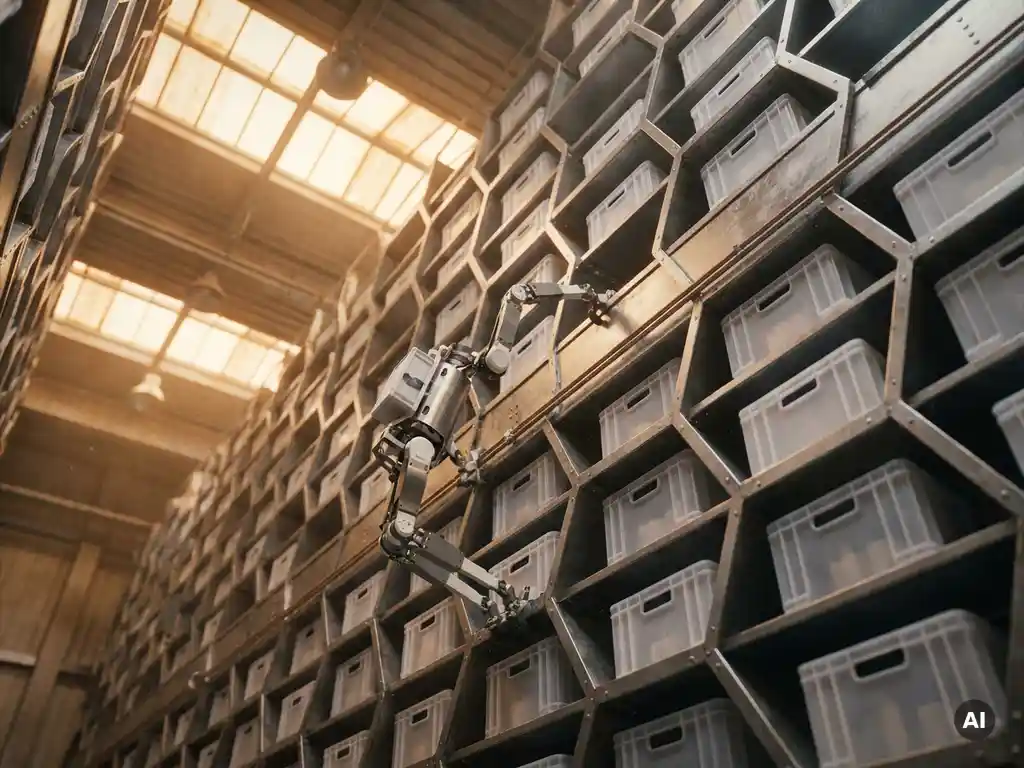
Hexxabotics is built specifically to address the factors that most directly drive warehouse automation return on investment. The system’s hexagonal AS/RS architecture delivers measurable ROI advantages across storage density, throughput scalability, energy efficiency, and long-term flexibility:
- Maximum storage density: The hexagonal tower structure utilizes full cubic volume up to 16 meters, converting vertical space into directly accessible storage positions without reshuffling or digging, reducing the need for facility expansion.
- Independent scalability: Storage capacity and throughput scale independently. Add towers for more capacity, add Hexxabots for more throughput, without structural redesign or operational downtime.
- No in-rack electrification: The passive rack structure eliminates embedded motors, cabling, and powered infrastructure, reducing energy costs, maintenance overhead, and failure risk.
- Distributed resilience: No single point of failure. If one robot unit stops, the system continues operating, protecting throughput during peak demand and reducing unplanned downtime costs.
- Fast integration: Standard API connectivity and a modular architecture reduce integration effort and commissioning time, accelerating the point at which savings begin to accumulate.
If you are evaluating automated storage and retrieval systems ROI for your operation, learn more about Hexxabotics and how the system is engineered to deliver measurable, long-term return on investment.
Related Articles
- How does automated slotting optimization reduce travel time in warehouses?
- What is an autonomous mobile robot used for in logistics?
- What are autonomous mobile robots used for in warehouses?
- How does AI improve warehouse inventory optimization?
- When should a 3PL provider invest in automated fulfillment systems?