
Total cost of ownership (TCO) for warehouse automation is the complete financial picture of an automated system across its entire operational life, covering not just the purchase price but every cost from installation and integration through maintenance, energy, labor, and eventual upgrades. For most operations, the upfront capital investment represents only 40 to 60 percent of what a system actually costs over a 10-year horizon. Understanding the full TCO is essential for comparing automation options accurately and building a business case that holds up under scrutiny. The sections below answer the most common questions buyers ask when evaluating warehouse automation investments.
What costs are included in warehouse automation TCO?
Warehouse automation TCO includes every cost associated with acquiring, deploying, running, and eventually adapting an automated system throughout its operational life. The main cost categories are capital expenditure (hardware, software, and installation), ongoing operating expenses (energy, labor, and consumables), maintenance and repair, integration and IT costs, and end-of-life or reconfiguration costs. No single category tells the full story on its own.
Breaking TCO down into structured categories makes it easier to compare systems that look similar on the purchase order but diverge sharply in long-term cost:
- Capital expenditure (CAPEX): Hardware acquisition, structural modifications to the building, electrical infrastructure, safety systems, and commissioning fees
- Software and integration: Warehouse control system (WCS) or warehouse management system (WMS) licenses, API development, and ongoing software support contracts
- Energy costs: Power consumption of motors, conveyors, lifts, lighting, and climate control within the automated zone
- Labor: Residual headcount for system supervision, exception handling, and maintenance technicians
- Maintenance and spare parts: Scheduled preventive maintenance, unplanned repairs, and the cost of holding spare components
- Downtime costs: Lost throughput during system failures or maintenance windows, which can be significant in high-volume operations
- Scalability costs: The cost of expanding the system when volume grows, including whether expansion requires structural rebuilding or simply adding modular units
A rigorous TCO model assigns realistic figures to each category across the expected system lifespan, typically 10 to 15 years for an AS/RS installation. Operations that skip this exercise often discover that a lower-priced system carries substantially higher operating costs that erode the apparent savings within the first few years.
How does upfront capital cost compare to long-term operating costs?
For most warehouse automation systems, the upfront capital cost is a significant but minority share of total lifetime cost. Operating expenses, including energy, labor, maintenance, and software, accumulate over years and frequently exceed the initial investment. In complex, high-throughput installations, operating costs over a 10-year period can reach 1.5 to 2 times the original capital outlay, making operational efficiency a more important financial variable than purchase price.
This relationship shifts depending on system architecture. Systems with heavy mechanical infrastructure, such as centralized cranes, powered rack systems, and fixed conveyor networks, tend to carry higher ongoing maintenance and energy costs because they rely on a smaller number of high-utilization components. When those components fail or reach end of life, repair or replacement costs are concentrated and disruptive.
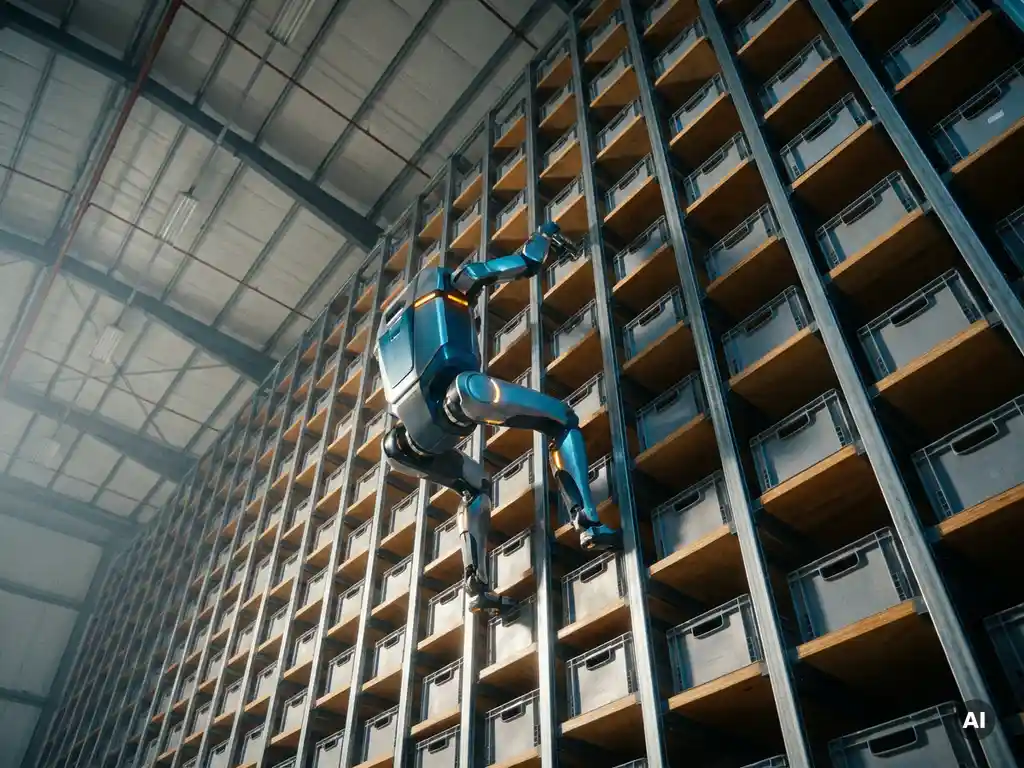
Distributed architectures behave differently. When throughput is delivered by a fleet of autonomous robots rather than a single crane or lift, maintenance costs are spread across many smaller units. A single robot going offline for service does not stop the system. This resilience has a measurable financial value that rarely appears in upfront cost comparisons but shows up clearly in a full TCO model.
Energy is another area where the capital-versus-operating cost comparison matters. Systems that embed motors, conveyors, and electrification into the rack structure consume power continuously, regardless of whether product is moving. Systems designed with passive, non-electrified structures consume energy only when robots are actively working, which reduces the baseline energy draw and flattens power peaks.
What hidden costs do warehouse automation buyers often overlook?
The most commonly overlooked costs in warehouse automation TCO are downtime losses, integration complexity, scalability constraints, and relocation or reconfiguration costs. These costs rarely appear in vendor proposals but can represent a substantial portion of the real lifetime investment, particularly for operations that grow, change product mix, or move facilities over a 10-year horizon.
Downtime and single points of failure
Systems built around centralized equipment, a single crane, a central lift shaft, or a primary conveyor spine, carry a hidden cost in the form of operational exposure. When that core component fails, the entire system stops. The financial impact of unplanned downtime in a high-throughput warehouse can be significant, and it rarely appears in a vendor’s cost model. Distributed systems, where many robots share the workload, eliminate this single point of failure: if one unit is taken offline, the remaining fleet absorbs the throughput without a full stoppage.
Integration and IT overhead
Connecting an automated storage system to an existing WMS or ERP platform is rarely plug-and-play. Custom API development, data mapping, testing cycles, and ongoing software maintenance all carry real costs. Buyers should request detailed integration specifications from vendors and build a realistic IT cost estimate into the TCO model rather than treating integration as a one-time project expense.
Reconfiguration costs are another blind spot. Operations that expect to grow, consolidate facilities, or shift product categories should ask vendors directly whether the system can be relocated or reconfigured, and at what cost. Some AS/RS architectures are effectively permanent once installed. Others are designed to be dismantled and rebuilt, which changes the risk profile of the investment considerably.
How does storage density affect the total cost of ownership?
Storage density directly affects TCO because it determines how much usable storage capacity a given building footprint delivers. Higher density means fewer square meters are needed to hold the same inventory, which reduces building costs, lease expenses, and the infrastructure required to serve that storage. Over a 10-year period, the compounding effect of a smaller, denser footprint can generate savings that rival the system’s original capital cost.
The relationship between geometry and density is worth understanding concretely. Conventional cubic storage structures achieve roughly 74 percent space utilization. Hexagonal storage geometry, which mirrors the structural efficiency of honeycomb, achieves closer to 94 percent utilization within the same volume. That difference translates directly into more storage positions per square meter, which means a smaller building can hold the same inventory, or the same building can hold significantly more.
Vertical density amplifies this further. Systems that can use the full height of a warehouse, up to 16 meters in advanced AS/RS designs, convert what is often dead air space into revenue-generating storage locations. Every additional meter of usable height reduces the horizontal footprint required, and horizontal footprint is one of the most expensive variables in any warehouse operation, whether the facility is owned or leased.
Direct access matters here too. Systems that require digging through inventory to reach a specific tote waste time and reduce effective throughput. When every storage location is directly accessible without reshuffling, the system operates at its rated capacity consistently, which means the productivity assumptions built into the TCO model are more likely to hold in practice.
Can throughput be scaled without increasing TCO proportionally?
Yes, throughput can be scaled without proportional TCO increases, but only in systems where storage capacity and throughput performance are architecturally independent. In traditional AS/RS designs, adding throughput often requires adding cranes, conveyors, or structural elements, each of which carries its own capital cost, maintenance burden, and energy draw. In distributed robotic systems, throughput scales by adding autonomous units to an existing structure, which is a fundamentally different cost curve.
The distinction matters because most warehouse operations do not need to double their storage and their throughput at the same time. A business entering peak season needs more picks per hour, not necessarily more storage locations. A business expanding its SKU range needs more storage, not necessarily faster picking. Systems that force these two dimensions to scale together make it expensive to address either need independently.
When throughput is delivered by a fleet of robots navigating a fixed structure, adding capacity is additive rather than multiplicative. Each additional robot contributes incrementally to throughput without requiring changes to the rack, the software architecture, or the building infrastructure. This linear scaling relationship is one of the most financially significant characteristics an AS/RS can have, because it means the system’s performance envelope grows in proportion to the investment, rather than requiring large step-change capital commitments to reach the next performance tier.
How do you calculate ROI for a warehouse automation system?
ROI for a warehouse automation system is calculated by comparing the total cost of ownership against the quantified financial benefits the system delivers over the same period. The core formula is net benefit divided by total investment, expressed as a percentage. In practice, building a credible ROI model requires identifying and valuing each benefit category, then stress-testing those assumptions against realistic operating scenarios.
Quantifying the benefit side
The main benefit categories for warehouse automation ROI are labor cost reduction, space efficiency gains, throughput improvement, error reduction, and inventory accuracy. Labor savings are typically the most straightforward to calculate: compare the headcount required for manual operations against the residual labor needed to supervise and maintain the automated system, then apply fully loaded labor costs across the projection period. Space efficiency gains are calculated by comparing the cost of the current footprint against what a denser system would require, either as lease savings or as deferred expansion capital. Throughput improvements translate into order fulfillment capacity, which can be modeled as revenue enablement if the operation is currently throughput-constrained.
Building the TCO side of the model
The TCO side of the model should include all cost categories discussed earlier: CAPEX, integration, energy, maintenance, downtime risk, and scalability costs. One practical approach is to build three scenarios, a conservative case, a base case, and an optimistic case, using different assumptions for energy costs, maintenance frequency, and throughput utilization. The range of outcomes gives decision-makers a realistic picture of the investment’s risk profile rather than a single number that may not survive contact with reality.
Payback period is a useful companion metric to ROI. Most warehouse automation investments target a payback period of three to five years, though this varies by system complexity, labor market conditions, and the scale of the operation. Systems with lower ongoing operating costs and higher density reach payback faster because their annual savings are larger relative to the initial outlay.
How Hexxabotics helps reduce warehouse automation TCO
Hexxabotics is designed specifically to address the cost drivers that inflate TCO in conventional AS/RS systems. The architecture separates storage capacity from throughput performance, so operations can scale each dimension independently without rebuilding infrastructure. Key TCO advantages include:
- No in-rack electrification: The hexagonal tower structure contains no embedded motors, conveyors, or powered components, which reduces energy consumption, simplifies maintenance, and eliminates a major category of failure points
- Distributed robotic throughput: Hexxabots operate in parallel with no centralized crane or single point of failure, so the system maintains stable throughput even when individual units are serviced
- Linear throughput scaling: Adding robots increases picks per hour without structural changes, keeping the cost of scaling throughput predictable and proportional
- Maximum storage density: Hexagonal geometry and full vertical utilization up to 16 meters deliver more storage positions per square meter, reducing the footprint and building costs that feed directly into long-term TCO
- Relocatable and reconfigurable: The modular structure can be adapted as operational needs change, protecting the capital investment over a longer horizon
For engineering and operations teams building a TCO model for their next automation investment, Hexxabotics offers a transparent architecture where every cost driver is visible and controllable. Learn more about the system design and scalability approach on the Hexxabotics about page, or contact the team to discuss how the system maps to your specific storage, throughput, and cost requirements.
Related Articles
- What is the difference between a 3PL and a dedicated pharmaceutical warehouse?
- What is direct-access storage and how does it support drug recalls?
- What is cross-docking and how does it influence warehouse design?
- Can warehouse automation lower your energy consumption?
- What is an autonomous mobile robot used for in logistics?