
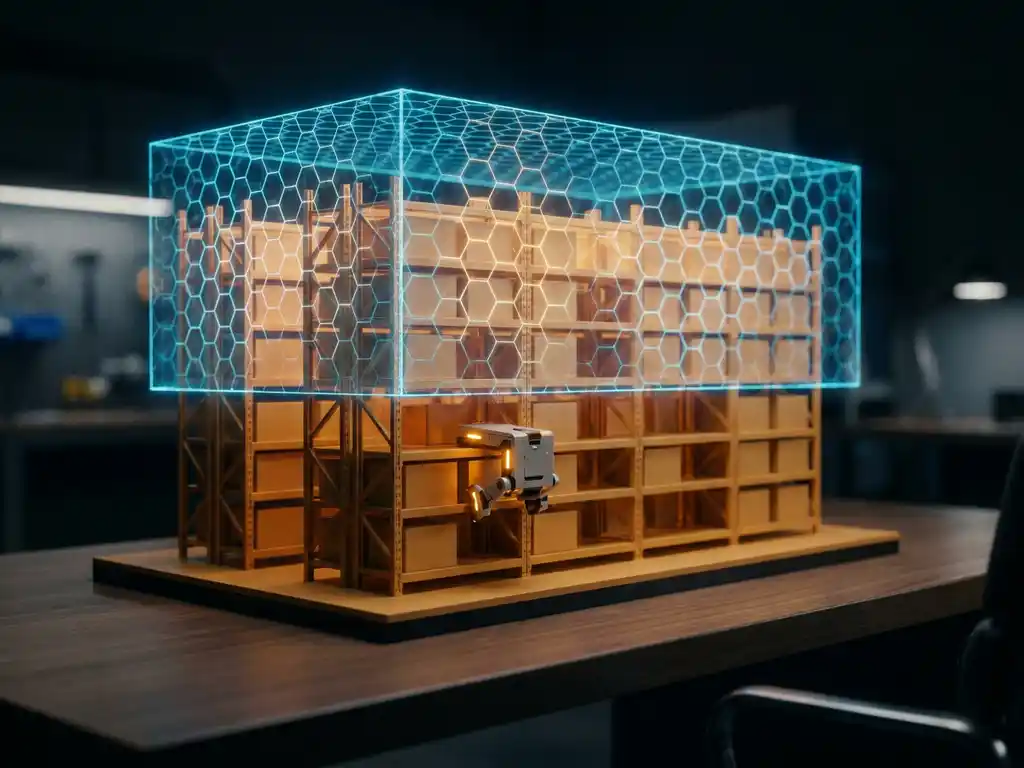
A digital twin in warehouse management is a real-time virtual replica of a physical warehouse environment that mirrors inventory positions, equipment states, workflows, and system logic. It receives live data from sensors, robots, and warehouse software, allowing operators to monitor, analyze, and test operational decisions without touching the physical environment. The sections below unpack how digital twins work, what they can simulate, and where they deliver the most operational value.
What can a digital twin actually simulate in a warehouse?
A warehouse digital twin can simulate inventory locations, robot and vehicle movements, order flow, picking sequences, storage utilization, throughput rates, and system bottlenecks. It replicates both the physical layout and the operational logic of the warehouse, meaning it models not just where things are, but how the system behaves under different conditions.
In practice, this means a digital twin can run scenarios that would be impossible or disruptive to test in a live environment. Operators can simulate what happens when order volume doubles during peak season, when a conveyor segment fails, or when a new product category is introduced. The twin processes these inputs against the current system model and returns predicted outcomes before any physical change is made.
For AS/RS environments specifically, simulation depth extends to robot routing logic, vertical access sequences, and tote positioning within storage towers. A warehouse automation system that provides direct access to every storage location without reshuffling gives the digital twin a cleaner data model to work with, because there are no hidden dependency chains between totes to account for.
How does a digital twin connect to warehouse hardware and software?
A warehouse digital twin connects to physical hardware through sensors, control systems, and data interfaces that feed real-time state information into the virtual model. On the software side, it integrates with the Warehouse Management System (WMS) and, where applicable, the automation control layer, pulling inventory data, order queues, and system events continuously.
The connection architecture typically involves three layers:
- Data ingestion: Sensors on robots, conveyors, and storage locations report position, status, and performance metrics in real time.
- Control system integration: The automation control layer, which manages robot coordination and task assignment, shares its operational state with the twin so the virtual model reflects actual robot behavior.
- WMS synchronization: Inventory records, order data, and fulfillment logic from the WMS keep the twin’s representation of stock positions and demand patterns accurate.
Standard APIs are the most common integration method, allowing the digital twin platform to communicate bidirectionally with existing warehouse software without requiring a full infrastructure overhaul. This matters for operations that need to layer digital twin capability onto a running system rather than rebuilding from scratch.
What’s the difference between a digital twin and a warehouse simulation?
The key difference is that a digital twin is connected to and continuously updated by the real warehouse, while a warehouse simulation is a standalone model built from historical data or assumptions. A simulation answers “what if” questions using a static snapshot. A digital twin answers “what is happening right now” and “what will happen next” using live operational data.
Warehouse simulations are valuable during the design and planning phase, when no physical system exists yet. Engineers use them to validate layout decisions, estimate throughput under different configurations, and stress-test system assumptions before committing to infrastructure. The output is a projection, not a reflection of reality.
A digital twin, by contrast, is a persistent operational tool. It does not replace simulation; it extends it. Once a warehouse is live, the twin inherits the simulation model and keeps it synchronized with real conditions. This means the same model used to plan the system can later be used to optimize it, diagnose faults, and plan future expansions, all without creating a separate planning environment from scratch.
How do digital twins improve throughput and storage performance?
Digital twins improve throughput and storage performance by making the operational logic of a warehouse visible and testable in real time. They identify where throughput is being lost, whether due to routing inefficiencies, congestion, suboptimal tote placement, or underutilized storage zones, and allow operators to correct those issues before they compound.
On the throughput side, the twin models robot or vehicle task assignments and can surface situations where robots are traveling empty, where pick sequences are inefficient, or where a particular zone is creating a queue. Operators can adjust task allocation rules within the twin, observe the projected impact, and then push the optimized configuration to the live system.
For storage performance, the twin tracks utilization across the entire storage volume and can recommend slotting changes based on order frequency, product velocity, and retrieval patterns. In high-density vertical storage systems, where vertical space is the primary capacity driver, the twin helps ensure that fast-moving SKUs are positioned to minimize retrieval cycle time, while slow-moving stock is placed in locations that do not interfere with peak throughput.
Because capacity and throughput can behave independently in modern AS/RS architectures, the digital twin needs to model both dimensions separately. Adding robots increases throughput. Extending the storage structure increases capacity. The twin helps operators understand which constraint they are actually hitting before they invest in expanding either dimension.
Which warehouse operations benefit most from a digital twin?
The warehouse operations that benefit most from a digital twin are those with high variability, high complexity, or high cost of failure. These include AS/RS management, peak demand planning, slotting optimization, robot fleet coordination, and maintenance scheduling. Operations where a single decision affects many downstream processes gain the most from having a live model to test against.
E-commerce fulfillment is a strong use case because order profiles change rapidly and the cost of a throughput bottleneck during peak periods is immediate and measurable. The digital twin allows fulfillment teams to simulate the impact of promotional events or seasonal volume spikes and pre-position inventory and robot capacity accordingly.
Spare parts and 3PL logistics operations also benefit significantly. Spare parts warehouses typically manage large SKU counts with unpredictable demand patterns, making slotting decisions difficult without a model that reflects real retrieval frequency. Third-party logistics providers managing multiple clients within a shared facility can use the twin to simulate how changes to one client’s inventory volume affect the overall system without disrupting live operations.
Pharmaceutical and food and grocery environments add a compliance dimension, where the twin supports batch traceability and expiry management by modeling first-expiry-first-out logic and validating that the physical system is executing it correctly.
What does it take to implement a digital twin in an existing warehouse?
Implementing a digital twin in an existing warehouse requires three foundational elements: reliable real-time data from the physical environment, a software platform capable of building and maintaining the virtual model, and integration with existing WMS and automation control systems. The complexity of implementation scales with the complexity of the warehouse and the quality of existing data infrastructure.
The most common implementation challenges are:
- Data quality and coverage: If sensors are sparse or inventory records are inconsistent, the twin’s accuracy is limited from the start. A data audit before implementation is essential.
- Integration effort: Connecting the twin to existing WMS platforms and automation controllers requires API compatibility. Systems with standard, well-documented APIs reduce this effort significantly.
- Model fidelity: Building an accurate virtual representation of the physical layout, storage logic, and robot behavior takes time. Starting with a high-quality simulation model from the design phase shortens this process considerably.
- Organizational readiness: The twin generates insights that require someone to act on them. Without defined processes for reviewing twin outputs and translating them into operational decisions, the technology underperforms.
For warehouses running modular automation systems, implementation is typically more straightforward because the underlying architecture is consistent and well-documented. Systems where storage capacity and throughput scale independently, and where no embedded rack electrification complicates the sensor landscape, provide a cleaner foundation for a digital twin to model accurately.
How Hexxabotics supports digital twin-ready warehouse automation
Hexxabotics is built on an architecture that aligns naturally with digital twin implementation. Its design removes many of the variables that make warehouse digital twins difficult to build and maintain accurately.
- Direct access to every storage location: No reshuffling or dependency chains means the twin’s inventory model is always clean and predictable.
- Independent scalability: Capacity and throughput scale separately, so the twin can model each dimension independently and give operators precise guidance on which constraint to address.
- No in-rack electrification: Fewer embedded components mean fewer failure points for the twin to monitor and fewer variables to account for in predictive maintenance models.
- Standard API integration: The Hexxabotics Control System connects to external WMS platforms through standard APIs, reducing the integration effort required to synchronize live operational data with a digital twin platform.
- Distributed robot operation: Parallel Hexxabot operation with no single point of failure gives the twin a stable, consistent data stream even during peak demand.
If you are evaluating warehouse automation infrastructure with digital twin capability in mind, the underlying system architecture matters as much as the twin platform itself. Talk to the Hexxabotics team to understand how the system’s design supports real-time operational modeling and long-term scalability.