
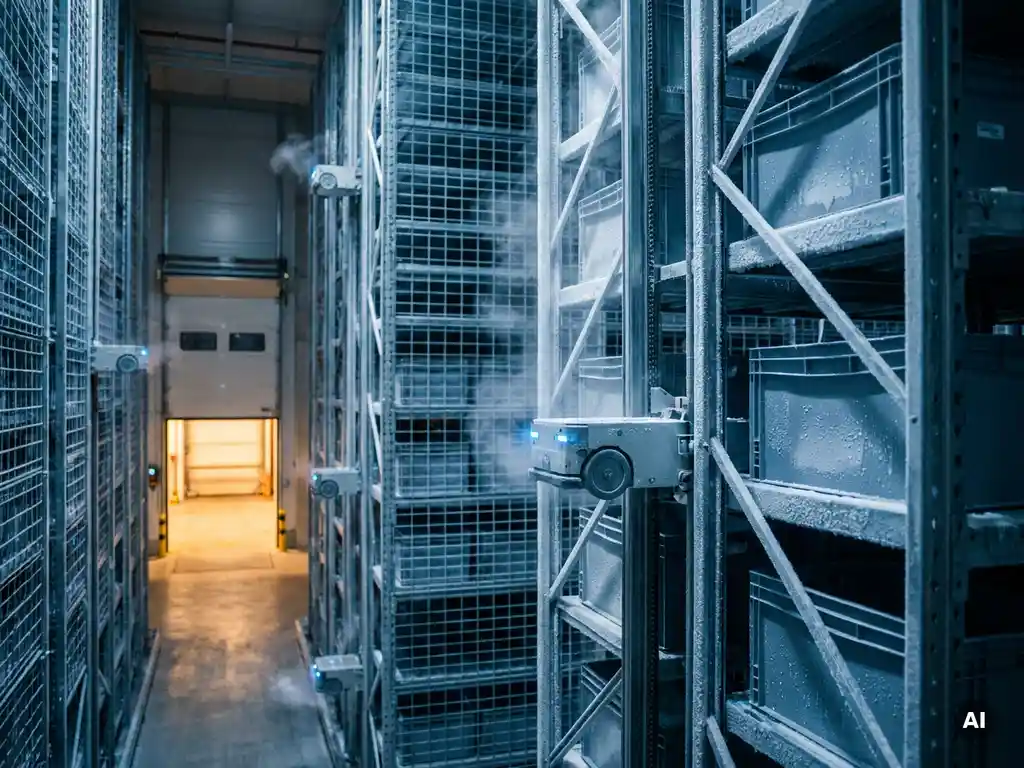
Temperature-controlled storage fundamentally changes warehouse layout requirements by forcing every design decision to account for the thermal envelope first. Refrigeration infrastructure, insulation boundaries, and controlled access points all consume space and constrain where racking, aisles, and workstations can go. The result is a warehouse that must balance thermal efficiency against operational throughput from the earliest planning stage. The sections below address the most common questions engineers and operations planners face when designing or upgrading a cold chain facility.
What layout zones does a temperature-controlled warehouse require?
A temperature-controlled warehouse requires clearly separated thermal zones, each maintained at a defined temperature range, along with transition areas that prevent warm air from entering cold spaces. The core zones typically include ambient receiving, chilled storage, frozen storage, and a staging or dispatch area. Each zone must be physically enclosed, and movement between them requires airlocks or rapid-roll doors to limit thermal transfer.
Beyond the primary storage zones, a well-designed cold storage warehouse layout must also account for:
- Receiving docks with dock seals or enclosed loading bays to protect temperature integrity during inbound transfers
- Quarantine or quality-hold areas within the appropriate temperature band
- Pick and pack stations positioned at the boundary between cold storage and ambient dispatch
- Mechanical plant rooms housing refrigeration compressors, condensers, and control systems
- Staff welfare areas outside the cold zone, since sustained exposure to low temperatures limits worker time on the floor
Each of these zones adds to the total building footprint and must be planned before racking or automation layouts are drawn. The thermal boundary is not negotiable after construction, which means zone planning errors are expensive to correct.
How does refrigeration infrastructure affect usable floor space?
Refrigeration infrastructure reduces usable floor space in a cold storage warehouse in several direct ways. Insulated wall panels are significantly thicker than standard construction walls, reducing internal dimensions relative to the external building footprint. Evaporator units mounted at ceiling level or on walls create clearance requirements beneath them. Refrigerant pipework and electrical conduit running along walls and across the ceiling further constrain where tall racking structures can be positioned.
The practical consequence is that the effective storage envelope inside a refrigerated warehouse is smaller than the gross building area suggests. Engineers designing cold chain warehouse layouts must work from the internal clear dimensions after insulation, not from the external shell. In facilities with low eave heights, ceiling-mounted evaporators can eliminate the upper portion of the racking zone entirely, compressing storage into a narrower vertical band.
This is precisely why cubic-space utilization becomes a more useful planning metric than floor area alone in cold storage environments. Every square meter of insulated floor that is occupied by an aisle, a plant room, or refrigeration equipment represents both a capital cost and a lost storage opportunity. Dense vertical storage systems that exploit building height rather than spreading across the floor can recover a meaningful proportion of that lost capacity within the same thermal envelope.
Why do aisle width and racking design differ in cold storage?
Aisle width and racking design differ in cold storage primarily because the cost of the thermal envelope makes wasted space more expensive than in ambient warehouses, and because the equipment operating in cold environments has different performance characteristics. Conventional wide-aisle forklift operations that are acceptable in ambient facilities become difficult to justify in refrigerated warehouses where every aisle represents insulated floor space that must be cooled continuously.
Several factors drive the design differences:
- Equipment performance in low temperatures: Standard forklifts and reach trucks require cold-store specification variants with heated cabs and battery systems rated for low-temperature operation. Their turning radii and lift heights may differ from ambient equivalents, affecting aisle width calculations.
- Operator exposure limits: Regulations and occupational health standards restrict the time workers can spend in freezer environments. Shorter operator cycles mean that aisle layouts optimized for human navigation become less relevant as automation becomes more attractive.
- Condensation and ice formation: Moisture introduced by personnel, vehicles, and air exchanges can accumulate on floors and racking, creating safety and structural concerns that influence how aisles are designed and drained.
- Fire suppression system placement: Sprinkler heads and suppression pipework must remain functional at low temperatures, and their placement can restrict racking height and configuration.
Narrow-aisle and very-narrow-aisle racking systems are more common in cold storage precisely because they reduce the proportion of the thermal envelope dedicated to movement rather than storage. Any reduction in aisle space directly reduces the refrigeration load required to maintain temperature across that area.
How does throughput design change when storage is temperature-controlled?
Throughput design in a temperature-controlled warehouse must account for the fact that goods spend as little time as possible outside their required temperature band. This constraint compresses the time available for picking, consolidation, and dispatch, and it places greater pressure on the speed and reliability of retrieval systems. A throughput bottleneck that would be a minor inconvenience in an ambient warehouse can become a cold chain compliance failure in a refrigerated facility.
The design implications are significant. Goods-to-Person workstations positioned at the thermal boundary allow pickers to work in an ambient or semi-ambient environment while the storage system operates within the cold zone. This protects both product integrity and worker welfare simultaneously. The retrieval system must then be capable of delivering totes or cases to those workstations at a rate that matches order demand without creating queues that leave product waiting outside temperature control.
Throughput resilience is also more critical in cold storage than in ambient environments. A system that depends on a single mechanical component for all retrieval creates a risk that a single failure halts all output. Distributed retrieval architectures, where multiple autonomous units operate in parallel so that the failure of one unit does not stop the rest of the system, are better suited to cold chain operations where continuity is a compliance requirement as well as an operational preference.
What automation technologies are best suited for cold storage environments?
Automation technologies best suited for cold storage environments are those that minimize the need for human presence inside the cold zone, operate reliably at low temperatures, and do not require extensive in-rack electrification that would complicate maintenance in a sealed refrigerated space. Goods-to-Person AS/RS systems, autonomous mobile robots, and shuttle-based storage systems are all used in cold chain applications, though their suitability depends on the specific temperature band, SKU profile, and throughput requirements of the facility.
Key selection criteria for cold storage automation include:
- Operating temperature range: Systems must be specified for the target temperature band, whether chilled or frozen, and all mechanical and electronic components must be rated accordingly
- In-rack electrification requirements: Powered rack infrastructure in a sealed cold environment creates maintenance complexity; systems that place electrical components in the robots rather than the structure simplify servicing
- Direct access to all storage locations: Retrieval architectures that require moving other totes to reach a requested one are slower and less suitable for environments where speed matters for cold chain compliance
- Scalability without structural redesign: Cold storage expansion is expensive because it requires extending the thermal envelope; automation that can scale capacity and throughput independently reduces the frequency of major structural interventions
Systems that operate without in-rack electrification are particularly relevant to cold storage because they reduce the number of electrical connections that must be maintained inside a sealed, low-temperature environment. Autonomous robots that charge while in operation and carry their own power source into the storage zone simplify the infrastructure requirements considerably.
How should warehouse layout planning account for cold storage expansion?
Warehouse layout planning should account for cold storage expansion by treating the thermal envelope as a modular boundary that can be extended, not as a fixed wall. This means designing the initial installation so that the insulated structure, refrigeration plant, and automation system can all grow in the same direction without requiring the existing operation to stop. Expansion joints, oversized plant room capacity, and automation architectures that add capacity through additional units rather than structural redesign all contribute to a more expandable facility.
A common planning error is sizing the initial cold store to current inventory volumes without leaving a clear expansion path. When demand grows, the options become either a full building extension, which is disruptive and expensive, or the use of external cold storage, which adds cost and complexity to the cold chain. Planning for a defined expansion corridor from the outset, even if it remains ambient or unused initially, preserves the option to extend the thermal envelope later without relocating the entire operation.
The automation system inside the cold store should follow the same logic. Storage capacity and throughput that can be expanded independently of each other give planners more flexibility when growth takes unexpected forms. A facility that acquires many additional SKUs without a proportional increase in daily order volume needs more storage locations, not necessarily more retrieval speed. A system that can respond to these two forms of growth separately avoids the cost of oversizing one dimension simply to obtain more of the other.
How Hexxabotics helps with cold storage warehouse layout
Hexxabotics is designed for exactly the constraints that make cold storage layout planning difficult. Its hexagonal vertical AS/RS converts full cubic warehouse volume into usable storage up to 16 meters in height, reducing the floor area needed for storage and leaving more of the thermal envelope available for operational zones. Because the rack structure contains no embedded electrification, maintenance inside the cold zone is simpler and less disruptive. Key capabilities relevant to cold chain environments include:
- 100% direct access to every storage location, eliminating retrieval delays that risk cold chain compliance
- Distributed autonomous Hexxabots that continue operating if one unit stops, maintaining throughput during peak demand
- Independent scaling of storage capacity and throughput, so SKU growth and order volume growth can be addressed separately
- No in-rack electrification, reducing infrastructure complexity inside sealed refrigerated spaces
- A modular architecture that can expand during regular operations without stopping daily processes
If you are planning a temperature-controlled facility or rethinking an existing cold chain layout, explore Hexxabotics to understand how a dense, directly accessible AS/RS can work within your thermal envelope.
Related Articles
- How do you choose the right racking system for pharmaceutical warehousing?
- How does warehouse design impact GMP compliance for pharmaceuticals?
- What is the difference between cold chain and ambient pharmaceutical storage?
- How do you conduct a pharmaceutical lot recall from a warehouse?
- What is cross-docking and how does it influence warehouse design?