
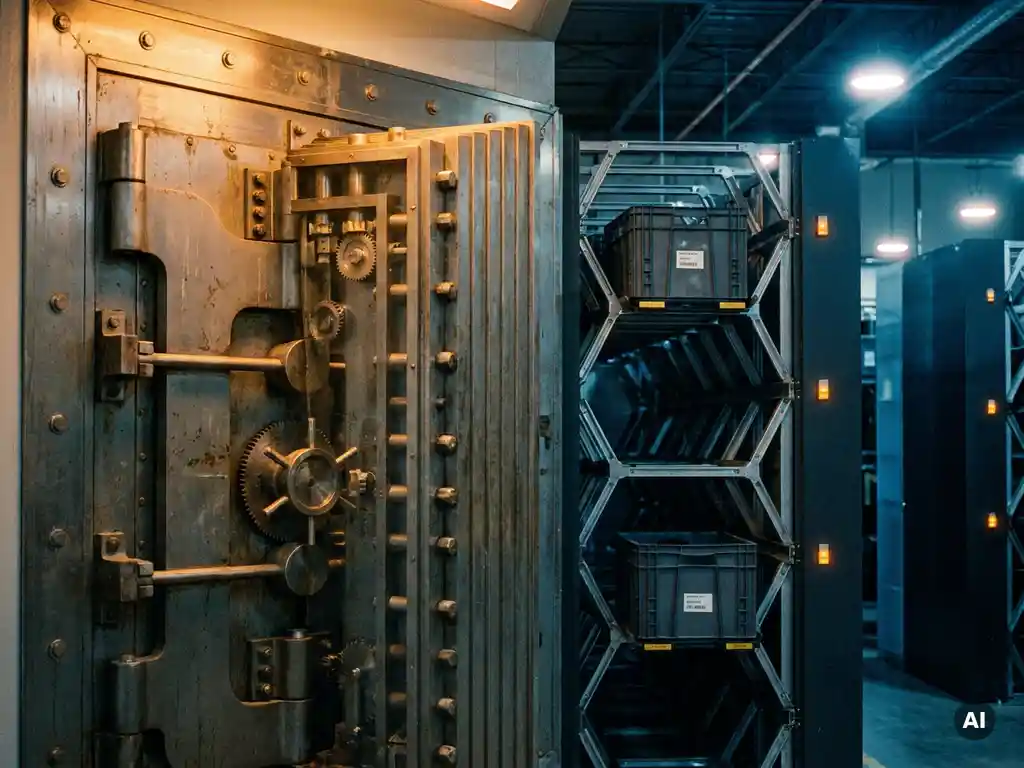
DEA Schedule I substances have significantly stricter storage requirements than Schedule II substances. Schedule I drugs have no accepted medical use in the United States, so they are subject to the most restrictive physical security standards the DEA enforces. Schedule II substances, while still tightly controlled, are approved for medical use and carry a slightly less severe security burden. The sections below cover the specific rules, approved storage hardware, access controls, recordkeeping obligations, and consequences of non-compliance for both schedules.
What storage requirements apply to Schedule I substances?
Schedule I controlled substances must be stored in a securely locked, substantially constructed cabinet or safe that meets DEA specifications under 21 CFR Part 1301. Because Schedule I drugs have no recognized medical use and carry the highest abuse potential, the DEA requires the most stringent physical security measures for any facility authorized to handle them, which in practice means only DEA-registered research institutions and approved laboratories.
The core storage requirement is that Schedule I substances must be kept in a vault or safe that is anchored to the structure of the building or is heavy enough to resist removal. The DEA evaluates the construction of the enclosure, the locking mechanism, and the alarm systems in place. Facilities must also have an electronic alarm system that detects unauthorized entry and reports to a monitoring station or law enforcement. The storage area must be separate from other controlled substances and from general inventory, and access must be restricted to the smallest possible group of authorized personnel.
Because Schedule I registration is rare and purpose-specific, the DEA reviews each applicant’s security plan individually before granting registration. There is no standard commercial pharmacy or distributor handling Schedule I drugs under normal circumstances. Any deviation from the approved security plan must be reported to the DEA promptly.
How do Schedule II storage rules differ from Schedule I?
Schedule II controlled substance storage rules differ from Schedule I primarily in the level of physical security required and the range of facilities authorized to store them. While both schedules demand locked, substantially constructed storage, Schedule II substances can be stored in a wider variety of DEA-compliant safes and vaults, and the facilities authorized to handle them include pharmacies, hospitals, practitioners, and distributors, not just research institutions.
Under 21 CFR 1301.72, Schedule II through V non-narcotic substances may be stored in a securely locked, substantially constructed cabinet. However, Schedule II narcotics must be stored in a safe or steel cabinet equivalent in construction to a safe. The practical distinction is that Schedule I requires vault-grade or equivalent storage with a comprehensive alarm system as a baseline expectation, while Schedule II permits a broader range of compliant enclosures depending on the facility type and the quantity stored.
Another meaningful difference is context. Schedule II substances are dispensed daily in clinical and retail settings, so the DEA’s rules are designed to balance security with operational practicality. Schedule I storage rules, by contrast, assume a research or analytical context where operational throughput is not a primary concern. The result is that Schedule II compliance frameworks are more detailed in their guidance for commercial operations, covering everything from pharmacy safes to hospital medication rooms.
What types of safes or vaults does the DEA approve for each schedule?
The DEA does not publish a formal list of approved safe brands or models, but it specifies construction and security standards that storage equipment must meet. For Schedule II narcotics and Schedule I substances, the enclosure must be equivalent in security to a steel safe with a combination or key lock that resists forced entry. For Schedule II non-narcotics and Schedules III through V, a securely locked, substantially constructed cabinet meets the standard.
Storage hardware standards for Schedule I
For Schedule I substances, the DEA expects vault-grade or safe-grade storage that is either permanently anchored to the building structure or heavy enough (typically 750 pounds or more when empty) to prevent removal. The enclosure must be combined with an electronic alarm system capable of detecting intrusion and alerting a monitoring service or law enforcement. Facilities undergoing DEA inspection must demonstrate that the physical enclosure, alarm system, and access controls together form a comprehensive security barrier.
Storage hardware standards for Schedule II
For Schedule II narcotics, a steel safe or equivalent cabinet with a combination lock or a key-operated lock that resists manipulation is the standard. For Schedule II non-narcotic substances, a substantially constructed, securely locked cabinet is sufficient in most contexts, though the DEA may require a higher standard based on quantity, facility type, or local risk factors. Pharmacies and hospitals often use purpose-built pharmacy safes or automated dispensing cabinets that meet DEA construction standards and include audit-trail capabilities. Any storage unit used for Schedule II substances should be anchored where possible, and facilities should document the equipment specifications in their security plan.
Who is allowed access to Schedule I and Schedule II storage areas?
Access to Schedule I and Schedule II storage areas must be limited to authorized employees whose job responsibilities require it. The DEA requires registrants to restrict access to the minimum number of employees necessary, and those employees must be identifiable, accountable, and subject to background screening consistent with DEA requirements. No unauthorized individual, including other staff members, contractors, or visitors, should have unsupervised access to controlled substance storage areas.
For Schedule I substances, access is typically limited to the principal investigator or researcher named on the DEA registration and a small number of designated staff. The DEA expects registrants to maintain a clear record of who has access and why. For Schedule II substances in commercial settings such as pharmacies or hospitals, access controls are implemented through key management systems, combination lock procedures, or electronic access systems that log every entry. Automated dispensing cabinets used in clinical environments provide an electronic audit trail that identifies which staff member accessed the cabinet and when.
The DEA also holds registrants responsible for the conduct of their employees. If a staff member with authorized access diverts controlled substances, the registrant faces regulatory liability. This makes access management not just a physical security issue but a compliance and liability issue as well.
What recordkeeping and inventory rules accompany storage compliance?
Recordkeeping for Schedule I and Schedule II controlled substances is more rigorous than for any other schedule. The DEA requires registrants to maintain a complete and accurate inventory of all Schedule I and II substances, conduct a biennial inventory, and keep records of every acquisition, transfer, dispensing, and disposal. These records must be kept separately from records for other controlled substances and must be available for DEA inspection at any time.
For Schedule I substances, every transaction involving the substance must be documented, including quantities received, quantities used in research, and quantities destroyed. Destruction must follow DEA-approved procedures and be witnessed and recorded. For Schedule II substances, pharmacies and distributors must use DEA Form 222 or the electronic equivalent (the Controlled Substance Ordering System, or CSOS) for every order of Schedule II drugs. This creates a documented chain of custody from manufacturer to distributor to dispenser.
Inventory records for Schedule II must be maintained for a minimum of two years and must be readily retrievable. Any significant loss or theft must be reported to the DEA immediately using DEA Form 106. The combination of physical storage security and meticulous recordkeeping is what gives the DEA the ability to trace any Schedule II substance from its point of manufacture to its point of use or disposal. Gaps in records are treated as seriously as physical security failures during DEA inspections.
What are the penalties for non-compliance with DEA storage regulations?
Non-compliance with DEA storage regulations for Schedule I and Schedule II substances can result in civil monetary penalties, suspension or revocation of DEA registration, and in cases of criminal conduct, federal prosecution. The severity of the penalty depends on whether the violation was administrative, negligent, or intentional, and whether it resulted in diversion of controlled substances into illicit channels.
Administrative violations, such as inadequate storage hardware, insufficient access controls, or recordkeeping gaps, typically result in a warning letter or a show-cause proceeding in which the registrant must explain the deficiency and demonstrate corrective action. Repeat violations or failures to correct known deficiencies can lead to suspension or revocation of the DEA registration, which effectively ends a facility’s ability to handle controlled substances.
Criminal penalties apply when non-compliance involves intentional diversion, falsification of records, or distribution outside the scope of the registration. Under the Controlled Substances Act, criminal penalties for Schedule I and II violations can include substantial fines and imprisonment. Practitioners, pharmacists, and facility operators found responsible for diversion face both federal prosecution and loss of professional licensure. The DEA coordinates with the Department of Justice and state regulatory bodies, meaning that a single serious violation can trigger consequences at multiple regulatory levels simultaneously.
How Hexxabotics supports pharmaceutical storage compliance
While DEA storage regulations focus on physical security and access control, the operational challenge for pharmaceutical distributors goes further: managing thousands of controlled and non-controlled SKUs with full traceability, batch visibility, and reliable inventory accuracy. Hexxabotics addresses the storage and retrieval layer of that challenge with a high-density automated system designed for pharmaceutical environments.
- Direct access to every tote: The architecture ensures every storage location is individually retrievable without moving other inventory, supporting the controlled, predictable access that regulated pharmaceutical operations require.
- Batch and lot traceability: When integrated with a WMS or WES, the system supports retrieval logic driven by batch identity, expiry date, and order requirements, relevant to operations managing controlled substance inventory records.
- Independent capacity and throughput scaling: Storage can be expanded by extending the structure; throughput can be increased by adding robots. Neither change requires structural redesign, which matters for facilities operating under fixed regulatory footprints.
- Compact, high-density footprint: By utilizing full building height up to 16 meters, the system fits more compliant pharmaceutical inventory into an existing facility without requiring expansion or relocation.
- No in-rack electrification: Simplified infrastructure reduces maintenance complexity and supports reliable, auditable operations.
If your pharmaceutical distribution operation needs storage infrastructure that combines density, traceability, and operational reliability, contact Hexxabotics to discuss how the system can be configured for your compliance requirements.
Related Articles
- How do you choose the right racking system for pharmaceutical warehousing?
- What temperature ranges are required for pharmaceutical cold storage?
- What is goods-to-person fulfillment and how does it change warehouse design?
- Should you lease or buy warehouse automation equipment?
- What are the biggest challenges of implementing warehouse automation?