
Third-party logistics providers benefit from warehouse automation by increasing storage density, improving order throughput, reducing labor dependency, and gaining the flexibility to scale operations without expanding their physical footprint. These advantages are especially significant in 2026, as 3PL providers face mounting pressure from e-commerce growth, tighter labor markets, and clients demanding faster, more accurate fulfillment. The sections below unpack the most common questions 3PL decision-makers ask before committing to an automation investment.
What types of warehouse automation do 3PL providers typically use?
3PL providers most commonly use Automated Storage and Retrieval Systems (AS/RS), autonomous mobile robots (AMRs), conveyor and sortation systems, and warehouse management software with automation integrations. Among these, AS/RS technology has gained the most traction in high-density 3PL environments because it combines compact storage with consistent, repeatable retrieval performance across diverse client inventories.
Each automation type serves a different operational need:
- AS/RS systems store and retrieve totes or cases automatically, maximizing vertical space and eliminating manual picking from racking.
- AMRs transport goods horizontally across a warehouse floor, often working alongside human pickers.
- Conveyor and sortation systems move high volumes of parcels or cartons between zones, suited to parcel-heavy operations.
- Goods-to-Person (GtP) workstations bring items directly to a stationary operator, reducing travel time and improving ergonomics.
- Warehouse execution and control systems coordinate robots, inventory logic, and order flow without requiring manual intervention.
For 3PLs managing multiple clients under one roof, AS/RS solutions integrated with a flexible warehouse management system tend to deliver the most consistent results, because they handle mixed SKU profiles without requiring a separate infrastructure per client.
How does warehouse automation improve storage density for 3PL operations?
Warehouse automation improves storage density for 3PL operations by converting underused vertical space into active storage. Traditional racking systems rarely exploit full building height because manual or semi-manual access becomes impractical above a certain level. Automated systems remove that constraint entirely, allowing 3PLs to store significantly more inventory within the same floor area.
The practical difference is substantial. Conventional shelving and pallet racking typically use only a fraction of available cubic volume, particularly when aisle space is factored in. Automated vertical storage systems eliminate most aisle requirements and can reach heights of up to 16 meters, turning previously wasted overhead space into revenue-generating storage positions.
For a 3PL provider, this matters in a direct commercial sense. Denser storage means more client inventory under one roof, which increases billable capacity without requiring a new facility. It also reduces the cost per stored unit over time, improving margin on storage contracts. When every square meter is generating revenue, the economics of the warehouse shift significantly in the operator’s favor.
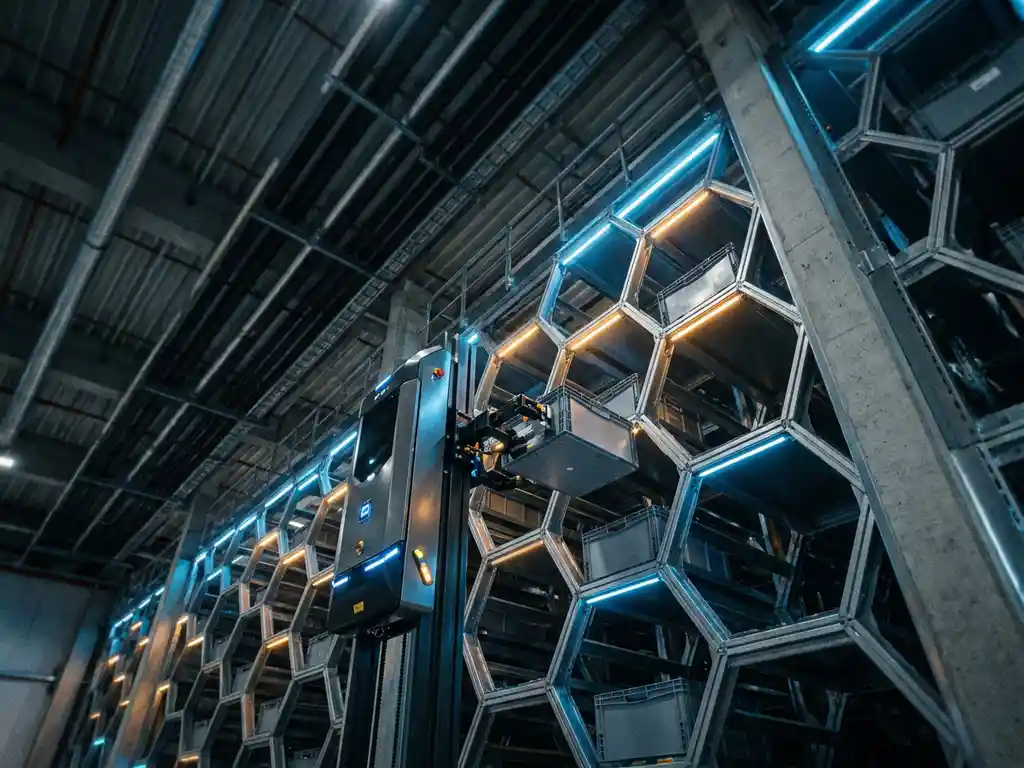
Systems that use a hexagonal or grid-based vertical architecture go further by eliminating the embedded motors, powered racks, and fixed lifting infrastructure that add structural weight and maintenance overhead in traditional high-bay systems. Fewer embedded components mean lower structural complexity and a simpler path to adding storage locations as client volumes grow.
How can 3PLs scale throughput without expanding their facility?
3PLs can scale throughput without expanding their facility by adding autonomous robotic units to an existing automation architecture rather than rebuilding infrastructure. In systems where throughput is decoupled from storage capacity, operators increase picking performance simply by deploying additional robots into the same grid, with no structural changes required.
This is one of the most operationally significant advantages of modern AS/RS technology for 3PL providers. In legacy automation, throughput is often tied to a central crane or conveyor that becomes a bottleneck as order volumes rise. Once that core equipment reaches its limit, the only path forward is a costly infrastructure upgrade.
Distributed robotic architectures solve this differently. Because multiple autonomous units operate in parallel across the same grid, throughput scales linearly with the number of active robots. There is no single point of failure and no centralized crane to replace. A 3PL facing a seasonal peak or a new high-volume client can increase picking output by adding units, then redeploy or redistribute capacity when demand normalizes.
This independent scalability of capacity and throughput is particularly valuable for 3PL business models, where client contracts vary in volume, SKU complexity, and service level requirements. The ability to respond to demand changes without physical construction gives operators a meaningful competitive edge.
What’s the difference between automation built for 3PLs and single-operator warehouse systems?
Automation built for 3PL providers is designed to handle multiple clients, diverse SKU profiles, and variable throughput demands within a single shared infrastructure. Single-operator warehouse systems are typically optimized for one product range, one order profile, and one set of service level requirements. The core difference is flexibility versus optimization for a fixed use case.
Multi-client flexibility in 3PL automation
A 3PL warehouse may store thousands of SKUs across dozens of clients, with each client expecting accurate inventory segregation, independent reporting, and tailored pick rates. Automation built for this environment needs software that supports multi-client inventory logic, API integration with different client WMS platforms, and the ability to handle mixed tote or carton types without reconfiguring hardware.
Systems that require client-specific engineering for each deployment create friction and cost for 3PL operators. Modular architectures that use a consistent structural logic across projects reduce setup time and allow the same infrastructure to serve a new client without redesign.
Fixed optimization in single-operator systems
Single-operator systems, by contrast, are often purpose-built for a specific product type, order structure, or throughput target. A retailer automating their own distribution center can afford to optimize deeply for their own SKU profile, seasonal patterns, and internal processes. The tradeoff is rigidity: when demand shifts or the business model changes, the system may require significant modification to adapt.
For 3PLs, that rigidity is a liability. Client contracts end, volumes shift, and new product categories arrive. Automation that can be reconfigured, relocated, or extended without structural redesign aligns far better with the commercial realities of third-party logistics.
Does warehouse automation reduce labor costs for 3PL providers?
Yes, warehouse automation meaningfully reduces labor costs for 3PL providers, primarily by replacing repetitive manual tasks such as walking, searching, and retrieving inventory with robotic systems that perform those tasks continuously and consistently. The reduction is not always a direct headcount cut; more often it means the same team handles significantly higher order volumes without proportional hiring.
In a Goods-to-Person setup, operators remain at fixed workstations while the system delivers totes directly to them. This eliminates travel time, which in a manual warehouse can account for a large share of each operator’s working hours. The result is more picks per person per hour, which translates directly into lower labor cost per order fulfilled.
Labor savings also extend beyond picking. Automated systems reduce the need for inventory counting, locating misplaced items, and managing congestion in picking aisles. When inventory is always directly accessible and tracked in real time, the administrative overhead of managing a large 3PL warehouse drops substantially.
For 3PL providers operating in markets where warehouse labor is scarce or expensive, automation also reduces exposure to hiring risk. A system that maintains consistent throughput regardless of staff availability provides a more predictable cost structure, which makes it easier to price contracts accurately and protect margins.
When should a 3PL provider invest in warehouse automation?
A 3PL provider should invest in warehouse automation when manual operations are becoming a constraint on growth, accuracy, or profitability. Specific indicators include consistently high labor turnover, inability to meet peak throughput without temporary staff, growing error rates in picking, or clients requesting faster order cycle times that manual processes cannot reliably deliver.
The timing question often comes down to whether the cost of inaction exceeds the cost of investment. If a 3PL is turning away new client contracts because it lacks storage capacity or throughput, or if it is losing existing clients to competitors with faster fulfillment, the ROI case for automation becomes straightforward.
Other situations that signal readiness for automation include:
- A lease renewal or facility expansion that creates a natural opportunity to redesign the warehouse layout.
- A shift toward e-commerce fulfillment requiring faster, smaller-batch picking at higher accuracy rates.
- Increasing SKU complexity that makes manual inventory management error-prone.
- Client contracts that include service level penalties tied to order accuracy or dispatch timing.
- A need to differentiate the 3PL’s service offering to win premium contracts.
Automation does not need to be an all-or-nothing investment. Modular systems that can be expanded incrementally allow 3PL providers to start with a defined scope and grow the infrastructure as client volumes justify additional capacity or throughput. This phased approach lowers initial capital exposure while preserving the ability to scale without rebuilding from scratch.
How Hexxabotics helps 3PL providers with warehouse automation
Hexxabotics offers a next-generation AS/RS system built specifically for the scalability and flexibility demands of 3PL operations. Its hexagonal vertical storage architecture and autonomous Hexxabots address the core challenges that third-party logistics providers face when automating shared warehouse environments. Key advantages include:
- Independent scaling of capacity and throughput — add storage locations or robots without structural redesign, so the system grows with client demand.
- 100% direct access to every tote — no digging, no reshuffling, consistent retrieval performance across all storage positions.
- No in-rack electrification — the passive steel structure reduces maintenance complexity and simplifies relocation when client contracts change.
- Distributed robotic operation — parallel Hexxabot performance eliminates single points of failure and maintains stable throughput during peak demand.
- Standard API integration — connects with existing warehouse management systems without custom engineering per client.
- Vertical density up to 16 meters — converts full cubic warehouse volume into billable storage, maximizing revenue per square meter.
If your 3PL operation is ready to move beyond the constraints of manual warehousing, get in touch with Hexxabotics to discuss how the system fits your specific throughput, capacity, and client requirements.
Related Articles
- Why are fulfillment centers replacing conveyor belts with AMRs?
- What is the difference between AMRs and AGVs in warehouses?
- What are autonomous mobile robots used for in warehouses?
- When should a 3PL provider invest in automated fulfillment systems?
- What does robotic picking mean in a fulfillment center?