
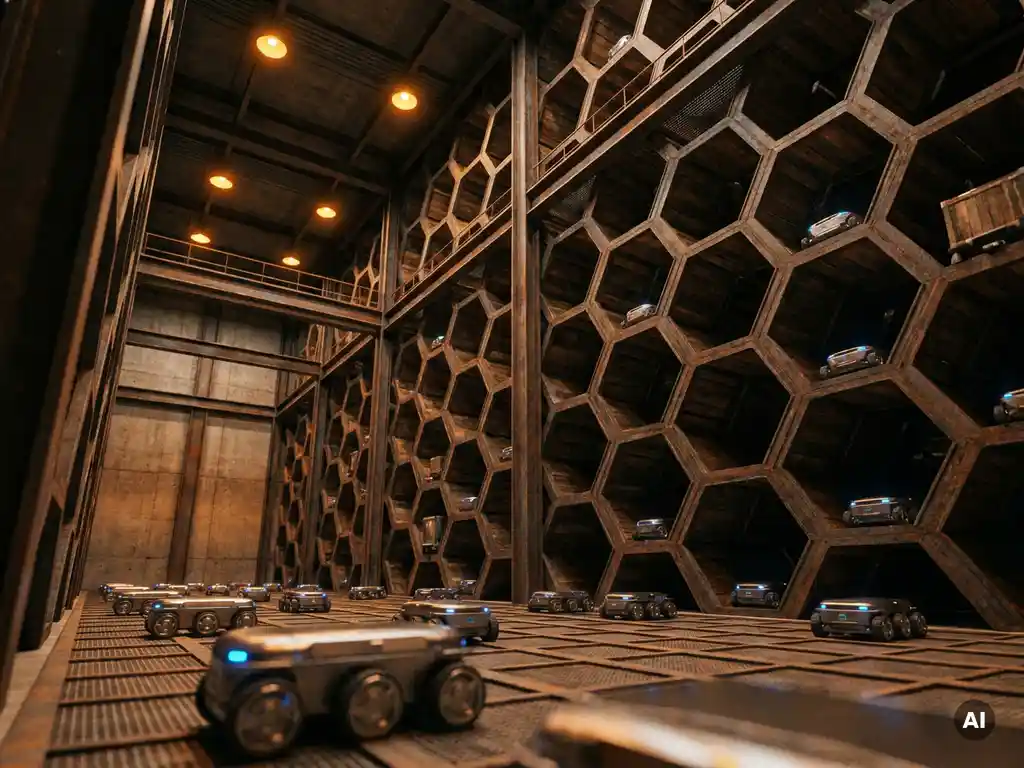
You scale a robot fleet as warehouse demand grows by adding autonomous units to an existing structure rather than rebuilding the infrastructure around them. The key is choosing a system architecture that separates storage capacity from throughput performance so that each dimension can expand independently. The questions below unpack exactly how that works in practice, from identifying what limits scaling to knowing when to extend structure versus deploy more robots.
What limits a robot fleet from scaling with warehouse demand?
The most common barrier to scaling a robot fleet is architectural dependency: when the physical infrastructure and the robots are designed as a single tightly coupled system, adding more robots requires modifying the structure itself. In traditional AS/RS designs, throughput is constrained by centralized equipment such as cranes or fixed vertical conveyors that become bottlenecks before the robot count ever reaches its theoretical limit.
Several specific constraints appear repeatedly in warehouse automation projects:
- Single points of failure: Systems built around a central crane or lift shaft mean one mechanical failure can halt the entire operation. Adding robots does not eliminate this risk when the bottleneck sits in shared infrastructure.
- Fixed vertical access: When vertical movement depends on a centralized lifting core, adding horizontal robots creates queue congestion rather than throughput gains. The vertical channel saturates before the robot fleet does.
- Electrified rack structures: Infrastructure with embedded motors, sensors, and cabling in the racks themselves becomes progressively harder to extend. Each new bay requires electrical integration, increasing both cost and downtime risk.
- Tightly linked capacity and throughput: In many conventional systems, storage density and picking speed are engineered together. Increasing one dimension forces a redesign of the other, which breaks the economics of incremental scaling.
The underlying principle is straightforward: a robot fleet can only scale as freely as its supporting architecture allows. When that architecture was not designed for independent expansion, demand growth forces structural change rather than fleet growth.
What’s the difference between scaling capacity and scaling throughput?
Scaling capacity means increasing the number of storage locations available in the system. Scaling throughput means increasing the number of picks or deposits the system can complete per hour. These are two distinct engineering problems, and the most important insight in warehouse robot fleet management is that they do not have to be solved at the same time or with the same mechanism.
Capacity is primarily a structural question. More storage locations require more physical space, whether that means extending a rack system horizontally or utilizing additional building height vertically. The geometry of the storage structure determines how efficiently floor area and ceiling height convert into usable positions.
Throughput is primarily a robot density question. Given a fixed structure, picking performance scales with the number of autonomous units operating simultaneously within that structure. More robots running parallel cycles produce more picks per hour, provided the architecture does not force them to compete for shared resources like a single crane or a centralized conveyor.
The practical implication for warehouse automation growth planning is significant. A warehouse experiencing a seasonal demand spike needs more throughput, not more storage. A warehouse onboarding a new product line needs more capacity, not necessarily more robots. Systems that force both changes simultaneously impose unnecessary capital expenditure and operational disruption. Architectures that decouple the two allow targeted, proportional investment in whichever dimension the business actually needs.
How do you add more robots to an existing warehouse system?
Adding robots to an existing warehouse system requires three conditions to be met: the physical structure must have space for additional units to operate without interfering with existing ones, the control software must be capable of coordinating a larger fleet without performance degradation, and the robots themselves must be deployable without taking the system offline.
In practice, the process varies significantly depending on the architecture in use. In systems with distributed robot operation, where robots navigate independently beneath a storage grid rather than competing for a shared crane, adding units is largely a matter of commissioning new hardware and registering it with the control system. The structure itself does not change. Throughput scales in proportion to the number of active units because each robot handles its own horizontal and vertical movement independently.
The critical design requirement is the absence of centralized bottlenecks. When every robot has direct access to every storage location without passing through shared equipment, fleet expansion produces linear throughput gains. When robots must queue for a central resource, adding units past a certain threshold produces diminishing returns or active congestion.
Charging strategy also matters at scale. Systems that charge robots while they are in process, rather than requiring dedicated docking time, maintain higher utilization rates as the fleet grows. A robot that charges during motion contributes to throughput continuously rather than cycling in and out of service.
When should a warehouse expand storage structure versus add robots?
A warehouse should expand its storage structure when it is running out of storage locations and inventory is being displaced or delayed. It should add robots when storage locations are available but picks per hour are not meeting demand. The decision point is determined by which constraint is actually limiting operations, not by a general growth target.
Several operational signals indicate a structural expansion is the right move:
- Inventory overflow is occurring, and product is being stored outside the automated system
- SKU count is growing, and new product lines cannot be accommodated within existing locations
- Storage utilization is consistently above the threshold where retrieval efficiency begins to degrade
Signals that point toward adding robots instead include:
- Order backlogs are building during peak hours despite available inventory in the system
- Pick rates are falling short of SLA targets while storage utilization remains manageable
- Seasonal demand spikes require temporary throughput increases that do not justify permanent structural investment
The most operationally efficient approach is to make both decisions independently and incrementally. A well-designed system allows structure to be extended without stopping operations and robots to be added without mechanical redesign. When those two actions can be taken separately, warehouse operators can respond to the specific constraint they face rather than over-investing in the dimension that is not yet limiting performance.
How does robot fleet software manage coordination at scale?
Robot fleet software manages coordination at scale by assigning tasks dynamically across all active units, resolving path conflicts in real time, and distributing workload to prevent any single robot or zone from becoming a bottleneck. The software layer is what transforms a collection of individual robots into a coherent, throughput-optimized system.
At the core of fleet coordination is task allocation logic. The control system continuously monitors the location, charge state, and current assignment of every robot, then assigns incoming storage or retrieval tasks to the unit best positioned to complete them efficiently. As fleet size grows, this logic must scale without introducing coordination latency that offsets the throughput gains from additional hardware.
Path management becomes progressively more complex as robot density increases. In a distributed system where robots navigate beneath a storage grid, the software must prevent collisions and resolve competing routes without forcing robots to stop and wait. Effective systems use decentralized coordination principles, where robots make local decisions within global rules, rather than routing every movement through a central planner that becomes a computational bottleneck.
Integration with external warehouse management systems is equally important at scale. The fleet control system must receive order priorities, inventory updates, and demand signals from the broader WMS in real time so that robot assignments reflect actual business priorities rather than queued tasks from a static list. Standard APIs make this integration achievable without custom engineering for each deployment, which matters significantly when scaling across multiple sites or expanding an existing installation.
How Hexxabotics helps with scaling a robot fleet
Hexxabotics is built specifically to address the scaling constraints described throughout this article. The system’s hexagonal AS/RS architecture separates storage capacity from throughput performance at the design level, so warehouses can expand in the dimension they actually need without rebuilding infrastructure.
- Independent scalability: Capacity grows by extending the hexagonal tower structure. Throughput grows by adding Hexxabots. Neither change requires the other.
- No centralized bottlenecks: Detachable climber units provide distributed vertical access across every tower, eliminating the single points of failure common in crane-based systems.
- No in-rack electrification: The passive steel structure requires no embedded motors or cabling, making structural expansion straightforward and reducing long-term maintenance complexity.
- Linear throughput scaling: Because robots operate in parallel without competing for shared lifting infrastructure, adding units produces proportional performance gains.
- Live scalability: Both structural expansion and robot deployment can occur during regular operations, without shutting down the system.
For automation engineers and system integrators evaluating how to build a warehouse robot fleet that grows with demand, the architecture decisions made at the outset determine how much flexibility remains later. Explore the Hexxabotics system to see how the hexagonal AS/RS approach delivers controlled, predictable scalability from initial deployment through full-scale operation. To understand the engineering principles behind the design, visit the Hexxabotics about page.
Related Articles
- How does a hexagonal grid system change warehouse logistics?
- How does predictive maintenance prevent downtime in automated warehouses?
- What is the difference between an AMR and an AGV in warehousing?
- Should you choose an AMR system or a fixed-rail AS/RS in 2026?
- What is the difference between fixed automation and flexible automation?