
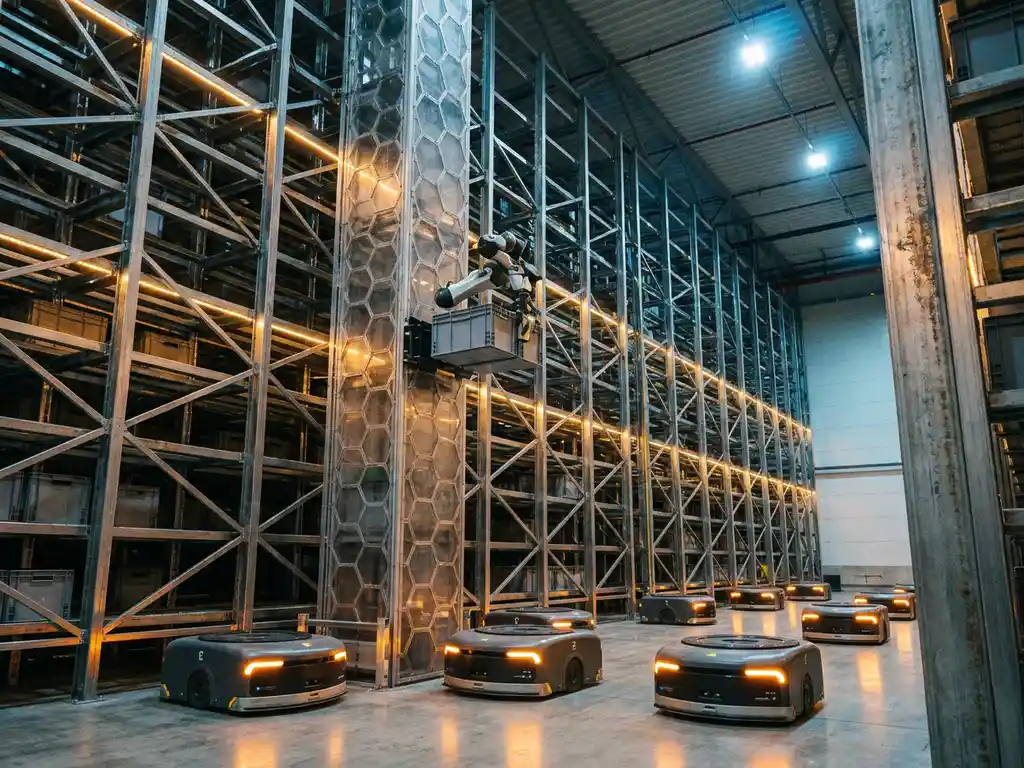
AI coordinates multiple robots in a warehouse by acting as a real-time traffic management and task allocation layer across the entire fleet. Each robot receives dynamic instructions based on current system state, and the AI continuously recalculates routes, priorities, and assignments to prevent collisions and eliminate idle time. The sections below unpack how this works across the specific challenges warehouse engineers face when deploying multi-robot systems at scale.
How does AI coordinate multiple robots in a warehouse without collisions?
AI prevents collisions in multi-robot warehouse environments by maintaining a live spatial model of every robot’s position, trajectory, and task assignment, then resolving conflicts before they occur. Rather than reacting to near-misses, the coordination layer uses predictive path planning to assign non-overlapping routes in real time, reserving grid zones or corridors as robots move through them and releasing those reservations as the robot clears the space.
In practice, this involves several interdependent mechanisms working simultaneously. The AI assigns each robot a time-stamped path through the warehouse grid, factoring in the paths of every other active unit. When two robots are assigned tasks that would bring them into conflict, the system either staggers their departure timing, reroutes one unit, or temporarily holds one in place while the other clears the contested zone.
In distributed architectures where robots navigate beneath a storage grid, horizontal movement coordination is especially critical. The AI must track dozens or hundreds of units moving simultaneously without any centralized physical bottleneck to enforce spacing. This is where real-time sensor feedback, onboard localization, and fleet-level AI logic work together to keep the system collision-free without requiring fixed lane structures or physical barriers.
What tasks does AI actually handle in a robot fleet management system?
In a robot fleet management system, AI handles task allocation, route optimization, traffic coordination, load balancing, exception handling, and predictive maintenance scheduling. These are not separate modules running independently but interconnected functions that the AI resolves together in each planning cycle, ensuring that individual robot decisions serve the overall system’s throughput and reliability goals.
Breaking this down by function:
- Task allocation: The AI matches incoming storage or retrieval requests to the most suitable available robot, factoring in current position, battery level, and queue depth.
- Route optimization: Each robot receives a path that minimizes travel distance while avoiding congestion zones and other active units.
- Traffic management: The AI enforces priority rules and zone reservations to keep robots moving without deadlocks or unnecessary waits.
- Load balancing: Work is distributed across the fleet to prevent some robots from being overloaded while others sit idle.
- Exception handling: When a robot encounters an error, the AI reassigns its pending tasks to other units without interrupting overall throughput.
- Charge management: The AI schedules charging cycles based on battery state and workload forecasts, ensuring robots return to service before they become a bottleneck.
Together, these functions mean that warehouse operators interact with the system at the order level rather than the robot level. The AI translates business demand into robot behavior automatically.
How does AI improve throughput in high-density automated storage systems?
AI improves throughput in high-density automated storage systems by eliminating wasted motion, reducing idle time between tasks, and enabling parallel operation across the full robot fleet. In a well-coordinated system, robots are almost never waiting for instructions or blocked by one another, which means the physical capacity of the hardware is used as fully as possible at any given moment.
One of the most impactful contributions AI makes is batching and sequencing. Rather than processing retrieval requests in the order they arrive, the AI groups tasks by location proximity, robot position, and downstream demand, reducing the total travel distance required to fulfill a given volume of orders. In vertical storage systems, this means the AI can schedule a robot to complete both a deposit and a retrieval in a single vertical cycle, doubling the useful work performed per trip.
In architectures like Hexxabotics, where detachable climber units perform vertical access within each tower independently, the AI coordinates horizontal and vertical movement simultaneously across the full grid. This distributed approach means throughput scales linearly as robots are added because no centralized crane or lift shaft creates a ceiling on performance. The AI ensures each added robot contributes proportional output rather than creating new coordination overhead.
AI also improves throughput indirectly by predicting demand patterns. By analyzing order history and inbound data from a warehouse management system, the AI can pre-position inventory or stage robots near high-velocity locations before peak periods begin, reducing response latency when order volume spikes.
What’s the difference between centralized and decentralized AI coordination?
Centralized AI coordination uses a single system that calculates and issues instructions for every robot in the fleet, while decentralized coordination distributes decision-making across individual robots or clusters, allowing each unit to make local decisions based on shared system state. The key difference is where intelligence resides and what happens when part of the system fails or scales.
Centralized coordination
In a centralized model, a master controller holds the complete picture of the warehouse and assigns every task, route, and timing decision. This approach can produce globally optimal plans because the planner has full visibility. However, it introduces a single point of failure: if the central controller is disrupted, the entire fleet is affected. Centralized systems can also struggle to scale because the computational load grows with every robot added, and communication latency between the controller and individual robots becomes a performance constraint at high fleet sizes.
Decentralized coordination
In a decentralized model, robots share state information across the fleet and make local decisions using shared rules or AI models running onboard or in distributed software agents. This approach is more resilient because no single failure point can halt the whole system. If one robot goes offline, the others continue operating without interruption. Decentralized systems also tend to scale more naturally because adding a robot adds both capacity and local processing rather than adding load to a central bottleneck. The trade-off is that globally optimal planning is harder to achieve, though modern AI techniques like multi-agent reinforcement learning are narrowing this gap significantly.
Most production warehouse systems in 2026 use a hybrid approach: a fleet management layer maintains global state and high-level task allocation, while robots handle local collision avoidance and micro-routing decisions independently.
How does AI in warehouse robots integrate with existing warehouse management systems?
AI in warehouse robots integrates with existing warehouse management systems (WMS) through standard APIs that translate business-level order data into robot-executable tasks. The robot coordination layer sits between the WMS and the physical hardware, receiving order requests from the WMS and returning inventory updates, task completion confirmations, and system status in real time.
From an engineering perspective, this integration typically works in one direction for task input and another for data output. The WMS sends pick, put-away, and replenishment instructions to the robot coordination system, which translates these into specific robot assignments. As robots complete tasks, the coordination system updates inventory positions and reports back to the WMS, keeping stock records accurate without manual intervention.
The practical value of standard API integration is that it does not require replacing or heavily modifying an existing WMS. A warehouse running established enterprise software can add a robotic AS/RS without rebuilding its order management logic. The Hexxabotics Control System follows this model, using standard interfaces to connect with external WMS platforms so that integration effort is minimized and the existing software investment is preserved.
For engineering teams evaluating automation systems, the key questions to verify during integration planning are whether the robot system supports bidirectional real-time data exchange, how inventory discrepancies are reconciled between systems, and what happens to in-flight tasks if the WMS connection is temporarily interrupted.
When does adding more robots stop improving warehouse performance?
Adding more robots stops improving warehouse performance when the system reaches a structural bottleneck that robots cannot resolve, such as a fixed number of workstations, a centralized lift or crane that limits vertical throughput, or an AI coordination layer that cannot efficiently manage the expanded fleet. At that point, additional robots create congestion rather than capacity.
This ceiling is not universal. It depends heavily on the architecture of the storage system. In systems built around centralized cranes or fixed conveyor loops, throughput is capped by the capacity of that core equipment regardless of how many robots are deployed elsewhere. In distributed architectures where every tower has independent vertical access and robots operate in parallel across the full grid, the throughput ceiling is much higher and more directly tied to the number of active robots and the number of goods-to-person workstations receiving output.
The AI coordination layer also has a scaling limit. As fleet size grows, the complexity of route planning and conflict resolution increases. Systems that handle this well maintain near-linear throughput scaling as robots are added, meaning each new robot contributes roughly the same incremental output as the previous one. Systems with less sophisticated coordination start to see diminishing returns earlier because robots spend more time waiting for one another to clear shared zones.
A practical signal that a system is approaching its robot-scaling ceiling is when average robot utilization drops while order queue length remains high. This indicates that the constraint is no longer robot availability but something structural in the system design, whether that is the number of output stations, the coordination logic, or the physical layout of the storage structure.
How Hexxabotics addresses multi-robot warehouse coordination
Hexxabotics is designed from the ground up to support the kind of distributed, scalable multi-robot coordination that this article describes. The system addresses the core coordination challenges through its architecture and control logic:
- No single point of failure: Autonomous Hexxabots navigate beneath the grid independently, so the failure of one unit does not halt the fleet.
- Distributed vertical access: Detachable climber units give every tower its own vertical access, eliminating the centralized lift bottleneck that caps throughput in conventional AS/RS systems.
- Linear throughput scaling: Throughput grows by adding robots, not by rebuilding infrastructure, and the coordination system is built to manage an expanding fleet without degrading per-robot performance.
- Standard API integration: The Hexxabotics Control System connects to existing warehouse management systems through standard interfaces, reducing integration effort for engineering teams.
- 100% direct access: Every storage location is directly reachable, which means the AI never needs to schedule reshuffling cycles, keeping robot utilization focused on productive tasks.
If you are evaluating autonomous warehouse robotics for a high-density storage project, get in touch with Hexxabotics to discuss how the system fits your throughput and integration requirements.