
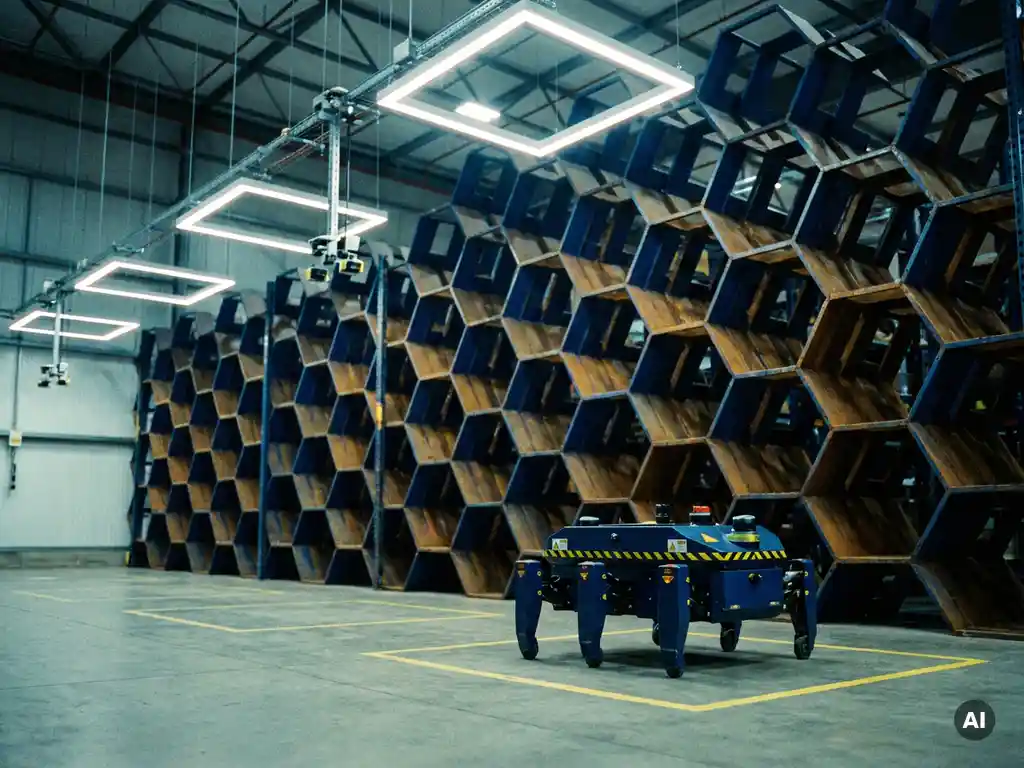
In 2026, autonomous mobile robots operating in warehouses must comply with a set of internationally recognized safety standards, primarily ISO 3691-4 for industrial trucks including AMRs, and ANSI/RIA R15.08 for industrial mobile robots in North America. These frameworks establish the baseline requirements for safe design, risk assessment, and operational behavior. Depending on the deployment region and application, additional directives and sector-specific regulations may also apply. The sections below break down each key compliance question engineers and operations teams face when deploying AMRs today.
Which specific standards govern AMRs in 2026?
The two primary standards governing autonomous mobile robots in 2026 are ISO 3691-4, which covers driverless industrial trucks and their systems, and ANSI/RIA R15.08, the North American standard specifically developed for industrial mobile robots. ISO 3691-4 is the internationally recognized benchmark, while R15.08 provides more granular guidance tailored to AMR-specific behaviors and integration scenarios.
Beyond these two core frameworks, several related standards intersect with AMR deployments. ISO 12100 governs general machinery safety and risk assessment methodology, forming the backbone of any compliant safety analysis. IEC 62061 and ISO 13849 both address functional safety of control systems, which directly applies to the onboard software and sensor logic that AMRs rely on for collision avoidance and path planning. In environments where AMRs work alongside humans, ISO/TS 15066 provides supplementary guidance on collaborative operation thresholds, even though it was originally developed for robotic arms.
The regulatory landscape has matured considerably since the early AMR deployments of the previous decade. Regulators and standards bodies have worked to close gaps that previously left AMR manufacturers and integrators navigating ambiguous territory. In 2026, compliance expectations are clearer, but the number of overlapping frameworks means engineers must map their specific deployment against multiple documents rather than relying on a single standard.
How do AMR safety standards differ from traditional AGV requirements?
AMR safety standards differ from traditional AGV requirements primarily because AMRs navigate dynamically using onboard sensors and real-time path planning, while AGVs follow fixed routes. This fundamental operational difference means AMR standards place significantly more emphasis on perception system performance, dynamic obstacle detection, and behavioral safety in unpredictable environments, rather than the physical guarding and fixed-path safeguarding that AGV standards prioritize.
Traditional AGV standards, including earlier versions of ISO 3691-4 and its predecessor ISO 10218, were designed around systems that travel predetermined paths marked by wires, magnetic tape, or optical guides. Safety measures for those systems could be relatively straightforward: define the path, guard the zone, and stop the vehicle if something enters a fixed detection field.
AMRs operate without fixed paths, which introduces a different category of risk. The robot must continuously assess its environment, predict the behavior of people and other equipment nearby, and make real-time decisions about speed, direction, and stopping. Standards for AMRs therefore specify performance requirements for sensor coverage angles, detection reliability, response times, and the logic governing how the robot reacts to different obstacle types. ANSI/RIA R15.08 in particular introduced a structured approach to evaluating these dynamic behaviors, something that AGV-era standards did not address.
Another key difference is the treatment of fleet-level behavior. When multiple AMRs operate simultaneously in the same space, the interactions between units become a safety concern that traditional AGV frameworks were not designed to handle. AMR standards require that fleet management systems coordinate robot movements in ways that prevent conflicts and maintain safe separation distances across the entire operational area.
What are the core safety requirements AMRs must meet?
The core safety requirements AMRs must meet in 2026 cover four main areas: risk assessment documentation, perception and detection performance, emergency stop capability, and safe speed and separation monitoring. Every compliant AMR deployment must demonstrate that these requirements have been evaluated, tested, and verified before the system enters live operation.
- Risk assessment: A documented risk assessment following ISO 12100 methodology is mandatory. This assessment must identify all foreseeable hazards, evaluate the severity and probability of harm, and define the protective measures implemented to reduce risk to an acceptable level.
- Obstacle detection and response: AMRs must be equipped with sensors capable of detecting people and objects within defined protective fields. The system must reduce speed or stop within specified response times when an obstacle is detected, with performance requirements validated through testing.
- Emergency stop: Every AMR must have a functional emergency stop mechanism that can be triggered manually. The stop function must bring the robot to a safe state without creating secondary hazards such as tipping or load ejection.
- Speed and separation monitoring: In areas where humans and robots share space, the robot must monitor its proximity to people and adjust speed accordingly. This is particularly relevant in goods-to-person environments where operators work near active robot zones.
- Communication and fleet coordination: Where multiple units operate together, the control system must manage traffic, prevent collisions between robots, and maintain safe behavior at the fleet level, not just the individual unit level.
Functional safety requirements under ISO 13849 or IEC 62061 apply to the safety-related control functions, meaning the software and hardware that execute protective behaviors must be designed and validated to a defined Performance Level or Safety Integrity Level.
How does CE marking apply to AMRs sold in Europe?
AMRs sold or deployed in Europe require CE marking, which confirms that the product meets the essential health and safety requirements of the EU Machinery Directive (2006/42/EC), currently being superseded by the EU Machinery Regulation (2023/1230/EU), which will fully apply from January 2027. CE marking is not optional for machinery placed on the European market, and AMRs fall squarely within the definition of machinery under both frameworks.
To achieve CE marking, manufacturers must complete a conformity assessment process that includes a thorough risk assessment, technical file compilation, and the application of relevant harmonized standards. ISO 3691-4 is one of the harmonized standards that can be used to demonstrate conformity with the Machinery Directive’s requirements for driverless industrial trucks. Applying a harmonized standard creates a presumption of conformity for the requirements it covers, which simplifies the path to CE marking.
The transition to the new EU Machinery Regulation introduces updated requirements, particularly around software safety and autonomous decision-making systems. Engineers evaluating AMR deployments in 2026 should be aware that products placed on the market before the Regulation’s full application date may still be assessed under the existing Directive, but any new designs or significant modifications should be evaluated against the incoming requirements to avoid costly redesigns later.
System integrators who purchase AMR components and integrate them into a larger installation may also trigger the role of manufacturer under EU law, making them responsible for the CE marking of the complete system rather than just the individual robot units. This has direct implications for warehouse automation projects where an AMR fleet is combined with conveyors, workstations, and warehouse management software.
Who is responsible for AMR safety compliance in a warehouse deployment?
Responsibility for AMR safety compliance in a warehouse deployment is shared between the robot manufacturer, the system integrator, and the end-user operator, with each party holding distinct obligations. In practice, the integrator often carries the heaviest compliance burden because they combine components from multiple sources into a complete system and are typically responsible for the final risk assessment and CE marking of that system.
The robot manufacturer’s responsibilities
The manufacturer is responsible for ensuring that the individual AMR unit meets the applicable product safety standards, including ISO 3691-4 and any relevant functional safety requirements. They must provide technical documentation, a declaration of conformity where applicable, and clear instructions covering safe use, integration requirements, and maintenance. If the robot is sold as an incomplete machine, the manufacturer must supply a declaration of incorporation and specify the conditions under which it can be safely integrated.
The system integrator’s responsibilities
The integrator takes on responsibility for the complete installation. This includes conducting a system-level risk assessment that accounts for how the AMRs interact with the specific warehouse environment, other equipment, and the people working in that space. The integrator must validate that the fleet management system, safety zones, emergency stop circuits, and operational procedures collectively meet the requirements of the applicable standards. In Europe, the integrator is typically the party who applies CE marking to the complete system and holds the technical file.
The end-user operator’s responsibilities
Once the system is handed over, the operator becomes responsible for maintaining compliance during ongoing use. This includes ensuring that safety zones are not modified without reassessment, that operators receive adequate training, that maintenance is performed according to the manufacturer’s instructions, and that any changes to the operational environment are evaluated for their impact on the original risk assessment. Regulatory bodies in most jurisdictions can hold operators liable if a workplace accident is linked to inadequate maintenance or unauthorized modifications.
What safety validation steps are required before going live?
Before an AMR system goes live, the following safety validation steps are required: completion of the system-level risk assessment, functional testing of all safety-related control functions, verification of detection field coverage and response times, operator training, and formal sign-off documented in the technical file. Skipping or abbreviating any of these steps creates both regulatory exposure and genuine operational risk.
The validation process typically begins during the integration phase, not at the end of it. Risk assessment should be a living document that is updated as design decisions are made, rather than a box-checking exercise completed after installation. By the time physical testing begins, the assessment should already define exactly what needs to be verified and what pass or fail criteria apply.
Functional testing of safety systems must cover all defined protective behaviors under realistic conditions. This means testing emergency stops under load, verifying that detection fields perform as specified at the actual operating speeds the system will use, and confirming that fleet coordination logic prevents conflicts when multiple robots operate simultaneously. Testing in an empty warehouse during commissioning is a starting point, but validation should also include scenarios that reflect peak operational conditions.
Documentation requirements are substantial. The technical file must contain the risk assessment, design drawings, component specifications, test records, and a copy of the declaration of conformity. This file must be retained and made available to regulatory authorities on request. In Europe, the technical file must be retained for at least ten years after the last unit of the product is placed on the market.
Operator training is a formal requirement, not an informal handover. Training records should document what was covered, who received training, and when. Any change to the operational environment, such as a new floor layout or the introduction of additional robot units, should trigger a review of whether existing training remains adequate.
How Hexxabotics Supports Safe AMR Deployment
Hexxabotics has designed its autonomous AS/RS system with compliance-relevant principles built into the architecture from the ground up, making it easier for integrators and operators to meet the safety requirements outlined above. Key features relevant to AMR safety compliance include:
- No in-rack electrification: The passive steel tower structure contains no embedded motors, cabling, or powered components, which reduces the number of failure points and simplifies the safety assessment of the fixed infrastructure.
- Distributed robot operation: Because throughput is distributed across multiple autonomous Hexxabots rather than concentrated in a single crane or lift, there is no single point of failure. If one unit stops, the system continues operating, which supports both safety and uptime requirements.
- Independent scalability: Storage capacity and throughput can be scaled independently without rebuilding infrastructure, meaning safety validations for the base system do not need to be repeated in full when capacity is extended in a controlled, modular way.
- Control system integration: The Hexxabotics Control System manages robot coordination and interfaces with external warehouse management systems through standard APIs, supporting the fleet-level safety coordination that AMR standards require.
If you are evaluating an autonomous storage and retrieval system for a new or existing warehouse and want to understand how the architecture aligns with your compliance requirements, learn more about Hexxabotics or explore the full system to start the conversation with our team.
Related Articles
- What are the benefits of autonomous mobile robots in warehousing?
- Can warehouse automation lower your energy consumption?
- How does a hexagonal grid system change warehouse logistics?
- Should you choose an AMR system or a fixed-rail AS/RS in 2026?
- What is the difference between fixed automation and flexible automation?