
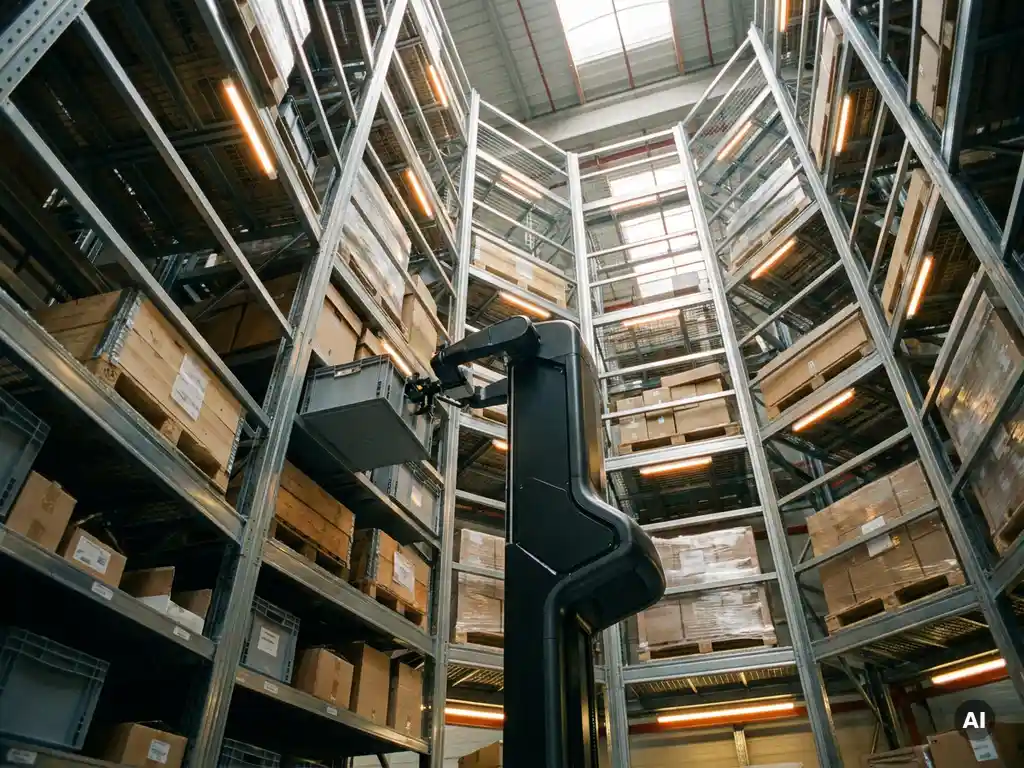
The industries that benefit most from AMR-based warehouse automation are e-commerce fulfillment, pharmaceuticals, food and grocery, fashion and apparel, FMCG, and third-party logistics (3PL). These sectors share a common profile: high SKU counts, variable order volumes, space constraints, and strong pressure to reduce labor dependency. The sections below unpack the specific factors that determine where autonomous mobile robots deliver the greatest return.
Which industries have the highest ROI from AMR deployment?
E-commerce fulfillment, pharmaceutical distribution, food and grocery, and 3PL operations consistently generate the highest ROI from AMR warehouse automation. These industries combine high order frequency, diverse SKU ranges, and tight fulfillment windows, exactly the conditions where autonomous mobile robots replace slow, error-prone manual picking with consistent, scalable throughput.
In e-commerce, the economics are straightforward: order volumes spike unpredictably, labor costs are high, and customers expect same-day or next-day delivery. AMRs address all three pressure points simultaneously. Pharmaceutical warehouses benefit from a different angle: regulatory traceability requirements and the cost of picking errors make automation a compliance tool as much as an efficiency one. Direct-access storage, where every tote is retrievable without reshuffling inventory, is particularly valuable when batch traceability is mandatory.
Food and grocery fulfillment adds another layer: product rotation, temperature sensitivity, and short shelf lives demand fast, accurate retrieval. FMCG operations face similar dynamics during promotional peaks, where throughput demands can multiply overnight. For 3PL providers, the ROI case is structural: a single automated system must serve multiple client profiles, so flexibility and the ability to scale capacity independently of throughput performance are decisive factors.
Fashion and apparel round out the high-ROI group. Seasonal collections, high return rates, and the need to manage thousands of active SKUs simultaneously make dense, directly accessible automated storage far more efficient than conventional shelving or conveyor-based systems.
How does warehouse layout affect AMR performance across industries?
Warehouse layout directly determines how much of an AMR system’s theoretical performance translates into real-world throughput. The key variables are ceiling height, floor space footprint, aisle configuration, and the distance between storage and goods-to-person workstations. Layouts that maximize vertical utilization and minimize travel distance consistently produce better AMR performance.
In traditional flat-floor warehouses, AMRs that operate horizontally are constrained by the building’s footprint. When floor space is expensive or limited, common in urban fulfillment centers and cold storage facilities, the ability to use vertical space becomes a critical differentiator. Systems that combine horizontal robot navigation with vertical climbing inside storage towers can convert full cubic volume into usable storage, rather than treating height as unused overhead.
Aisle width is another layout factor that varies significantly by industry. Pharmaceutical and spare parts warehouses often store small, high-value items in compact configurations where narrow-aisle or no-aisle automated storage outperforms wide-aisle manual racking. Food and grocery operations, by contrast, may need to accommodate mixed tote sizes and temperature zones, which influences how storage towers are arranged relative to picking stations.
The practical implication for engineers planning a deployment is that layout optimization should happen before robot selection, not after. An AMR system designed around a hexagonal vertical grid, for example, can achieve significantly higher storage density per square meter than a flat grid-based system in the same building envelope, but only if the building height and floor plan support that architecture from the outset.
What throughput demands make AMR automation most justified?
AMR automation becomes most justified when a warehouse consistently processes high order volumes with variable peaks, requires parallel picking across many SKUs simultaneously, and cannot afford the labor costs or error rates of manual operations at scale. As a general indicator, operations handling hundreds to thousands of order lines per hour are strong candidates for automated storage and retrieval.
The throughput justification threshold differs by industry. In e-commerce, the trigger is often the peak-to-baseline ratio: a warehouse that handles five times its average volume during peak periods cannot staff up and down efficiently with manual labor. AMR systems that scale throughput by adding autonomous units, rather than rebuilding infrastructure, handle this variability without permanent labor overhead.
For manufacturing and spare parts operations, the justification is less about volume and more about retrieval speed and accuracy. A production line that stalls because a component wasn’t picked correctly carries a cost far exceeding the picking error itself. Here, the value of direct-access storage, where every location is reachable in one motion without digging through inventory, is measured in uptime, not just picks per hour.
FMCG and retail supply operations justify automation through promotional demand cycles. A system capable of throughput ranges from hundreds to thousands of picks per hour, with performance that scales linearly as more robots are added, can absorb promotional peaks without the bottlenecks that cripple centralized crane-based or conveyor-dependent systems. The absence of a single point of failure is particularly important here: distributed robot operation means one unit stopping does not halt the entire system.
How do AMRs integrate with existing warehouse management systems?
AMRs integrate with existing warehouse management systems (WMS) primarily through standard APIs, which allow the automation control layer to exchange order data, inventory positions, and task assignments with the WMS in real time. Most modern AMR systems are designed to sit beneath the WMS in the software stack, receiving instructions and returning confirmations without requiring the WMS to be replaced or heavily customized.
The integration architecture typically works in two directions. The WMS sends order lines or replenishment tasks to the AMR control system, which then coordinates robot movements, prioritizes retrievals, and manages tote positions within the storage grid. Completed tasks are confirmed back to the WMS, keeping inventory records accurate without manual scanning or reconciliation.
For industrial engineers evaluating integration complexity, the critical question is whether the AMR control system supports the communication protocols already used by the existing WMS. REST APIs and standard data formats have become the baseline expectation for enterprise-grade automation systems. Systems that require proprietary middleware or deep WMS customization introduce integration risk and extend deployment timelines.
A practical advantage of well-integrated AMR systems is that they enable goods-to-person workflows without disrupting the broader warehouse operation. Operators at picking stations receive totes automatically, confirm picks through the WMS interface, and return totes to storage, all without interacting with the robot layer directly. This separation of concerns reduces training requirements and makes the automation layer largely transparent to warehouse staff.
What’s the difference between AMRs and traditional AS/RS for industry-specific needs?
The core difference between AMRs and traditional AS/RS systems is how they handle the relationship between storage capacity and throughput. Traditional AS/RS systems, including mini-load cranes and shuttle systems, tie these two dimensions together: adding capacity often means adding infrastructure that also affects throughput, and vice versa. AMR-based systems decouple them, allowing capacity and throughput to scale independently.
Traditional AS/RS: strengths and limitations
Conventional AS/RS systems are well-established and reliable for stable, predictable environments. Mini-load cranes offer high vertical density but become rigid as they scale: each crane serves a fixed aisle, creating bottlenecks when demand spikes. Shuttle systems improve throughput but add mechanical complexity at every tier. The common limitation across traditional systems is that core equipment handles most of the operation: when that equipment reaches its limit, the entire system slows, and expanding beyond that limit typically requires structural changes.
AMR-based AS/RS: distributed performance
AMR-based automated storage and retrieval systems replace centralized lifting and conveying infrastructure with distributed autonomous units. Robots navigate horizontally beneath the storage grid and climb vertically inside towers to perform deposit and retrieval in one continuous motion. Because no single machine controls vertical access, there is no centralized bottleneck. Throughput scales by adding robots; capacity scales by extending the structure. Neither change requires rebuilding the other dimension.
For industry-specific needs, this distinction matters in concrete ways. Pharmaceutical operations benefit from direct access to every storage location without reshuffling, a capability that traditional crane-based systems cannot guarantee at high density. E-commerce operations benefit from linear throughput scaling during peak periods without infrastructure duplication. 3PL providers benefit from a relocatable, reconfigurable architecture that can adapt to changing client requirements without the capital cost of a full system replacement.
When should a business upgrade from manual picking to AMR automation?
A business should upgrade from manual picking to AMR automation when the cost, error rate, or throughput ceiling of manual operations is becoming a structural constraint on growth, not just a temporary inconvenience. The clearest signals are rising labor costs that scale linearly with volume, picking accuracy problems that generate returns or compliance issues, and an inability to meet fulfillment speed requirements during peak periods.
There are several concrete indicators that manual picking has reached its practical limit. First, if adding headcount no longer produces proportional throughput gains, because of congestion, coordination overhead, or physical space constraints, the operation has hit a labor efficiency ceiling. Second, if picking errors are generating measurable downstream costs in returns processing, customer service, or regulatory penalties, the cost of inaccuracy has become a business risk rather than an operational nuisance.
Third, and often underweighted, is the cost of floor space. Manual picking requires wide aisles, accessible shelving heights, and significant horizontal area per SKU. As SKU counts grow and building costs rise, the space inefficiency of manual storage becomes a direct drag on profitability. Automated storage systems that utilize full building height, converting vertical space into revenue-generating storage locations, can effectively expand capacity within an existing footprint.
The timing of the upgrade also matters. Businesses that automate proactively, before manual operations become a crisis, have more flexibility to phase the deployment, integrate gradually with existing WMS infrastructure, and train staff without operational disruption. Businesses that wait until manual picking is actively failing typically face compressed timelines and higher implementation risk. For operations in high-growth sectors like e-commerce, food and grocery, or pharmaceutical distribution, the window for proactive automation is narrowing as competitive fulfillment benchmarks continue to rise.
How Hexxabotics helps with AMR warehouse automation
Hexxabotics delivers a next-generation autonomous AS/RS system built specifically to address the limitations that hold back conventional warehouse automation. For industrial engineers and operations leaders evaluating AMR deployment across demanding industry environments, the system offers:
- Independent scalability: Storage capacity and throughput scale separately: extend the hexagonal tower structure to add locations, add Hexxabots to increase picks per hour, without rebuilding infrastructure
- 100% direct access: Every tote is retrievable in one continuous vertical motion, eliminating digging, reshuffling, and the bottlenecks that come with centralized lifting systems
- No in-rack electrification: The passive steel structure contains no embedded motors, cabling, or powered components, reducing failure points and simplifying maintenance
- Distributed resilience: Parallel robot operation eliminates single points of failure: if one unit stops, the system continues at stable throughput
- Standard API integration: The Hexxabotics Control System connects to existing WMS platforms without requiring proprietary middleware or infrastructure replacement
- Up to 16 meters of vertical density: Full cubic volume utilization converts building height into usable, revenue-generating storage within a compact footprint
Whether you are evaluating your first automated storage deployment or looking to replace a system that has reached its throughput ceiling, learn more about Hexxabotics and explore how the hexagonal AS/RS architecture fits your specific industry requirements.
Related Articles
- What is goods-to-person automation and how does it work?
- How do procurement teams evaluate warehouse automation ROI?
- How does computer vision improve quality control in automated warehouses?
- How does a digital twin work in warehouse management?
- How does warehouse automation affect order processing speed?