
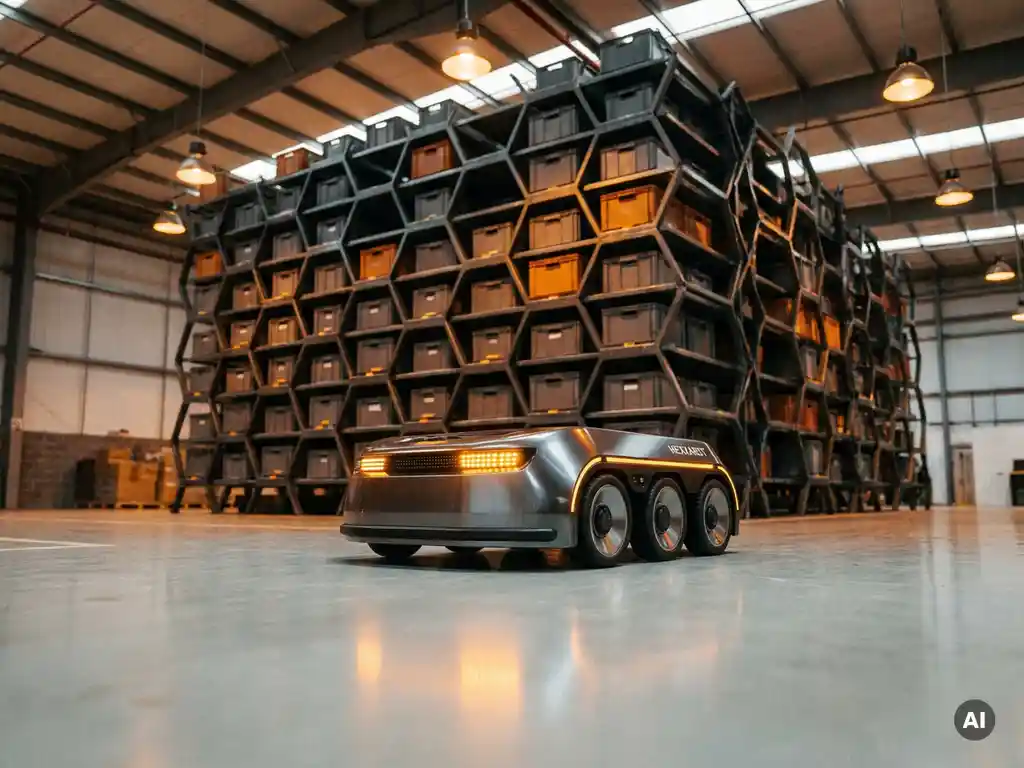
Free-roaming robot technology reduces warehouse downtime by eliminating the centralized mechanical dependencies that cause traditional systems to fail. When robots operate autonomously across a distributed grid rather than relying on fixed cranes or conveyor lines, a single unit stopping does not halt the entire operation. The sections below unpack the specific mechanisms behind this resilience, from navigation architecture to charging strategy and infrastructure design.
What causes the most downtime in traditional warehouse automation systems?
The most common source of downtime in traditional warehouse automation is centralized mechanical dependency. When a single crane, conveyor segment, or fixed lifting system fails, it creates a bottleneck that stops or severely degrades the entire operation. Because throughput in conventional AS/RS systems is concentrated in a small number of high-load components, any failure at those points cascades across the whole system.
Beyond mechanical failure, traditional systems create downtime through structural rigidity. Shuttle-based and mini-load crane systems are difficult to expand without halting operations, meaning that growth itself introduces planned downtime. Similarly, systems with embedded motors and electrified rack structures require scheduled maintenance windows that take equipment offline. The more complex the infrastructure, the more points of potential failure exist, and the longer repairs take when something goes wrong.
Grid-based storage systems add another layer of risk: because items are stacked on top of one another, retrieving a product buried deep in the grid requires moving other totes first. This reshuffling increases robot travel time, creates congestion, and raises the probability of operational errors that interrupt throughput. In environments with high SKU variety or unpredictable demand, this structural limitation becomes a persistent source of slowdowns rather than an occasional event.
How does free-roaming robot navigation eliminate single points of failure?
Free-roaming robot navigation eliminates single points of failure by distributing throughput across many independent autonomous units rather than concentrating it in one or two core machines. In a distributed architecture, if one robot stops, the remaining units continue operating without interruption. The system degrades gracefully rather than failing completely, which is the defining characteristic of resilient warehouse automation.
In the Hexxabotics system, Hexxabots navigate horizontally beneath the storage grid to reposition themselves and then climb vertically inside towers to complete storage and retrieval cycles. Because there are no centralized cranes managing all movement, there is no single mechanical component whose failure would bring operations to a halt. Each robot operates as an independent agent within the grid, coordinated by the Hexxabotics Control System but not dependent on any other unit to complete its task.
This architecture also means that throughput scales linearly. Adding more robots increases performance without requiring structural changes. The classical single-point-of-failure problem found in crane-based systems is structurally absent, not managed around. When peak demand arrives, the system handles it by running more units simultaneously rather than pushing a fixed machine harder until it breaks.
Why does direct-access storage reduce operational interruptions?
Direct-access storage reduces operational interruptions because every storage location is immediately reachable without moving other totes first. In systems that require reshuffling to retrieve a buried item, robots must perform multiple additional movements for every retrieval, increasing cycle time, creating congestion, and raising the risk of errors. Direct access removes this overhead entirely, keeping each retrieval cycle predictable and fast.
In a hexagonal vertical storage grid, every tote location is independently accessible. Robots climb directly to the required position and complete a full deposit-and-retrieve cycle in one vertical interaction, with no empty trips and no dependency on the state of neighboring locations. This means that operational speed does not degrade as inventory fills up or as SKU variety increases, two conditions that reliably cause slowdowns in cube storage and grid-based systems.
The operational consistency that direct access enables is particularly valuable during high-demand periods. When order volumes spike, a system that requires reshuffling compounds its own congestion. A directly accessible system simply processes more requests in parallel, maintaining stable throughput even as the workload increases. For warehouses handling e-commerce, spare parts, or pharmaceutical fulfillment, this consistency directly translates to fewer missed service windows and lower error rates.
How does charging robots in-process prevent downtime from battery management?
Charging robots in-process prevents battery-related downtime by eliminating the need to remove units from operation for dedicated charging cycles. When robots recharge while performing their normal tasks, the fleet maintains continuous availability. No robot needs to leave the grid to dock at a charging station, which means battery management never competes with throughput requirements.
In traditional autonomous mobile robot deployments, battery management is a persistent scheduling challenge. Robots must be pulled from active duty to recharge, which reduces the effective fleet size during charging windows and creates throughput dips that are especially damaging during peak periods. Managing this requires either a larger fleet than operationally necessary or careful scheduling that becomes difficult when demand is unpredictable.
By designing the charging process into the operational cycle itself, the Hexxabotics approach removes this trade-off. Robots maintain their charge as a byproduct of doing their job, which means the fleet size available at any given moment reflects the actual deployed fleet, not the deployed fleet minus however many units are currently docked. This keeps robot uptime consistently high without requiring complex scheduling logic or oversized robot inventories to compensate for charging losses.
What role does independent scalability play in maintaining uptime during expansion?
Independent scalability maintains uptime during expansion by allowing storage capacity and throughput performance to grow separately, without requiring the system to stop or be restructured. In traditional AS/RS systems, adding capacity or throughput typically means halting operations, redesigning infrastructure, or duplicating entire system components. Independent scalability removes this constraint, so growth does not introduce planned downtime.
In the Hexxabotics architecture, capacity grows by extending the hexagonal tower structure horizontally, and throughput grows by adding more autonomous robots to the grid. These two dimensions of growth are fully decoupled. A warehouse that needs more storage locations can add towers without touching the robot fleet. A warehouse that needs faster order processing can add robots without modifying the rack structure. Neither expansion requires stopping daily operations.
This separation is significant for warehouse operators managing seasonal demand or gradual business growth. The ability to scale during regular operations means that expansion projects do not create the service disruptions that traditionally accompany AS/RS upgrades. The system’s consistent architectural logic also means that each expansion follows the same pattern, reducing engineering effort and deployment time compared to systems that require bespoke modifications at each growth stage. You can learn more about the design principles behind this approach on the Hexxabotics about page.
How does removing electrification from the rack structure affect maintenance downtime?
Removing electrification from the rack structure reduces maintenance downtime by eliminating the most failure-prone components from the fixed infrastructure. Embedded motors, cabling, and powered lifting systems inside racks require periodic inspection, repair, and replacement. When these components fail, the rack segment they serve goes offline. A passive steel structure with no in-rack electronics has no equivalent failure mode at the infrastructure level.
In the Hexxabotics system, vertical movement is performed by the robots themselves rather than by motors embedded in the towers. The towers contain no electronics, no motors, and no lifting systems. All active components are concentrated in the robots, which are detachable and individually serviceable. If a robot requires maintenance, it is removed and replaced without affecting the rack structure or the robots continuing to operate around it.
This design also simplifies the maintenance process itself. Technicians servicing a robot unit work on a discrete, portable component rather than navigating a complex electrified structure. Fault diagnosis is faster, replacement is straightforward, and the scope of any single maintenance event is limited to one unit. The result is shorter maintenance windows, lower maintenance complexity, and a rack infrastructure that remains fully operational regardless of what is happening with individual robots.
No in-rack electrification also reduces energy consumption and removes the need for power distribution cabling throughout the structure. This simplifies installation, lowers the total cost of ownership, and makes the system relocatable, a practical advantage for 3PL operators or any warehouse that may need to move or reconfigure its automation over time.
How Hexxabotics helps reduce warehouse downtime
Hexxabotics has built its autonomous AS/RS system specifically to address the structural causes of warehouse downtime rather than managing around them. The system combines several design decisions that work together to keep operations running continuously:
- Distributed robot fleet: No centralized crane or single mechanical component that stops the system when it fails
- Direct access to every tote: No reshuffling, no congestion, and no retrieval delays regardless of inventory state
- In-process robot charging: Full fleet availability at all times, with no robots removed from operation for battery management
- Passive rack structure: No embedded motors or cabling in the towers, removing the most maintenance-intensive components from fixed infrastructure
- Independent scalability: Capacity and throughput expand during regular operations, without planned downtime for infrastructure changes
- Up to 16 meters of vertical storage density: Maximum cubic utilization within a compact footprint, with every location directly accessible
If you are evaluating autonomous warehouse robots or next-generation AS/RS systems for a facility that cannot afford operational interruptions, contact the Hexxabotics team to discuss how the system fits your throughput and reliability requirements.
Related Articles
- Why is robot navigation accuracy critical in automated storage systems?
- Why are fulfillment centers moving toward fully automated operations?
- Why is multi-agent robot coordination important in fulfillment centers?
- What are autonomous mobile robots used for in warehouses?
- What role does AI play in multi-robot warehouse coordination?