
Maintaining temperature-controlled storage for pharmaceuticals requires a combination of validated environmental systems, continuous monitoring technology, and documented procedures that keep medicines within their approved storage conditions at all times. The specific requirements depend on the product type: some drugs need standard ambient conditions, while others require refrigeration or even freezing. This article covers the core questions pharmaceutical storage professionals need answered, from temperature ranges and excursion risks to regulatory frameworks and facility validation.
What temperature ranges are required for pharmaceutical storage?
Pharmaceutical storage temperature ranges are defined by product classification and regulatory guidance. The most common categories are ambient storage (15°C to 25°C), refrigerated storage (2°C to 8°C), and frozen storage (typically -20°C or below, with some biologics requiring -80°C or colder). These ranges are not arbitrary: they reflect the thermal stability limits established during product development and clinical testing.
Most regulatory bodies and pharmacopoeias use standardized definitions to ensure consistency across the supply chain. The International Council for Harmonisation (ICH) guidelines, for example, define climatic zones that influence which temperature conditions a product must be tested and stored under, depending on where it is distributed globally.
- Ambient (controlled room temperature): 15°C to 25°C, with short-term excursions permitted up to 30°C in many guidelines
- Refrigerated: 2°C to 8°C, used for vaccines, insulin, biologics, and many liquid formulations
- Frozen: -20°C (±5°C) for many plasma products and certain vaccines
- Ultra-cold: -60°C to -80°C for mRNA vaccines and some advanced therapy medicinal products
- Cryogenic: Below -150°C, typically liquid nitrogen, for cell and gene therapies
Pharmaceutical wholesalers and distributors managing large SKU assortments often need to maintain multiple temperature zones simultaneously within a single facility, since a single operation may stock products across several of these categories. Designing storage infrastructure that cleanly separates these zones while maintaining operational efficiency is one of the central engineering challenges in pharmaceutical logistics.
How does temperature excursion affect drug stability and safety?
A temperature excursion occurs when a pharmaceutical product is exposed to temperatures outside its approved storage range, and the consequences range from accelerated degradation to complete loss of efficacy or safety. The impact depends on the product’s chemistry, the severity of the excursion, and its duration. Even brief exposure to out-of-range temperatures can trigger irreversible changes in some biologics and protein-based medicines.
Degradation mechanisms vary by product class. Small-molecule drugs may undergo hydrolysis, oxidation, or photodegradation when temperature control fails. Biologics, including monoclonal antibodies and vaccines, are particularly sensitive because their activity depends on precise three-dimensional protein structures that denature under thermal stress. Cold-chain failures in the opposite direction (freezing products that should remain refrigerated) can also destroy efficacy through ice crystal formation or aggregation.
Patient safety consequences
From a patient safety perspective, a degraded product may appear visually unchanged while delivering a fraction of its intended therapeutic dose. This is especially dangerous for narrow-therapeutic-index drugs, anticoagulants, or immunosuppressants, where sub-therapeutic dosing can have serious clinical consequences. Contamination risk can also increase if degradation compromises preservative systems within multi-dose formulations.
Regulatory and commercial consequences
Regulators require that any product subject to a significant excursion be quarantined and assessed before release or continued distribution. If the excursion cannot be demonstrated to be within acceptable limits through stability data, the affected batch must be destroyed. Beyond the direct product loss, excursion events generate mandatory documentation, potential regulatory reporting obligations, and in serious cases, regulatory action against the license holder or distributor.
What systems are used to maintain pharmaceutical cold storage?
Pharmaceutical cold storage is maintained through a layered combination of refrigeration infrastructure, insulated enclosures, airflow management, and backup systems designed to sustain approved conditions even during equipment failures or peak load periods. No single technology provides complete protection on its own: reliable cold chain storage depends on how these components are engineered and integrated together.
Walk-in cold rooms and refrigerated warehouses form the backbone of large-scale pharmaceutical temperature-controlled storage. These are purpose-built enclosures with industrial refrigeration units, insulated panels rated for the target temperature range, and controlled air circulation to eliminate hot and cold spots. For ultra-cold requirements, dedicated freezer units or liquid nitrogen systems are used.
- Refrigeration units: Redundant compressor systems ensure continuity if a primary unit fails
- Air circulation systems: Fan-driven airflow distributes temperature evenly and prevents stratification
- Insulated racking and storage structures: Minimize thermal mass and reduce recovery time after door openings
- Backup power: Uninterruptible power supplies (UPS) and generator systems maintain refrigeration during grid outages
- Alarm systems: Automated alerts notify responsible personnel when temperatures approach or breach defined limits
- Controlled access: Restricted entry minimizes door-open events that introduce warm air
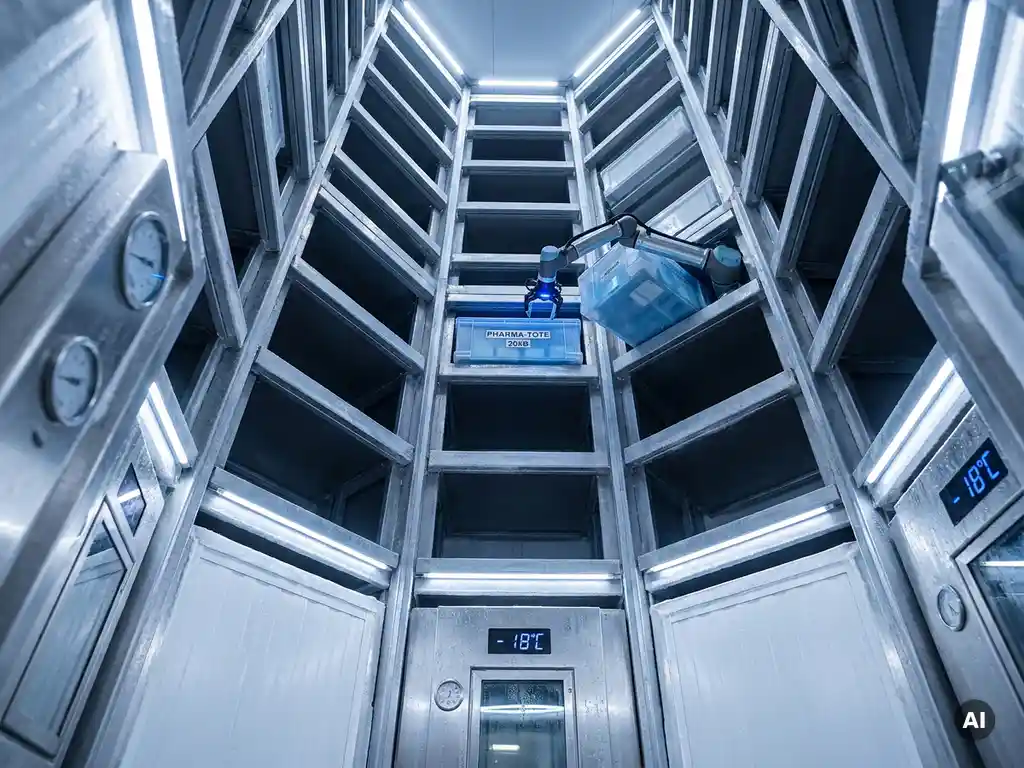
Within the storage structure itself, the design of racking and retrieval systems influences temperature uniformity. Dense storage configurations need to account for airflow paths: poorly designed layouts can create stagnant zones where temperatures drift from the monitored average. Automated storage and retrieval systems operating within cold environments must also be specified for the target temperature range, since standard robotics and electronics require adaptation for sustained operation at 2°C to 8°C or below.
How is temperature monitoring and data logging done in pharma warehouses?
Temperature monitoring in pharmaceutical warehouses is performed through networks of calibrated sensors placed at mapped locations throughout each storage zone, connected to continuous data logging systems that record readings at defined intervals and generate alerts when thresholds are approached or breached. The data these systems produce forms part of the regulatory evidence that storage conditions have been maintained.
Modern pharmaceutical temperature monitoring systems are typically electronic and networked, replacing older chart recorders with digital loggers that transmit data in real time to a central monitoring platform. Sensors are placed according to a thermal mapping study that identifies the locations within a storage zone most likely to experience temperature variation, typically near doors, air inlets, and at the extremes of the storage envelope.
Continuous monitoring requirements
GDP guidelines and most national regulatory frameworks require continuous monitoring, meaning that temperature is recorded without gaps throughout storage and transit. Logging intervals are typically every 5 to 15 minutes, though some high-risk environments log more frequently. The monitoring system must be capable of generating alarms that reach a responsible person in time to take corrective action before a product is irreversibly compromised.
Data integrity and audit trails
Data integrity is a regulatory requirement, not just a best practice. Temperature records must be tamper-evident, time-stamped, and retained for the period defined by the applicable regulation, often the shelf life of the product plus a defined additional period. Systems must prevent unauthorized modification of historical records. When auditors or inspectors review a storage facility, temperature logs are among the first documents examined, and gaps or anomalies in the record raise immediate compliance concerns.
What regulations govern pharmaceutical temperature-controlled storage?
Pharmaceutical temperature-controlled storage is governed primarily by Good Distribution Practice (GDP) guidelines, Good Manufacturing Practice (GMP) requirements where applicable, and national regulatory frameworks that implement or adapt these international standards. In the European Union, the EU GDP Guidelines (2013/C 343/01) set the baseline for wholesale distributors, while the United States FDA enforces 21 CFR Part 211 for manufacturers and Drug Supply Chain Security Act requirements for distributors.
GDP compliance for storage specifically requires that medicines are stored under the conditions specified by the marketing authorization holder, that temperature is monitored continuously, that deviations are documented and investigated, and that staff handling temperature-sensitive products are trained. Inspections by national competent authorities assess whether these requirements are met in practice, not just on paper.
- EU GDP Guidelines: Govern wholesale distributors of medicinal products in the European Economic Area
- WHO Technical Report Series guidelines: Provide internationally referenced standards used in many non-EU markets
- USP chapters (e.g. USP <1079>): Provide detailed technical guidance on good storage and distribution practices in the US context
- ICH Q1A-Q1F stability guidelines: Define the testing conditions that establish a product’s approved storage range
- Falsified Medicines Directive (FMD): Adds serialization and verification requirements relevant to pharmaceutical distribution workflows
Compliance is not achieved by the storage infrastructure alone. It depends on the complete implementation: the facility, the monitoring systems, the documented procedures, the training records, and the management of deviations. A well-engineered cold room that lacks validated monitoring or documented excursion procedures does not meet GDP requirements, regardless of how precisely it maintains temperature.
How do you validate a temperature-controlled storage facility?
Validating a temperature-controlled pharmaceutical storage facility involves a structured qualification process (typically Installation Qualification (IQ), Operational Qualification (OQ), and Performance Qualification (PQ)), supported by thermal mapping studies that demonstrate the facility consistently maintains approved conditions across its entire storage volume under real operating conditions.
Thermal mapping is the practical core of storage validation. Calibrated sensors are placed throughout the storage zone (including at the locations identified as most thermally challenging), and temperature is recorded over a defined period that includes representative seasonal conditions and operational events such as door openings and stock movements. The mapping study generates the evidence base that the facility can maintain required conditions and identifies where permanent monitoring sensors should be positioned.
Qualification phases
Installation Qualification documents that the refrigeration equipment, monitoring systems, and physical infrastructure have been installed according to specification. Operational Qualification demonstrates that the systems perform as intended across their operating range, including alarm and alert functions. Performance Qualification, conducted under actual or simulated operational conditions, confirms that the complete facility (including normal usage patterns) consistently maintains the required temperature profile.
Ongoing revalidation
Validation is not a one-time activity. GDP guidelines require that temperature-controlled storage facilities are revalidated after any significant change, including modifications to the refrigeration system, changes to the storage layout, building alterations, or equipment replacement. Annual or periodic revalidation is also standard practice to confirm that performance has not drifted over time. Each revalidation generates documentation that forms part of the ongoing compliance record for the facility.
How Hexxabotics supports pharmaceutical temperature-controlled storage operations
Hexxabotics addresses several of the operational challenges that make pharmaceutical storage complex, particularly for distributors and wholesalers managing large, mixed assortments that include temperature-sensitive products.
- Direct-access retrieval: Every tote is individually accessible without moving others, supporting controlled, traceable inventory management aligned with batch and expiry requirements
- High-density storage in a compact footprint: The hexagonal vertical structure maximizes cubic space utilization, which is particularly valuable when temperature-controlled floor space is expensive to build and maintain
- Independent capacity and throughput scaling: Storage capacity and retrieval throughput can be scaled separately, allowing operations to respond to assortment growth and order-volume growth as distinct requirements
- Software-managed inventory logic: The Hexxabotics Control System integrates with warehouse management systems through standard APIs, supporting the inventory traceability and audit trail requirements central to GDP-compliant operations
- No electrification in the rack structure: Simplified infrastructure reduces maintenance complexity, which matters in controlled environments where access and intervention must be carefully managed
Temperature-controlled pharmaceutical storage demands precision engineering, regulatory rigor, and operational discipline. If you are evaluating automated storage solutions for a pharmaceutical distribution or fulfillment environment, contact Hexxabotics to discuss how the system can be configured to meet your specific compliance and operational requirements.
Related Articles
- How do pharmaceutical companies prepare for an FDA warehouse inspection?
- How do you ensure lot segregation in a high-density pharmaceutical warehouse?
- What are audit trail requirements for pharmaceutical warehouses in 2026?
- How does a hexagonal grid system change warehouse logistics?
- How does fleet management work for warehouse robots?