
A 3PL warehouse and a dedicated pharmaceutical warehouse are fundamentally different in purpose, accountability, and regulatory design. A third-party logistics provider offers shared warehousing and distribution services across multiple industries, while a dedicated pharmaceutical warehouse operates exclusively for medicinal products under strict regulatory frameworks. The right choice depends on your product’s regulatory classification, volume, and compliance requirements. This article answers the most important questions pharmaceutical companies ask when evaluating their storage and distribution options.
What regulations govern pharmaceutical warehouse storage?
Pharmaceutical warehouse storage is governed by Good Distribution Practice (GDP) guidelines, which set the legal and operational standards for how medicinal products must be stored, handled, and transported. In the European Union, GDP is defined by the European Commission’s Guidelines 2013/C 343/01. In the United States, the FDA’s Current Good Manufacturing Practice (cGMP) regulations and the Drug Supply Chain Security Act (DSCSA) apply. Any facility storing pharmaceutical products must comply with the relevant national or regional framework in its territory.
GDP compliance covers a broad range of operational requirements. Temperature and humidity must be continuously monitored and documented. Storage areas must be secured against unauthorized access. Products must be traceable by batch number and expiry date. Personnel must be trained and qualified. A Responsible Person must oversee and sign off on compliance activities. Deviation and complaint handling procedures must be in place.
For cold chain products, additional requirements apply. Refrigerated and frozen medicines must be stored within validated temperature ranges, and any excursion must be documented and assessed before the product can be released. These requirements apply equally to any facility storing pharmaceutical products, whether that facility is a dedicated pharmaceutical warehouse or a third-party logistics provider operating a GDP-licensed division.
What is a dedicated pharmaceutical warehouse?
A dedicated pharmaceutical warehouse is a storage and distribution facility built and operated exclusively for medicinal products, operating under a pharmaceutical wholesale dealer license or equivalent regulatory authorization. Every process, system, and staff member in the facility exists to serve pharmaceutical inventory. There is no co-mingling with consumer goods, industrial products, or other non-regulated categories.
Dedicated pharmaceutical warehouses are typically operated by pharmaceutical wholesalers, distributors, or large healthcare logistics companies. Their infrastructure is purpose-built: validated temperature zones, controlled-access areas for narcotics and high-value products, serialization and Falsified Medicines Directive (FMD) verification systems, and documented quality management systems aligned with GDP.
Because the entire facility is designed around pharmaceutical requirements, dedicated warehouses can offer a level of process depth and regulatory accountability that a general-purpose facility cannot easily replicate. Batch traceability, expiry management, FEFO (First Expired, First Out) inventory logic, and product recall procedures are not add-ons; they are core operational functions. For pharmaceutical manufacturers and distributors handling regulated medicinal products, a dedicated warehouse is often the default requirement rather than a choice.
How does a pharmaceutical 3PL handle compliance and quality?
A pharmaceutical 3PL handles compliance and quality by obtaining the necessary regulatory licenses, such as a wholesale dealer authorization or GDP certificate, and operating a dedicated pharmaceutical division within its broader logistics network. This means the 3PL maintains a Quality Management System, appoints a Responsible Person, and applies GDP-compliant procedures specifically to its pharmaceutical operations, even if the company also handles non-pharmaceutical goods in other areas of its business.
In practice, the quality standards of a pharmaceutical 3PL vary considerably. Some large, specialized healthcare logistics providers operate pharmaceutical divisions that are functionally indistinguishable from dedicated pharmaceutical warehouses in terms of process rigor. Others offer pharmaceutical handling as an extension of general warehousing, with compliance measures layered on top of existing infrastructure rather than built from the ground up.
Key quality indicators to assess in a pharmaceutical 3PL include:
- Possession of a valid wholesale dealer authorization or equivalent license in the relevant territory
- Named Responsible Person with documented qualifications
- Validated temperature monitoring with continuous recording and alarm systems
- Documented deviation and complaint management procedures
- Batch and serialization traceability systems, including FMD compliance where applicable
- Regular internal and external GDP audits
- Separation of pharmaceutical stock from non-pharmaceutical goods
- Qualified personnel training records
A pharmaceutical company engaging a 3PL for storage and distribution retains ultimate responsibility for ensuring its supply chain partner is compliant. Regulatory authorities expect manufacturers and marketing authorization holders to audit their 3PL partners and maintain records of those audits.
What are the key differences between a 3PL and a dedicated pharmaceutical warehouse?
The key difference between a 3PL and a dedicated pharmaceutical warehouse is the scope and exclusivity of pharmaceutical focus. A dedicated pharmaceutical warehouse exists solely for medicinal products, with every system, procedure, and resource designed around pharmaceutical regulatory requirements. A 3PL is a commercial logistics service provider that may offer pharmaceutical handling as one of several service lines, alongside retail, industrial, or consumer goods logistics.
Regulatory accountability and ownership
In a dedicated pharmaceutical warehouse, regulatory accountability sits entirely within the pharmaceutical operation. The Responsible Person, the Quality Management System, and all compliance infrastructure are built around pharmaceutical requirements by default. In a 3PL, pharmaceutical compliance is one operational stream among several. The Responsible Person and quality systems may be shared across categories, or the pharmaceutical division may be genuinely ring-fenced, depending on the provider.
Infrastructure and process design
A dedicated warehouse is designed from the outset for pharmaceutical storage: validated temperature zones, controlled areas, serialization infrastructure, and FEFO inventory logic are standard features. In a 3PL, these capabilities may be present but are more likely to have been added to an existing general logistics infrastructure. This distinction affects not just compliance but operational efficiency, particularly for complex pharmaceutical assortments with varied storage requirements.
Flexibility versus specialization
A 3PL typically offers greater commercial flexibility: shorter contract terms, shared infrastructure costs, and the ability to scale services up or down without owning a facility. A dedicated pharmaceutical warehouse offers deeper specialization and often greater process reliability for complex regulated products, but usually requires a more committed commercial relationship. For pharmaceutical companies with large, stable volumes and strict compliance requirements, a dedicated facility often delivers more predictable operational performance.
When should a pharmaceutical company choose a 3PL over a dedicated warehouse?
A pharmaceutical company should choose a 3PL over a dedicated warehouse when it needs operational flexibility, geographic reach, or cost efficiency that a dedicated facility cannot provide at its current scale. 3PLs are particularly well suited to companies entering new markets, managing seasonal or variable volumes, or distributing products that do not yet justify the fixed costs of a dedicated pharmaceutical warehouse.
Specific scenarios where a pharmaceutical 3PL makes strong commercial sense include:
- Market entry: A manufacturer entering a new country can use a licensed pharmaceutical 3PL to establish compliant distribution without building or leasing a dedicated facility.
- Lower-volume products: Products with modest distribution volumes may not generate sufficient revenue to justify the fixed overhead of a dedicated warehouse.
- Geographic distribution networks: A 3PL with an established network of GDP-licensed depots can provide regional coverage more efficiently than a single dedicated facility.
- Transitional periods: Companies undergoing restructuring, portfolio changes, or acquisitions may use a 3PL as a bridge while a longer-term distribution strategy is defined.
The decision should always be evaluated against the compliance requirements of the specific products involved. High-risk products, narcotics, biologics, and products with complex cold chain requirements may demand a level of process control that only a highly specialized pharmaceutical 3PL or dedicated facility can reliably deliver.
What should pharmaceutical companies look for when selecting a 3PL partner?
When selecting a pharmaceutical 3PL partner, companies should prioritize regulatory standing, process depth, traceability capability, and operational transparency above cost. The most important starting point is confirming that the 3PL holds a valid wholesale dealer authorization or equivalent license in every territory where it will handle your products, and that its Responsible Person is named, qualified, and actively engaged in quality oversight.
Beyond licensing, a structured evaluation should cover the following areas:
- GDP audit history: Request the most recent GDP inspection report and any regulatory correspondence. A provider with a clean, documented audit record demonstrates sustained compliance rather than point-in-time certification.
- Temperature control infrastructure: Assess whether temperature monitoring is continuous, validated, and independently alarmed. Ask how excursions are detected, escalated, and documented.
- Batch and serialization traceability: Confirm the 3PL’s systems can record and retrieve batch numbers, expiry dates, and serialization data at the individual unit level. FMD verification capability is a baseline requirement for EU distribution.
- Inventory management logic: Verify that FEFO rules are enforced systematically rather than manually. For pharmaceutical products with short shelf lives or strict expiry requirements, automated FEFO is not optional.
- Recall and deviation management: Request documented procedures for product recalls and quality deviations. Test whether the 3PL can execute a simulated recall exercise and demonstrate how quickly affected batches can be located and quarantined.
- IT integration and reporting: Assess whether the 3PL’s warehouse management system can exchange data with your own systems via standard APIs, and what inventory visibility and reporting you will receive in real time.
- Capacity and scalability: Evaluate whether the 3PL can accommodate your current volume and absorb growth without degrading service levels or compliance performance.
Finally, conduct a physical site audit before committing to any agreement. Reviewing documentation is necessary but not sufficient. A site visit reveals how GDP procedures are applied in practice, the condition of storage infrastructure, and the competence and awareness of operational staff.
How Hexxabotics supports pharmaceutical warehousing operations
Whether a pharmaceutical operation runs as a dedicated warehouse or a GDP-licensed 3PL division, the underlying storage and retrieval infrastructure determines how reliably it can meet compliance requirements at scale. Hexxabotics provides a high-density Automated Storage and Retrieval System designed for the specific demands of pharmaceutical distribution:
- Direct-access tote retrieval: Every storage location is individually accessible without moving other inventory, supporting FEFO logic, batch selection, and expiry-controlled retrieval without manual intervention.
- Batch and lot traceability: The system integrates with warehouse management and execution systems through standard APIs, enabling controlled, documented inventory movements aligned with GDP traceability requirements.
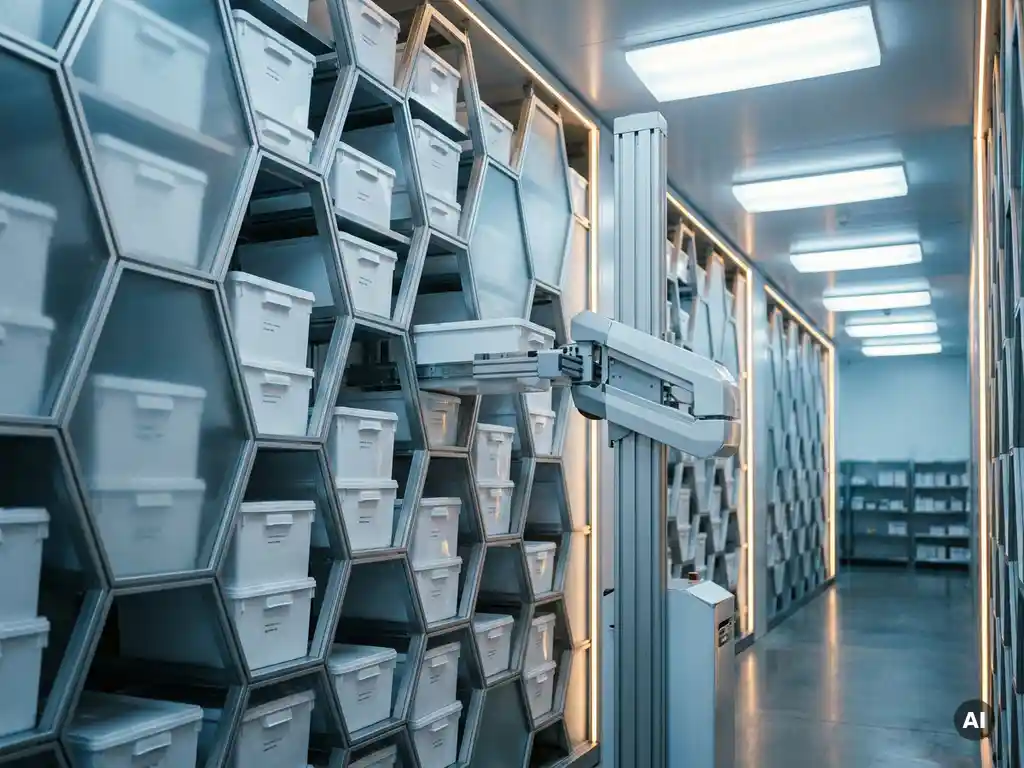
- Cubic-space utilization: The hexagonal vertical storage structure uses full building height, allowing pharmaceutical operations to hold more inventory within an existing facility footprint, reducing reliance on building expansion or external storage.
- Independent capacity and throughput scaling: Storage capacity grows by extending the structure; throughput grows by adding robots. Pharmaceutical distributors managing growing SKU counts and increasing order volumes can scale each dimension independently.
- No electrification in the rack structure: Robots operate autonomously and charge during operation, simplifying maintenance and reducing infrastructure complexity in regulated environments.
If you are evaluating how automated storage can strengthen the compliance and efficiency of your pharmaceutical warehousing operation, contact Hexxabotics to discuss your specific requirements.
Related Articles
- How do you ensure lot segregation in a high-density pharmaceutical warehouse?
- What are the most common reasons pharmaceutical warehouses fail inspections?
- What is the impact of floor flatness on automated warehouse systems?
- How do you design a warehouse for robotic picking systems?
- How does predictive maintenance prevent downtime in automated warehouses?